
The Spanish Timbrado Canary is the newest breed of song canary, developed in Spain in the 1940s and 1950s. It is also considered to be the purest domestic form of canary. It is closest genetically to the original wild canary as it was developed by crossing the wild canary with the songbird of Spain. This combination resulted in a bird with a very unique song. The name, like its song, suggests the chattering of Spanish castanets, Although loud, their songs are not grating or harsh. They consist of many quick successions and combinations of notes. A good Spanish Timbrado has a bright cheery song and is very pleasant to listen to.
This bird can make a wonderful companion to be enjoyed for its song as well as its beautiful appearance. They are developed with all sorts of colors along with a variety of clear, metallic tones to their songs. They are steadily growing in popularity.
The Spanish Timbrado is classed as one of several well-known “song canaries”, bred for song rather than physical appearance or color. Shows for these birds are of a different nature than shows for other canary types. Basically being entered into singing contests these canaries are bred with the goal of achieving winners with the best balance between quality and variety of song. Each breed has a distinctive song and a well-defined song standard. Some of the other well-known song canaries include: the Roller Canary, the American Singer Canary, the Russian Singer Canary, and the Waterslager Canary.
For more information about the care of Canaries see:
Guide to a Happy, Healthy Canary
- Kingdom: Animalia
- Phylum: Actiniform
- Class: Elasmobranchii
- Order: Passeriformes
- Family: Fringillidae
- Genus: Serinus
- Species: canaria
Scientific Name:
Distribution:
One of the newest breeds, the Spanish Timbrado Canary began to be bred by an organized breeders’ association in the 1940’s and 1950’s in Spain. Being bred for a very loud very clear metallic sound with bell tones, the most common meaning of the name ‘timbrado’ is the ringing of an old-fashioned doorbell. The first rules of standard for this bird were established in about 1963, but have been updated at least three times since then.
Description:
Though the Spanish Timbrado Canary is classified as a “song canary”, it is also bred for appearance which can vary widely depending on where an individual bird is from. Most Timbrados will reach a length of just over 5 inches (12.7 cm). As they are judged in shows for their appearance as well as their song, they need to be compact and robust looking, the chest must be wide, and the feet very short. The feathers need to be tight and the tail v-shaped but not too long.
Their coloring is often closer to that of the wild canary, being greenish, but they are also found in yellow, white, cinnamon, and variegated. There can be no frilling or red coloring in its plumage.
The song of this canary is most important. The song of the Spanish Timbrado Canary consists of twelve notes. They must be loud, metallic, bright, and harmonious. Negatives in the song are screeches, strained sounds, and nasal sounds. Standards for three types of songs have been established; the original known as ‘Classical’ line, the ‘Floreado line’, and the ‘Intermediate’ line which falls between the other two.
Canaries of both sexes can begin to sing a weak song as early as four weeks, but females usually don’t sing after about six months and won’t have the full long song of a male.
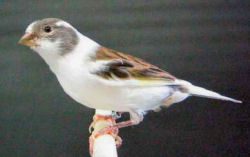 Spanish Timbrado Canary Photo © Animal-World:
Courtesy Denise Taormina
Care and feeding:
Canaries like wide open spaces so provide a roomy cage. Provide a cage with vertical bars and small perches of different size for foot exercise. Have at least 1 perch set high in the cage for the canary to roost (sleep). The cage should be placed high, so the canary can look down on us so to speak.
Canaries eat mainly canary seed and rape seed. Vitamin coated canary seed mixes are readily available at a pet store. Greens are also enjoyed and can be offered daily along with a little calcium in the form of a cuttlebone.
They do like to bath, so should be offered a bird bath. Cage cleaning and toe nail trimming is about all the maintenance canaries need.
See About Canaries: Housing and About Canaries: Care and Feeding for more information.
Social Behaviors:
Canaries are good-natured social creatures that do well when kept in cages or in aviaries. They are timid birds though and should not be housed with parakeets, lovebirds, or other hookbills that tend to be more aggressive birds by nature.
Male canaries should be kept in a cage by themselves to ensure quality singing. Males can be territorial and pairing up with two male canaries in a cage can cause fights. In a spacious aviary canaries can generally be housed with other canaries, finches, and other hardbills.
Activities:
Canaries do not require toys, mirrors or any other form of entertainment, a swing is all they need to keep themselves occupied. Most of the time, canaries are simply enjoyed for their beauty and singing. However, some canaries are allowed out of their cage to perch or are show canaries and therefore require taming or training.
For singing contests the Spanish Timbrado Canary requires training. They are trained to sing well defined song segments called ‘tours, and Timbrados can be taught to sing on cue. They can be trained either from listening to another perfect adult singer or from a recording. As they are also quite adept at mimicry, If they develop any faults in the song they must immediately be removed from any other birds being trained.
See About Canaries: Handling/Training for information on taming and training.
Breeding/Reproduction:
The Spanish Timbrado Canary is generally easy to breed. Most canaries breed easily and readily if provided with quality food, lighting, secure surroundings, and conditioning. Breeding season for most canaries is usually from December to April. They are best bred in breeding cages.They lay their eggs in a nest. The female will lay 3 to 6 eggs, one per day. It is best to allow a hen to have only two clutches.
See About Canaries: Breeding/Reproduction for more information on breeding.
Potential Problems:
These birds are hardy and healthy if provided with a good environment and a good diet. Avoid an environment that is wet, cool, and drafty.
See About Canaries: Potential Problems for information on health.
Availability:
Spanish Timbrado Canaries are most often available through breeders, but may also occasionally be found through bird shows, bird clubs, and on the internet.
Serinus canaria (Image Credit: Juan Emilio, Wikimedia Commons CC BY-SA 2.0 Generic)