
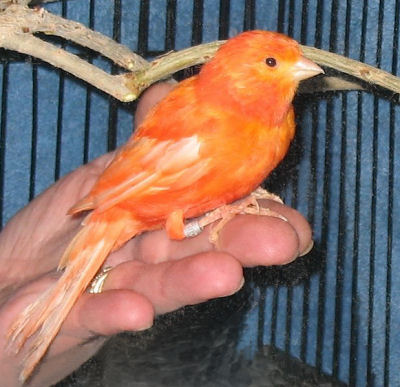
This gorgeous canary, the Red Factor Canary, is prized by many as the most beautiful of all the Color Bred Canaries!
Named after its beautiful plumage, the Red Factor Canary is one of the most popular canaries. It is active and lively, enjoyed by both those who wish to keep a pet canary as well as those who specialize in showing. A delightful entertaining little bird, it is hardy and very easy to keep. However they are not easy to breed, so will need a more advanced keeper for this purpose.
The Red Factor Canary is classed as a “color canary”, bred for color rather than physical characteristics or song. First bred in the 1930’s, they are the only Color Bred Canary that has a red factor as part of their genetic structure. They were developed as a cross between another type of finch, the now endangered Venezuelan Black Hooded Red Siskin Spinus cocullatus, and the Yellow Canary Serinus canaria,
For more information about the care of Canaries see:
Guide to a Happy, Healthy Canary
- Kingdom: Animalia
- Phylum: Actiniform
- Class: Elasmobranchii
- Order: Passeriformes
- Family: Fringillidae
- Genus: Serinus
- Species: canaria
Scientific Name:
Distribution:
Specialty breeding in canaries has an extremely long history. Even though breeding for “type” was the predominant focus for several hundred years, color breeding was happening intermittently. It wasn’t until the 1900’s however, that a great deal of interest was devoted to color.
In his book, Canaries, Paul Paradise describes the development of Red Factor Canaries and Color Bred Canaries. He says that in 1929 Dr. Hans Duncker, a German genecist, published a thesis stating his belief that a red canary could be developed by introducing a red factor into the genetic structure, possible by introducing a Venezuelan Black Hooded Red Siskin, Spinus cocullatus. Thus began the development of canaries termed “red factor” with the first being successfully bred by a Mr. A. K. Gill in Britain. It is generally accepted that canaries inheriting this genetic structure from their parents can be classed as Red Factor Canaries.
At the same time, other colors without the red factor were being readily introduced and became known as ‘New Color’ canaries. In 1947 the Canary Colour Breeders Association was formed. They initially held to strict rules that no artificial coloring could be fed, and all birds had to be shown in natural colors. Many of these birds lost their coloring after molting and soon in Europe a color known as Carophyll Red became popular, and the no artificial color ruling was removed. Today the Color Bred Canaries are some of the most popular with varied classes not only for just single colors, but for a large variety of different color strengths.
Description:
A nice well built bird, the Red Factor Canary will reach about 5 1/2 (14 cm) inches in length. These canaries are bred to show and there are many versions of this canary today. They are divided into Melanins and the Lipochromes classes. These are further divided into frosts or non-frosts, which affects how bright their color appears, and then into hard and soft feathers. Stance wise, they should stand perched at a 45° angle and their head should not be snaky or overly long.
Care and feeding:
Canaries like wide open spaces so provide a roomy cage. Provide a cage with vertical bars and small perches of different size for foot exercise. Have at least 1 perch set high in the cage for the canary to roost (sleep). The cage should be placed high, so the canary can look down on us so to speak.
Canaries eat mainly canary seed and rape seed. Vitamin coated canary seed mixes are readily available at a pet store. Greens are also enjoyed and can be offered daily along with a little calcium in the form of a cuttlebone.
In all Color Bred Canaries, red and orange pigments are obtained from their diet. Even the color of Red Siskin was found to be dependent on what it ate in the wild. Consequently the Red Factor Canary also requires feeding a special diet to keep its intense coloring.
Color feeding means feeding of foods that are specifically designed to enhance color. These are found in three chemicals; primarily carotenoids for most birds with the addition of Canthaxanthin and Beta-Carotene for Red Factor Canaries.
Berries, beets, sweet potatoes, squashes, tomatoes, and cherries contain carotenoids which enhance color. Red and orange can also be increased in many breeds by simply adding cayenne pepper and paprika to the diet. A carotenoid concentrate is also used by some experts and Canthaxanthin and Beta-Carotene are obtained as commercial supplements. These color feeding chemicals must be used carefully with close attention paid to proper quantities.
All canaries do like to bath, so they should be offered a bird bath.Cage cleaning and toe nail trimming is about all the maintenance canaries need.
See About Canaries: Housing and About Canaries: Care and Feeding for more information.
Social Behaviors:
They are good-natured social creatures that do well when kept in cages or in aviaries. They are timid birds though and should not be housed with parakeets, lovebirds, or other hookbills that tend to be more aggressive birds by nature.
Male canaries should be kept in a cage by themselves to ensure quality singing. Males can be territorial and pairing up with two male canaries in a cage can cause fights. In a spacious aviary canaries can generally be housed with other canaries, finches, and other hardbills.
Activities:
Canaries do not require toys, mirrors or any other form of entertainment, a swing is all they need to keep themselves occupied. Most of the time, canaries are simply enjoyed for their beauty and singing. However, some canaries are allowed out of their cage to perch or are show canaries and therefore require taming or training.
See About Canaries: Handling/Training for information on taming and training.
Breeding/Reproduction:
The Red Factor Canary is more difficult to breed and so this is recommended for a more advanced keeper. Most canaries breed easily and readily if provided with quality food, lighting, secure surroundings, and conditioning. Breeding season for most canaries is usually from December to April. They are best bred in breeding cages.They lay their eggs in a nest. The female will lay 3 to 6 eggs, one per day. It is best to allow a hen to have only two clutches.
See About Canaries: Breeding/Reproduction for more information on breeding.
Potential Problems:
These birds are hardy and healthy if provided with a good environment and a good diet. Avoid an environment that is wet, cool, and drafty.
See About Canaries: Potential Problems for information on health.
Availability:
Red Factor Canaries are usually available.They can often be found at pet stores, and are also be readily found through bird shows, bird clubs, breeders, and on the internet.
Featured Image Credit: Chris Allen, Pixabay