
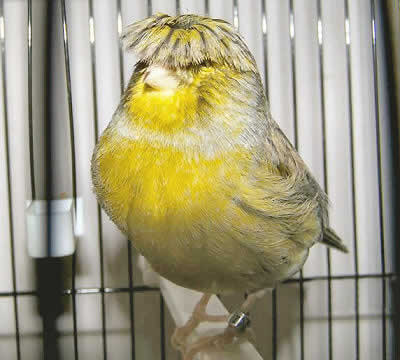
The Gloster Fancy Canary, a favorite among both expert and beginning enthusiasts, is one of the most popular canaries!
WBC_Ap13C_med.jpg)
Gloster Consort Canary
(variegated variety) Photo © Animal-World:
Courtesy Denise Taormina
The Gloster Fancy Canary is a perfect choice for the beginner as it is lively, very hardy and will readily breed. As with most canaries it is basically a cage bird, but quite enjoyable to observe. They have a pleasant song, though folks who prefer a song canary may find it a bit louder and more choppy than they prefer.
As a “type canary”, the Gloster Canary is bred for physical appearance rather than color or song. These attractive little birds have a roundish compact body and are quite lively and bold.
The Gloster Canary actually has two versions, the crested bird (shown above) is known as the ‘Corona’ while the plain headed bird is known as the ‘Consort’. Though the crested version is favored at shows, both types are of equal importance in the propagation of this breed. Other than the feathers on the head, the basic body types are the same for both versions of this bird.
For more information about the care of Canaries see:
Guide to a Happy, Healthy Canary
- Kingdom: Animalia
- Phylum: Actiniform
- Class: Elasmobranchii
- Order: Passeriformes
- Family: Fringillidae
- Genus: Serinus
- Species: canaria
Scientific Name:
Distribution:
The Gloster Canary is a relatively new breed. Unlike older breeds, the Gloster’s development in England in the mid 1920’s has been well documented indicating that it is a careful blending of three breeds; the crested Roller Canary, the small Crested Canary, and the Border Canary.
The Gloster Canary was the result of attempts to develop a miniature crested breed. Mrs. Rogerson’s of Cheltenham in Gloucestershire (the breed’s namesake) crossed crested Roller Canaries with Border Canaries while John McLay, a well known breeder and judge of Crested canaries in Scotland, crossed small Crested Canaries with small Border Canaries.
At the Crystal Palace exhibition in 1925, Judge A. W. Smith recognized Mrs. Rogerson’s original strain as a new, unique, and distinct breed. He went on to encouraged development of the Gloster with the blending of the three different breeds, and he later developed the first breed standards.
Description:
The Gloster Fancy Canary is a small, short stubby, canary reaching about 4 1/2″ (11.5 cm) in length. It is an active, lively, semi-erect, proud bird. The Corona (crest) bird should have a round symmetrical crest with a center point. The crest should have no interruptions, radiate evenly, and not cover eyes. The Consort (uncrested) head should not be too small and should reveal a light brow line.
The Gloster’s plumage occurs in all canary colors and markings, except the Red-Factor colorings. Green and cinnamon are two popular varieties, along with the frosts (buff) being favorites for show varieties. Any with red coloring on their bodies are rejected in shows.
WBC_Ap13C_med.jpg)
Gloster Consort Canary
(blue variety) Photos © Animal-World:
Courtesy Denise Taormina
Care and feeding:
Canaries like wide open spaces so provide a roomy cage. Provide a cage with vertical bars and small perches of different size for foot exercise. Have at least 1 perch set high in the cage for the canary to roost (sleep). The cage should be placed high, so the canary can look down on us so to speak.
Canaries eat mainly canary seed and rape seed. Vitamin coated canary seed mixes are readily available at a pet store. Greens are also enjoyed and can be offered daily along with a little calcium in the form of a cuttlebone.
They do like to bath, so should be offered a bird bath. Cage cleaning and toe nail trimming is about all the maintenance canaries need.
See About Canaries: Housing and About Canaries: Care and Feeding for more information.
Social Behaviors:
They are good-natured social creatures that do well when kept in cages or in aviaries. They are timid birds though and should not be housed with parakeets, lovebirds, or other hookbills that tend to be more aggressive birds by nature.
Male canaries should be kept in a cage by themselves to ensure quality singing. Males can be territorial and pairing up with two male canaries in a cage can cause fights. In a spacious aviary canaries can generally be housed with other canaries, finches, and other hardbills.
Activities:
Canaries do not require toys, mirrors or any other form of entertainment, a swing is all they need to keep themselves occupied. Most of the time, canaries are simply enjoyed for their beauty and singing. However, some canaries are allowed out of their cage to perch or are show canaries and therefore require taming or training.
See About Canaries: Handling/Training for information on taming and training.
Breeding/Reproduction:
Canaries breed easily and readily if provided with quality food, lighting, secure surroundings, and conditioning. They are best bred in breeding cages.
Breeding the Gloster Canary is no different than breeding colorbreds or any other variety of canary… with one exception, Glosters should only be bred corona to consort (see description above). Other pairings could create a lethal factor and there have also been reports of bald headed birds and poor crests.
They lay their eggs in a nest. The female will lay 3 to 6 eggs, one per day. Breeding season is usually from December to April; it is best to allow a hen to have only two clutches.
See About Canaries: Breeding/Reproduction for more information on breeding.
Potential Problems:
These birds are hardy and healthy if provided with a good environment and a good diet. Avoid an environment that is wet, cool, and drafty. One problem that occasionally arises with Gloster Canaries are feather lumps. Feather lumps are an ingrown feather, where the feather attempts to grow out, but cannot break the skin so will grow backwards.
See About Canaries: Potential Problems for information on health.
Availability:
Gloster Canaries are readily available and are fairly inexpensive. Sometimes available at pet stores, but more readily they can be found through bird shows, bird clubs, breeders, and on the internet.
Featured Image Credit: Fernando Zamora Vega, Shutterstock