
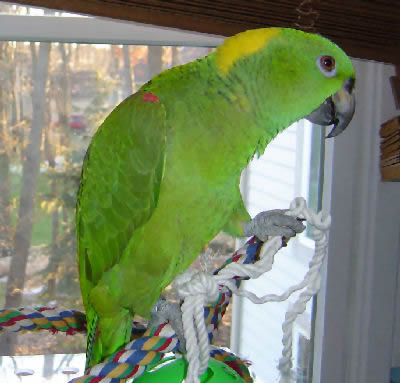
The Yellow-naped Amazon has just about the best reputation a pet bird can have!
The Yellow-naped Amazon Amazona auropalliata, is also known as the Golden Yellow-naped Amazon. This Amazon parrot has been kept as a pet for over 100 years. As early as 1842 they were reported as being kept by the Central American Indians because of their pleasing personalities. They are the ultimate in affection, clever and obedient, and gentle. They actually think of themselves as “little people”!
This Amazon is mostly a green birds, but gets its name from a bright yellow patch that develops on the nape of the neck. The Golden Yellow-naped Amazon is very similar to several other Amazon species that also develop yellow markings. One of these very popular Amazons is the Double Yellow-headed Amazon Amazona oratrix. Its entire head rather than just the nape becomes yellow. Another is the the Yellow-crowned Amazon Amazona ochrocepha that develops a patch of yellow the crown.
When they are young it is difficult to tell any of these yellow marked Amazons apart. The yellow markings develop as they age over a period of about four years. Besides color there are some other differences between these parrots. They differ from each other in things like body size, temperament, and talking ability. It’s important to know which Amazon you are getting so you know what to expect.
The Yellow-naped Amazon is considered to be an excellent all around bird. It is very popular as a great pet and can be one of the better talkers. Besides being quite intelligent, which makes them easy to tame and train, they are very fun and affectionate. This pet parrot is very social and enjoys the company of people as well as other birds. They will form very strong bonds with their owner, becoming fast friends and exhibit total confidence. They are also a hardy robust bird and can do well in either a cage or an aviary.
“Mia (seen above) is quite a singer! She uses sentences appropriately such as “What’s up?” when you come in to greet her. She is an absolute joy, and she will let anyone take her OUT of her cage. On top of all this, she is drop dead gorgeous, and she knows it”… Lisa. To learn more about Mia, visit: “Mia, The Yellow-naped Amazon”
For more information about the care of Amazon parrots see:
Guide to a Happy, Healthy Amazon Parrot.
Nando is a special Yellow-naped Amazon Parrot. He sings ‘Oklahoma!” all the way through complete with applause!
- Kingdom: Animalia
- Phylum: Chordata
- Class: Aves
- Order: Psittaciformes
- Family: Psittacidae
- Genus: Amazona
- Species: auropalliata
Scientific name
Amazona auropalliata
(Previously: Amazona ochrocephala auropalliata)
- Subspecies:
- Amazona auropalliata
- Amazona auropalliata parvipes
More recently the birds in the ochrocephala group have been under review, with some classification adjustments being made. In in 1991, a recommendation to reclassify this group was made by the Committee on Classification and Nomenclature of the American Ornithologists’ Union. This has resulted in the Amazona ochrocephela now being identified as the Yellow-crowned Amazon only. The Yellow-naped Amazon is now described as Amazona auropalliata, and the Yellow-headed Amazon is now Amazona Oratrix.
Distribution
The Yellow-naped Amazon Amazona auropalliata was first described by Lesson in 1842. They are also known as the Golden Yellow-naped Amazon. They are found in the Honduras, Guatamala, El Salvador, and Mexico. In the wild they live in pairs or flocks, from small groups to groups of several hundred birds. They live in tropical zones and inhabit woodlands, forests, where they feed on fruits, seeds, nuts, berries, and the blossoms and leafy buds of foliage.
Status
The Amazona auropalliata is on the IUCN Red List for Endangered Species as Least Concern (LC).
Description
The Yellow-naped Amazon or Golden Yellow-naped Amazon is green from head to tail, with the underparts a bit lighter green, and the tip of the tail being a light yellowish-green. They get their name from having a bright yellow patch about the size of a quarter on the nape of their neck. Some will also have a small yellow spot on their forehead. There are some black hairs in the cere. The beak is mixture of black and horn color. The eye is orange and the feet are gray with black nails.
Juveniles lack the yellow marking on the nape of the neck. Their yellow patch doesn’t actually begin to develop until they are about a year old, and then it takes up to about four years of molting to be fully colored. Mutations can occur naturally with this Amazon. A blue mutation Yellow-Naped Amazon is one of the most extraordinary mutations, and though rare, are occasionally see in the pet market.
Yellow-naped Amazons are rather heavy bodied though a bit smaller than the Double Yellow-headed Amazons. Mature birds are about about 14 inches (35 cm) long from the head to the tip of the tail. They reach maturity at about the 4 – 5 year range with a lifespan of 60 – 80 years.
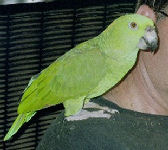 “Miss Evan” Yellow-naped Amazon Photo courtesy: Jack & George Johnson
Care and feeding
In the wild, the diet of the Golden Yellow-naped Amazon consists of fruits, plants, seeds and nuts and probably some protein. A pet bird will enjoy a varied diet, including a quality seed mix or a pelleted diet, and many fresh fruits and vegetables. Pellets will work if started at an early age.
Plenty of human food that is nutritious can be offered, and they like chicken. They like to eat at the table and enjoy eating with their family. Avocado and chocolate are toxic to any parrot. They will let you know when it’s dinner time.
Housing
A roomy cage is required for the Yellow-naped Amazon. Amazon cages must not be too confining, so get one that your pet will be able to feel comfortable in, preferable one with a playpen on top. There cage is their territory and safe place.This parrot likes to climb and play, and enjoys expanding its wings. It is recommended that a cage be 2 x 3 feet wide and 2 1/2 to 5 feet high, and with a play pen top. A great thing is to have a hanging perch above that for climbing.
Amazon parrots can tolerate varying temperatures, but they need to be kept away from any drafts. They love to be out of their cage on a playpen, and will enjoy interacting with their human as well as playing with toys. A variety of perches should be used of varying size and texture. A rougher textured perch instead of the smooth, doll-rod types, makes it easier for them to perch and is better for their feet and legs. A concrete perch can be placed as the highest perch in the cage and next to a toy. At times during the day they will perch there and it will save them (and you) from the ordeal of having their nails filed.
Learn to have fun during bath time. Whether you spritz your amazon with water or an aloe spritz, or just put him in the kitchen sink, make it fun. Your amazon will teach you how he likes to be bathed.
Maintenance
The basic cage care includes daily cleaning of the water and food dishes. Weekly you should wash all the perches and dirty toys, and the floor should be washed about every other week. A total hosing down and disinfecting of an aviary should be done yearly, replacing anything that needs to be freshened, such as old dishes, toys and perches.
Social Behaviors
This Amazon enjoys human interaction as well as interaction with other birds. In the wild they are very social birds living in groups. They are seen either in pairs or flocks, from small groups to groups of several hundred birds. They also form permanent pairs when they are sexually mature.
If you are looking for a quiet bird, an amazon is not for you. It is a highly social bird who loves human companionship and loves to play. They will learn tricks and look forward to interaction and games. The Yellow-naped Amazon will provide you with many fun moments and a lot of laughter.
Handling/Training
The Yellow-naped Amazon will adapt rapidly, quickly becoming accustomed to a new environment and its keeper. It is then ready to start bird training. Generally though, you should give a new arrival a few days to get use to you, your voice and its cage before trying to handle it. A hand fed baby will not need much taming and can often be handled right away, as it is use to human attention.
For information about training your Yellow-fronted Parrot see: Amazon Parrot Care: Handling and Training
Activities
The Golden Yellow-naped Amazon loves to climb and play. Provide lots of toys. It also needs room to stretch its wings, and climbing is one of its favorite activities. A hanging perch is great, as well as a moveable perch that can follow you around the house. This parrot is an active bird and needs plenty of toys. This Amazon likes to play, loves to wrangle with toys, and is quite an acrobat. They entertain themselves quite well and you will enjoy it.
Sexing – Sexual Differences
Yellow-naped Amazons are not sexually dimorphic, females look like males. If gender identification is important (for example for breeding birds) DNA / Feather or surgical sexing is recommended.
Breeding/Reproduction
These Amazons are commonly bred in captivity. They must be mature, 4 – 5 years of age. The sexes must be confirmed and the pair must be harmonious, bonded with each other. They will need a nest box that is 31″-39″ (80-100 cm) high with an inside diameter of 12″-14″ (30-35 cm) and an opening of 4″-5″ (10-12 cm). Provide some soft bedding material inside on the bottom of the box.
At the onset of warm weather (April to early May) courtship will begin. The hen will then lay three to four eggs which incubate for about 26 – 28 days. The young will leave the nest at 8-12 weeks. As with many parrots, the male will eat for both himself and the female while she incubates the eggs and feeds the young. The male regurgitates the food for the female to eat. He gets a lot less picky about what he eats at these times!
Potential Problems
In the wild, amazons will call out to each other first thing in the morning and then again as the sun is setting. So early in the morning your Golden Yellow-naped Amazon will be calling for you and he will warn you when the sun sets that it’s bed time. These two periods of the day, which usually last about 10 minutes, can be a little noisy with an Amazon. These parrots when well cared for will seldom become ill. Though it is often difficult to determine illness, some visible signs of illness to be aware of are:
- ruffled plumage
- listlessness
- drooping wings
- sagging body
- extreme mood changes
- having no appetite
- bulges in feathering
- partially closed or watery eyes
- swelling of the eyelids
- rasping
- difficulty breathing
- excessive saliva
- dirty vent
- any change in the feces not apparently diet related.
Some of the more common illnesses are:
- Psittacosis (chlamydiosis or parrot fever)
- bacterial, viral, or fungal infections
- feather picking (results of boredom, poor diet, sexual frustration, lack of bathing)
- allergies
- chewing flight and tail feathers by juveniles
- beak malformations in chicks
- Papillomas
- kidney disease (gout)
- toxicity
- heavy metal poisoning
- lipomas in older birds.
If you notice any of these bird illnesses in your Yellow-naped Amazon immediately provide a warm, draft free, secure environment kept at about 86°F (30°C). Place food and water close to the perch where it is easily accessible. An ailing parrot should be taken to a avian veterinarian for diagnosis and treatment.
Availability
The Yellow-naped Amazon is readily available and it should be easy to find one in a pet store or from breeders in your area.
References
- Animal-World References: Pet Birds – Exotic Birds
- Dr. David Alderton, The Atlas of Parrots of the World, T.F.H. Publications, Inc. 1991
- David Alderton, Parrots, Salamander Books, 1999
- David Alderton,, A Bird Keeper’s Guide to Parrots and Macaws, Salamander Books, 1989
- Werner and Susanne Lantermann, Amazon Parrots, Barron’s Educational Series, Inc. 1988
- Arthur Freud, All About The Parrots, Howell Book House, 1986
- Howard Voren, Blue Mutation Yellow-Naped Amazon, Voren’s Aviaries, Inc., Advancement of Psittacultural Science
- Joanie Doss, Amazon FAQ , Up at Six, Last Revised: Sunday, 20-Jul-2008
Featured Image Credit: Jim Cumming, Shutterstock