
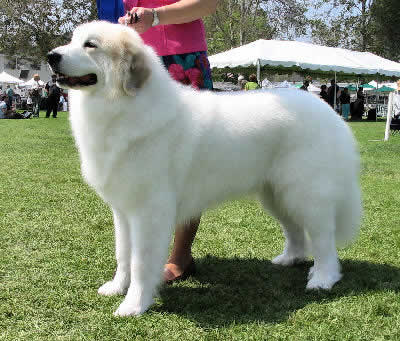
The Great Pyrenees is bred to guard livestock, but is also used as a sled dog and a rescue dog.
The Great Pyrenees is also known as the Pyrenean Mountain Dog. This is a beautiful, large working dog breed. They were bred to protect livestock, and as a companion dog are instinctively protective of, and devoted to, their families.
Great Pyrenees dogs tend to be very gentle and affectionate toward their families. This large dog breed is easy going until provoked, so needs early socialization and a confident but firm hand in training. They will get along with children and cats, but may not be tolerant of other types of pets. When choosing a Great Pyrenees, look for signs or family history of hip dysplasia.
- Kingdom: Animalia
- Phylum: Chordata
- Class: Mammalia
- Order: Carnivora
- Family: Canidae
- Genus: Canis
- Species: lupus familiaris
Common Name(s)
Great Pyrenees, Pyrenean Mountain Dog
Breed Type
The Great Pyrenees is a large working breed. Prized as a guard of livestock, the Great Pyrenees also makes a devoted pet. Cool climates are best for this breed.
Background
The Great Pyrenees is an ancient breed. Proof of the existence of dogs similar to the Great Pyrenees goes back to 1800 BC. Known as a European breed, it may have actually originated in Asia or Siberia. In addition to guarding livestock, the Great Pyrenees has served as a rescue dog, sled dog, and possibly a war dog.
Popular hybrids include the Golden Pyrenees, a cross between the Golden Retriever and the Great Pyrenees.
Description
The Great Pyrenees is large and solid, with a thick, coarse, long coat. Colors include white with tan, gray, or pale yellow patches, and solid white. The head is wedge-shaped, the ears medium and triangular, the nose black, and the eyes dark brown. The tail is feathered and slightly curved upward. Males are usually 27-32 inches tall and weigh 100 pounds or more. Females are 25-29 inches and weigh 85 pounds or more.
Care and Feeding
The Great Pyrenees should have a diet that consists of lamb, poultry, wheat and potato, with a high fat ratio. egular brushing is important for this breed, especially when shedding the undercoat. Baths should be given only as needed.
The Great Pyrenees is a healthy breed, but regular checkups are advised. Vaccinations are due as follows:
- 6-8 weeks: Distemper, Leptospirosis, Hepatitis, Parainfluenza, Parvo, and Corona virus (DHLPPC)
- 10-12 weeks: Second DHLPPC
- 14-16 weeks: Third DHLPPC and rabies
- Annually: DHLPPC and rabies booster
Great Pyrenees shed heavily once a year. Frequent vacuuming is necessary during this time.
Housing Your Dog
The Great Pyrenees needs plenty of space if kept indoors. They need a yard to exercise in, but it is best to keep them fenced in to prevent them from wandering off.
Social Behaviors
The Great Pyrenees gets along well with children if socialized with them early. It tends to get along well with other types of pets, particularly cats. Males may be aggressive toward any type of animal, however.
Handling and Training
Great Pyrenees may be difficult to train. Their trainers must be confident and firm in order to succeed.
Activities
The Great Pyrenees needs some form of exercise to stay healthy. This may be obtained through work as a livestock guardian. If not used for this purpose, they need long daily walks.
Breeding/Reproduction
When selecting a mate for your Great Pyrenees, ask the owner about hip dysplasia test results.
Common Health Problems
Generally a healthy breed, the Great Pyrenees sometimes suffers from hip dysplasia and skin problems. Skin problems may be avoidable by avoiding very hot temperatures.
Availability
Great Pyrenees are easier to find in cool climate areas. Prices are usually $400 to $800.
References
- Liz Palika, The Howell Book of Dogs: The Definitive Reference to 300 Breeds and Varieties , Howell Book House, 2007
- American Kennel Club, The Complete Dog Book: 20th Edition (Complete Dog Book) , Ballantine Books, 2006
- Kristin Mehus-Roe, The Original Dog Bible: The Definitive Source to All Things Dog, BowTie Press, 2005
- Great Pyrenees, Copyright Dog Breed Info Center
- Great Pyrenees, Wikipedia
- Great Pyrenees Puppies for Sale, Copyright PuppyFind.com, LLC
Featured Image Credit: Danita Delimont, Shutterstock