
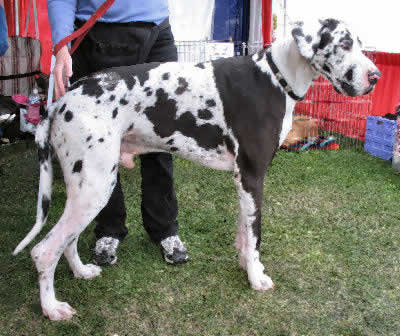
The Great Dane is a sweet tempered dog is known for being the tallest breed of dog.
The Great Dane is the tallest dog breed. But this is a sweet, affectionate dog and so has earned the common name of Gentle Giant. There is some contravery about where this large dog breed originated. Some say it is a German Great Dane and other suggest it possibly originated Denmark. Other common names, reflecting both countries, are the German Mastiff, which in German is Deutsche Dogge, and the Danish Hound, which in German is Danischer Hund.
This large dog is affectionate and loves the company of humans. It does do well with kids, but good training is important to keep it from getting too rambunctious with very small children. The Great Dane’s bravery and large size make it an excellent watchdog, and it rarely barks without good reason.
When selecting a Great Dane, look for family history of hip dysplasia and heart problems. It is said that Great Danes that are white near its eyes will be blind, and those with white near their ears will be deaf.
- Kingdom: Animalia
- Phylum: Chordata
- Class: Mammalia
- Order: Carnivora
- Family: Canidae
- Genus: Canis
- Species: lupus familiaris
Common Name(s)
Great Dane, German Mastiff (in German – Deutsche Dogge), Danish Hound (in German – Danischer Hund), Gentle Giant
Breed Type
A working breed, the Great Dane is known for being the tallest breed of dog. The Great Dane is a popular guard dog, but it is gentle enough to be a family pet.
Background
The Great Dane’s roots go back to Ancient Egypt, Greece and Rome. Its ancestors purportedly include the Mastiff, the Irish wolfhound and the Bullenbeisser. There is much debate as to whether the breed originated in Denmark or Germany. Popular Great Dane hybrids include the Daniff (Great Dane and Mastiff mix) and the Labradane (Great Dane and Labrador mix).
Description
The Great Dane is a large, muscular dog. Standard colors of its short, thick coat include fawn, brindle, black, blue, and harlequin. Eye color varies with coat color. Ears are medium length, and may or may not be cropped. The head is narrow with a long muzzle. Males are 30-34 inches tall and weigh 120-200 pounds. Females are 28-32 inches tall and weigh 100-130 pounds.
Care and Feeding
The Great Dane’s diet should include beef, oats, rye, and potato. Great Danes should be brushed and combed regularly, and should be dry shampooed as needed. Nails should be trimmed. The Great Dane’s ears may or may not be cropped as a puppy.
Annual checkups are important for this breed. Vaccinations should be given as follows:
- 6-8 weeks: Distemper, Leptospirosis, Hepatitis, Parainfluenza, Parvo, and Corona virus (DHLPPC)
- 10-12 weeks: Second DHLPPC
- 14-16 weeks: Third DHLPPC and rabies
- Annually: DHLPPC and rabies booster
Great Danes shed moderately. Regular vacuuming is important if they are to be kept indoors.
Housing Your Dog
Great Danes do surprisingly well in small spaces as long as they get sufficient exercise. It is best if they have a large outdoor space to play in.
Social Behaviors
The Great Dane does well with children, but obedience training is crucial to prevent them from getting too rambunctious with small ones. The breed does well with other dogs if properly socialized when young.
Handling and Training
Training can be somewhat difficult with the Great Dane. Positive reinforcement, however, is usually effective.
Activities
Great Danes need lots of exercise. Daily walks are essential, and regular play sessions are advisable.
Breeding/Reproduction
When selecting a mate for your Great Dane, check bloodlines for hip dysplasia, tumors, and heart disease.
Common Health Problems
Great Danes are prone to hip dysplasia, tumors, and tail injuries. Bloat is also rather common, but it is largely preventable with proper feeding and exercise practices.
Availability
Great Danes are reasonably easy to find. Prices are often in excess of $1,000.
References
- Liz Palika, The Howell Book of Dogs: The Definitive Reference to 300 Breeds and Varieties , Howell Book House, 2007
- American Kennel Club, The Complete Dog Book: 20th Edition (Complete Dog Book) , Ballantine Books, 2006
- Great Dane, Copyright Dog Breed Info Center
- Great Dane, Wikipedia
- Great Dane Puppies for Sale“, Copyright PuppyFind.com, LLC
Featured Image Credit: anetapics, Shutterstock