
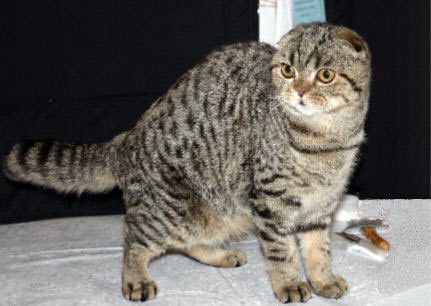
Scottish Fold cats are distinctive and adored, with an outstanding reputation as a great pet cat!
The Scottish Fold has a charming appearance with a face that somewhat resembles an owl. Of course the most notable feature of this breed are its small ears, which are tightly folded forward and down. Sometimes they will have a double fold, making the ear tips almost touch the forehead. Other features of the Scottish Fold cat include its round stocky body, which is complimented by a round head with big round, wide-open eyes. Another cat breed with unique ears is the American Curl, but its ears curl backwards rather than to the front.
This combination of ears, body form, and face give the Scottish Fold cats a very sweet and endearing expression. Its charming appearance carries through in its behavior as well, its pleasant look is a good representation of this breed’s personality. This cat breed is loving and gentle towards most people and animals, and makes a great addition to any family.
Scottish Folds are calm, placid pet cats that enjoy staying indoors. However they can also be playful, and are known for their excellent hunting skills so will enjoy an occasional romp outside. They are highly affectionate and gentle, which makes them ideal family cats. They are also quite adaptable, so they do well in noisy houses full of people or with a single, quiet owner in an apartment. They have a sweet, quiet voice that they use sparingly. And for maintenance, this breed just needs a simple weekly grooming.
These cats may have ancestry in China, but their most recent confirmed origins come from Scotland. The Scottish Fold is a mutation breed cat, the results of a spontaneous mutation of a dominant gene. An interesting tidbit is that this cat breed was originally called the Lop-Eared Cat or Lop Cat, after the lop-eared rabbits. The forebearers of the breed we see today originated in 1961 from farm cats in Perthshire, Scotland. A litter produced one white female kitten with the folded ears named Susie. All Scottish Fold cats in existence today can trace their heritage to her. There are also a couple of variations of the Scottish Fold. The Coupari, which is also known as the Long Haired Scottish Fold, and the Scottish Shorthair which is the name given to kittens that have upright ears, rather than folded ears.
Today the Scottish Fold can commonly be found in the United States, though they are less common in Europe, as well as Australia. Their may be uncommon in Europe due to the reluctance of one cat association in England, the Governing Council of the Cat Fancy (GCCF), to fully embrace this cat breed. Their concern is due to the gene that causes the folded ear mutation. It is incompletely dominant and can result in cartilage or skeletal abnormalities in some cats, as well as difficult to clean. However the Cat Association, also in England, accepted the breed in 1983. In the United States it has not only been recognized but has achieved championship status, and by the 1990’s it was ranked as one of the top ten most popular pedigree breeds.
For information about keeping a pet cat, see:
Cat Care: How to Take Care of a Cat
- Kingdom: Animalia
- Phylum: Chordata
- Class: Mammalia
- Order: Carnivora
- Family: Felidae
- Genus: Felis
- Species: domesticus
Background
The first written mention of a cat with folded ears was recorded in the 1880’s. This cat was thought to have been brought to Europe from China by an English sailor. It is unknown whether it had any offspring.
The first recognized Scottish Fold was born in 1961 on a farm in Perthshire, Scotland. The white, shorthaired, female cat was discovered by a shepherd who noticed its peculiar ears, and alerted the owners of this fact. The owners, Mr. and Mrs. McRae named the cat Susie, and two years later she gave birth to two folded ear kittens. One was neutered and kept as a pet, while the other, a white female named Snooks, was kept for breeding.
One of her offspring, Snowdrift, was borrowed by a London breeder named Pat Turner, who began a serious breeding program. The program flourished, and the Scottish Fold was established as a new breed. However, controversy arose because some people, including those in the Governing Council of the Cat Fancy (GCCF), the leading cat association in England, objected to the breed’s folded ears. The GCCF claimed that the folded ears were susceptible to infection and difficult to clean. As a result, they refused to recognize the breed. However, the Cat Association, another cat organization in England accepted the breed in 1983.
The Scottish Fold was more readily accepted in the United States, where it was registered in 1973, reached championship status in 1978, and was ranked as one of the top ten most popular pedigree breeds in the 1990’s.
Two variations of the Scottish Fold are the Coupari and the Scottish Shorthair. The Coupari is the long-haired version of the Scottish Fold, and the Scottish Shorthair is the name given to the kittens produced that have upright ears, rather than folded ears.
Description
The defining feature of the Scottish Fold is, of course, the folded ears, caused by a spontaneous mutation from a dominant gene. They are folded forward and downward. Smaller, more tightly folded ears are desirable. Some have a single fold, while some have a double fold. The double fold causes the ear tips to almost touch the head. Kittens begin to exhibit the folded ear trait at about 25 days, when the cartilage in the ears begins to harden, and most kittens’ ears stand up. These kittens’ ears simply stay down.
This is a medium-sized breed with a rounded, stocky body. The legs are medium in length and the tail is medium or long in length and tapering. The head is round and wide and sits on a short neck. The eyes are large, round, and wide open. The nose is short and softly curved. These features create an owl-like appearance. The Scottish Fold has a thick, double coat. All color combinations are accepted, except for chocolate, lavender, the Himalayan pattern, and any combinations of those colors with white. They generally weigh 6 to 13 pounds and live to be 10 to 15 years old.
Care and Feeding
The Scottish Fold requires no special diet. Their natural body form is padded and stocky, but as with all cat breed, take care to not let them become overweight. This can be avoided with simple activity and play.
Housing Your Cat
Scottish Folds can adapt to a variety of housing arrangements. They do well in houses or apartments. They can enjoy time to hunt and run around outdoors, but do not require it. They can be playful, but are often content to simply sit and watch.
Maintenance
Scottish Folds require weekly brushings, and additional grooming when they are shedding. The long-haired varieties require daily grooming.
Social Behaviors
This breed is very friendly. It is affectionate toward people, other cats, and even friendly dogs. It enjoys being around others, but does not require constant attention. It is likely to become especially attached to one person, but still be affectionate towards other people.
Activities
Scottish Folds may enjoy playing and hunting or they may be content with a sedentary lifestyle. This preference depends on their current mood and individual personality. As with all cats, owners should be careful not to let them become overweight, but the natural body type of the Scottish Fold is padded and stocky.
Breeding/Reproduction
Breeders should always be careful to only breed Scottish Folds with non-Scottish Folds. When they are bred together, 3 out of 4 kittens will have the folded ear characteristic. However, 1 out of four will exhibit other physical abnormalities, including shortened and stiffened legs and tail, due to fused vertebrae. When Scottish Folds are bred with other shorthaired breeds, approximately half of the kittens will have folded ears, and the other half will have upright ears. Litters contain about 4 to 6 kittens.
Common Health Problems
As was already mentioned, when two Scottish Folds mate, severe abnormalities can result. The stiffened legs and tail can reduce the quality of life and lifespan for the cats. Little can be done to treat them, except to provide pain relief with medication.
It was once believed that Scottish Shorthairs were susceptible to deafness. However, it was later found that the trait had originated from the white coats of some Scottish Folds. Other than these two abnormalities that can be avoided by careful breeding, Scottish Folds are hardy, healthy cats.
Availability
Since half of the kittens produced in a litter have folded ears and the other half have straight ears, Scottish Fold kittens are more difficult to find than some other breeds. However, breeders are easily found on the internet. Prices for Scottish Folds range from $300 for an adult pet to over $750 for a show quality kitten. Prices for Scottish Shorthairs (straight-eared kittens) range from around $100 to $400.
References
- See Animal-World References: Cat Breeds – Exotic Cats
- Bruce Fogle, CATolog, DK ADULT, 2002.
- Mordecai Siegal, Simon & Schuster’s Guide To Cats , Simon & Schuster, 1983
- Scottish Fold, Wikipedia
Featured Image Credit: Witsawat.S. Shutterstock