
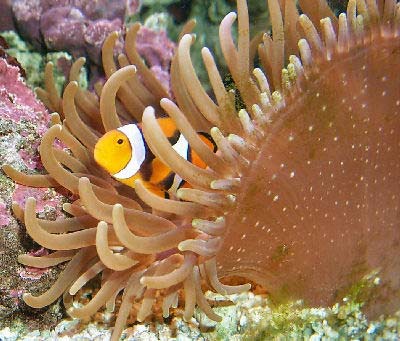
Like an ostrich, the Long Tentacle Anemone can completely cover itself in the sand if it is scared!
The Long Tentacle Anemone Macrodactyla doreensis or Corkscrew Anemone is a handsome large anemone, growing to about 19″ ((48 cm). Being brownish red to orange with distinctive white spots on its foot makes it a great low level centerpiece. This anemone appreciates bright light, fine sand/mud, and a mature system. Make sure you have 4″ or more of a soft substrate. Crushed coral won’t work very well with the Long Tentacle as the coral can lacerate its foot.
In nature the Corkscrew Anemone is not always a host to clownfish, though occasionally they are found in a symbiotic relationship. In captivity it is a toss up, sometimes they will host a clown and sometimes not. But this is a pretty anemone that will hold its own in beauty, even if a clownfish doesn’t take to it.
These anemones use their venomous cells or nematocysts found in their tentacles to sting and deflect any possible threats or attacks. Some predators of the Long Tentacle Anemone include certain angelfish, some butterfly fish, and predator sea stars. In general if this anemone is moving about, it is not happy.
There are a number of common names this anemone is known by. These include Corkscrew Anemone, Corkscrew Long Tentacled Anemone, Sand Anemone, Red Base Anemone, Long Tentacle Red Base Anemone, and Snaky Sea Anemone. When selecting a Long Tentacle, be careful not to buy a bleached anemone or an artificially colored anemone. These conditions, especially bleaching, can be fatal as it works to purge all of its fake color and then turns the color it was originally, a tan or reddish brown.
For information about Clown Fish anemones, see:
Facts About the 10 Clownfish Hosting Sea Anemones
The Long Tentacle Anemone needs 3 things: Matured tank that is at least 1 year old, a 3 to 4″ sand bed to bury it’s foot and strong lighting. These substrate dwellers can be a challenge to keep, often somehow finding a pump to kill itself in BEFORE it finds a place to settle. Once they find a place, leave them along and feed often. Avoid purchasing fish that like to be towards the bottom as they can easily become lunch. I personally had one kill a Fairy Wrasse who happened to spin their cocoon towards the bottom of the tank. It was peacefully sleeping there then the next morning it was dead and the anemone had crawled under that rock and stung him to death. Just one experience, may not happen in other tanks.
- Minimum Tank Size: 100 gal (379 L)
- Aquarist Experience Level: Advanced
- Temperament: Semi-aggressive
- Temperature: 72.0 to 82.0° F (22.2 to 27.8° C)
- Size of organism – inches: 19.0 inches (48.26 cm)
- Diet Type: Carnivore
- Suitable for Nano Tank: No
Habitat: Distribution / Background
Sea Anemone Facts: The Long Tentacle Anemone or Corkscrew Anemone Macrodactyla doreensis was described by Quoy and Gaimard in 1833. The Macrodactyla genus is a member of the Actiniidae family, and this genus contains 2 species. Some names they are known for are Corkscrew Anemone, Corkscrew Long Tentacled Anemone, Sand Anemone, Red Base Anemone, Long Tentacle Red Base Anemone, and Snaky Sea Anemone. The Macrodactyla doreensis is not on the IUCN Red List for endangered species.
Where are Sea Anemones Found: The Macrodactyla doreensis is found in West-Indo Pacific from southern Japan to Mauritius, the Philippines, New Guinea to northern Australia, and eastern Indonesia.
Sea Anemone Habitat: Sand Anemones are found in shallow waters up to 15 feet (5 m). They bury their foot in deep sand or mud. They are not always hosted by clownfish. They use their venomous cells or nematocysts found in their tentacles to sting and deflect any possible threats or attacks. Some predators are certain angels, some butterfly fish, and predatorial sea stars.
- Scientific Name: Macrodactyla doreensis
- IUCN Red List: NE – Not Evaluated or not listed
Description
Appearance of a Sea Anemone: The Long Tentacle Anemone has a soft squishy body that can be tube shaped. The pedal column has a sticky foot at the bottom which they use to adhere to various surfaces. They also use this “foot” to move around if conditions are not ideal. The color is brown, or reddish brown to orange, and they have distinctive white spots on their foot.
Tentacles are spaced further apart than similar anemones. The tentacles are on the surface of the oral disc, with the mouth being in the center. The tentacle colors can be white with pink tips, pinkish, tan, or purple. Tentacles can be also have a basic, corkscrew, or striated pattern.
The mouth should be closed and tight, and will open when hungry. Having an oval look, yet a gaping mouth, is a warning signal. The Macrodactyla doreensis takes food in, and expels waste through this same opening. Some anemones have Acrorhagi, which are basically shorter stubbier tentacles on the underside of the oral disk. These are exposed when the anemone is closed up.
Sea Anemones Life Cycles: Long Tentacle Anemones can grow up to 19″ ((48 cm), but it is unknown how long they live. Some anemones can be hundreds of years old in the wild, and in captivity some have been known to last 80 years or more. The Red Base Anemone has been known to divide in captivity, but this is rare.
- Size of organism – inches: 19.0 inches (48.26 cm)
- Lifespan: – Their lifespan is unknown, however in the wild they can last hundreds of years and in captivity they have lived over 80 years.
Difficulty of Care
Sea Anemone Care: The Long Tentacle Anemone can be difficult to care for because they do have high lighting needs and must be in a large enough aquarium to satisfy their ultimate size. Putting an anemone in a new tank will result in failure. The tank should be at least 1 year old and stable before adding your new M. doreensis.
When choosing your Corkscrew Anemone, make sure the color is good, their mouth is not gaping open, and their foot and tentacles are sticky to the touch. Also, they should be attached to something and make sure there is no damage to the foot area, often a result of pulling the anemone off its surface.
To take an M. doreensis anemone from another aquarium, use a thin blunt item like a credit card, gently wiggle it under the foot, slowly nudging it away from the glass. If it’s attached to a rock, ideally you can simply purchase the rock as well. If you cannot purchase the rock then directing water at it or wiggling the rock gently upside down under water while tickling the foot can work.
- Aquarium Hardiness: Moderately Difficult
- Aquarist Experience Level: Advanced
Foods and Feeding
What Do Sea Anemones Eat: The Long Tentacle Anemone is a carnivore. In the wild, these anemones are well equiped with nutritional alternatives for their well-being. They derive daily nutrition from their symbiotic algae, zooxanthellae, which dwells within their tissues. They also use their venomous cells or nematocysts found in their tentacles to sting and capture prey. They absorb nutrients from the water around them and they consume wastes from resident animals like clownfish. It is not necessary for them to be fed by Clownfish they host, though clowns will often carry chunks of food to the anemone.
In captivity you can feed your M. doreensis chopped silversides, shrimp, krill, and mussels, fresh chopped fish (from your grocery store), as well as frozen carnivore preparations. If the food is not small enough, they will regurgitate it. They need food 2 to 4 times a week.
Clownfish hosted with your anemone usually will not be able to sufficiently feed themselves and their anemone with the small quantity of food that is put in a captive environment. You will need to target feed this anemone. You can just offer your clowns a piece of fish flesh and they will usually snatch it out of your hand and give it to their host. However, not all clowns are this smart, so don’t depend on the clown fish to feed the anemone.
- Diet Type: Carnivore
- Meaty Food: All of Diet – They can be fed chopped silversides, shrimp, krill, and mussels, fresh chopped fish (from your grocery store), as well as frozen carnivore preparations.
- Feeding Frequency: Weekly – Feed 2 to 4 times a week.
Aquarium Care
Water changes of 10% bi-monthly or 20% a month are typical. Monitor your water quality for your particular situation and adjust your water changes accordingly. A good sized Long Sand Aanemone is equal to 4 or more fish as far as waste production is concerned. Purigen and Poly-fiber are great products to help in maintaining water quality. Purigen is a synthetic polymer that removes soluble and insoluble impurities from water at an exceptionally high rate and capacity, helping to control ammonia, nitrites and nitrates. Additions of Iodine and and trace elements are suggested.
- Water Changes: Bi-weekly
- Iodine Levels: – Additions of Iodine and and trace elements are suggested.
Aquarium Setup
The typical live rock/reef environment with a sand only substrate is what is needed for your Long Tentacle Anemone. Have at least 1 foot in diameter of fine sand/mud for the M. doreensis to settle into. The Long Tentacle Anemone will attach to a hard surface through the sand. Once it is secured, if it is happy it will stay put. If it isn’t happy and is moving around, be sure to check your lighting and water quality, and also make sure you are feeding it adequately. With all anemones its a good rule of thumb to have all of your pumps covered, most good quality pumps have guards on them.
- Minimum Tank Size: 100 gal (379 L)
- Suitable for Nano Tank: No
- Live Rock Requirement: Typical Amount
- Substrate Type: Sand
- Lighting Needs: Moderate – normal lighting – Moderate to High lighting.
- Temperature: 72.0 to 82.0° F (22.2 to 27.8° C)
- Specific gravity: 1.023-1.025 SG
- Water Movement: Weak
- Water Region: Bottom
Social Behaviors
All anemones are semi-aggressive because they can be mobile, and when moving around the tank will sting other corals and fish. A contented Long Tentacle Anemone will stay put once it has found a place to settle. If it starts moving around you need to check your aquarium parameters and feeding schedule to find out why it is unhappy. Certain clown fish may take to the Red Base Anemone, these include the Clark’s Clownfish, True Percula Clownfish, Pink Skunk Clownfish, Saddleback Clownfish, and Maroon Clownfish.
After splitting, anemones will tolerate their own “clones” and sometimes their own species. All anemones in the tank need to have their own space, otherwise there can be a “chemical” warfare between species. This will usually cause one to not eat, shrink and eventually die. Having excellent filtration and a large tank (over 100 gallons), will usually allow 2 anemones at opposite ends to thrive. You can also build a natural blockade to help prevent them from wandering into each others “space”.
If you want to have your Long Tentacle Anemone host a clownfish, be sure your anemone is 3x’s larger in diameter than the length of the clown fish you introduce.
It has been found in nature hosting the following Clownfish species:
- Clark’s Clown fish Amphiprion clarkii
- Pink Skunk Clownfish A. perideraion
- Saddleback Clownfish A. polymnus
- True Percula Clownfish A. percula
- Mauritian Clownfish A. chrysogaster
Additionally, in captivity it has been known to also host the following Clownfish:
- Maroon Clownfish Premnas biaculeatus
- Venomous: Yes
- Temperament: Semi-aggressive
- Compatible with:
- Same species – conspecifics: Sometimes
- Anemones: Monitor
- Mushroom Anemones – Corallimorphs: Monitor
- Leather Corals: Monitor
- Stony Corals: May be aggressive
- Soft Corals: May be aggressive
Sex: Sexual differences
No sexual difference in appearance is known.
Breeding / Reproduction
Propagating is not suggested due to the fact that the M. doreensis almost never recovers from the incident. Anemones in general can multiply by sexual and asexual means. One way is using fission, which is when they actually split in half from the foot or mouth to form a clone, although the clone is its own animal, similar to twins. They will also reproduce using male and female sex glands or find another anemone of the opposite sex. This results in the production of ciliated planula larvae. This planula will eventually fall to the sea floor, develop a pedal disk, and then begin to grow into a new anemone.
- Ease of Breeding: Difficult
Ailments / Diseases
Problems for this anemone are pretty minimal unless your lighting, water movement, feeding and water quality are low. Then your anemone will detach to look for “better conditions.” In general, if your anemone moves, it is not happy. Some predators are certain angels, some butterfly fish, and predatorial sea stars.
Availability
Buy A Sea Anemone: The Long Tentacle Anemone or Corkscrew Anemone M. doreensis is easy to find in stores and online. The cost online starts at about $29.00 USD and goes up depending on size and color.
References
- Animal-World References: Marine and Reef
- Scott W. Michael , Damselfishes & Anemonefishes, TFH Publications, 2008
- Ronald L. Shimek, Guide to Marine Invertebrates: 500+ Essential-to-Know Aquarium Species, Microcosm, 2005
- Alf Jacob Nilsen and Svein A. Fossa, Reef Secrets: Starting Right, Selecting Fishes & Invertebrates, Advanced Biotope Techniques, T.F.H Publications inc., 2003
- Helmut Debelius and Hans A. Baensch, Marine Atlas Volume 1 (Baensch Marine Atlas), Microcosm Ltd, 1997
- Joyce D. Wilkerson, Clownfishes, TFH Publications, 1997
- Bob Goemans, Long Tentacle/Corkscrew Anemone , Animal Library, Saltwatercorner.com
Featured Image Credit: congerdesign, Pixabay