Unit conversion calculator for aquariums: How many gallons are in your aquarium, how many drops in a teaspoon, whats the difference between a US gallon and a UK gallon, not to mention liters?
Pictures from a coral frag conference! Live coral frags and topics on Nano Reef Aquariums and large reef aquariums, taking care of a reef and coral propagatio
Mini reef aquarium guide. Reef aquarium setup for large reef tanks, Nano reef tanks, Pico reef or MIcro reef aquariums with reef tank lighting, filtration, choosing coral reef animals, and problem solving!
I bought a bubble tip anenome yesterday and woke this morning to a disaster. The anenome had committed suicide. Sometime in the night it crawled into my wave fan... (more)MaryM
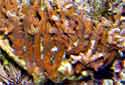
Fire Coral and Lace Coral - Hydrocorals include fire corals in the Milleporidae family and lace corals in the Stylasteridae family. They are Cnidarians just like the stony corals, but are in the class Hydrozoa. They have a potent sting.
Corallimorphs
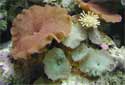
Mushroom Anemones - Corallimorphs or Mushroom Anemones. Although similar to sea anemones as they have no calcerous skeleton, anatomically they more strongly resemble stony corals.
Octocorals - Soft Corals
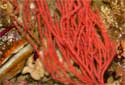
Gorgonians - Sea Fans and Sea Whips - members of the subclass Octocorallia. This group is called the Octocorals, and loosely referred to as soft corals.
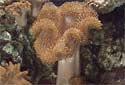
Leather Corals - Types of Leather Corals - Beginner Aquarium Soft Corals. They come in all sorts of attractive shapes and can be quite dynamic in the reef aquarium.
Soft Corals - Types of Soft Coral in the Family Alcyoniidae. The true soft corals consist of many beautiful species that occur in all the colors of the rainbow and come in all sorts of attractive shapes.
Unique Octocorals - Blue Coral, Organ Pipe Coral, Green Star Polyps, Sea Pens.
Order: Actiniaria and Ceriantharia
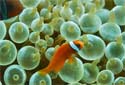
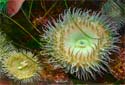
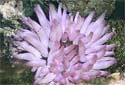
Anemones - Watching an anemone living with a clownfish is one cool experience! Learn about aquarium care for anemones and which ones are most likely to host clownfish.
Order: Zoantharia - Zoanthus, Palythoa, Zoas
Zoanthids - Button Polyps, Colonial Anemones, Sea Mats. They resemble clusters of miniature sea anemones, often growing like a mat across a hard substrate.
Stony Corals
Stony Corals LPS - Large Polyp Stony Corals. These corals are generally larger calcareous corals. They have much larger fleshy polyps than those of the small polyp stony (SPS) corals.
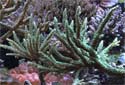
Stony Corals SPS - Small Polyp Stony Corals. The SPS corals have much smaller polyps than the LPS corals. SPS corals are usually either branching or plated.
Tridacnid Clams
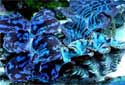
Giant Clams - Tridacna Clams and Hippopus Clams. Tridacna Clams and Hippopus Clams are beautiful, hardy, grow rapidly, and require little care. It is important to be well prepared for the care of your clam before actually purchasing one.
The Hawaiian name of the flowery flounder is Paki'i. They are found in the Indo-Pacific and the tropical eastern Pacific. A very interesting 'flat' fish, they have both eyes on the same side of the head. Actually all flounders have this characteristic. This fish will generally lie on the bottom, usually over sandy areas. Sometimes it burries itself under a thin layer of sand, so that only its eyes are exposed. It reaches a maximum length of about 18 inches.
Note: For simplicity and lack of confusion, we have followed the classifications and categories as presented in Julian
Sprung and J. Charles Delbeeks' book , The Reef Aquarium - Volumes One and Two, 1994 and 1997. This often differs from the hobbyist
classification.