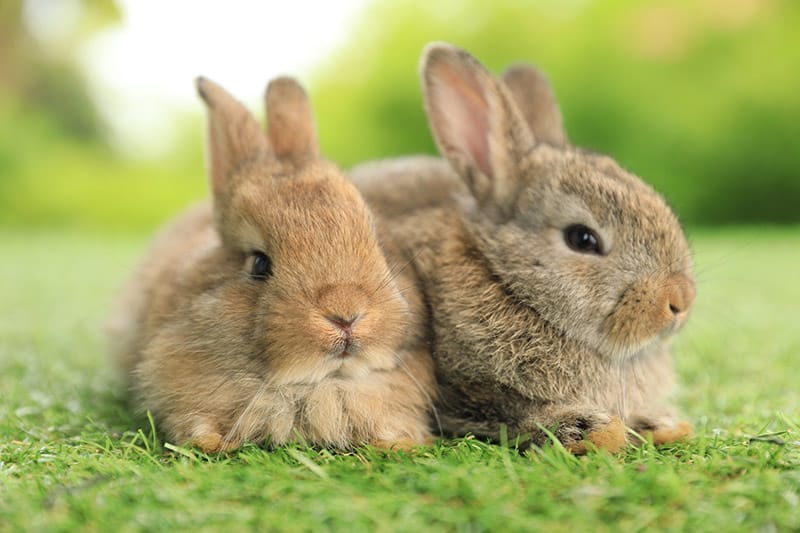
Animal-World’s Featured Pet of the Week: The Dwarf Hotot Rabbit!
April 14, 2013 by Jasmine
Filed under Catch All, Featured Pets, Small Pets

Animal-World’s Featured Pet for this week is: The Dwarf Hotot Rabbit!
Here is an adorable, small, and playful bunny rabbit! A little late for Easter, but these Dwarf Hotot Rabbits actually make fantastic pets! They are not quite as common as some other pet rabbits, but they are oh-so-cute! I am not sure if we ever kept any of these rabbits at our pet store, but they were available for special order and I’ve definitely run into them at rabbit shows. Many people like them to show them! Being petite and a beautiful pure white color with black bands around their eyes, they really stand out. Their name is pronounced Dwarf “Oh-Toe” Rabbit and are also known as Eyes of the Fancy.
Many people think Dwarf Hotot Rabbits make good pets because they are so playful. In fact they enjoy playing with both people and toys! They usually are quite affectionate with their owners if held regularly and are easy to hold. Because of this they are one of the better pet rabbits for children. They are a dwarf breed and so do not get as large as a regular full-sized rabbit. They only reach 2 to 3.5 pounds and can live in a smaller enclosure than a 10 to 15 pound rabbit could. They can live to be around 7 to 10 years old.
Dwarf Hotot Rabbits do not have a straightforward background history. It is often assumed that they are just a “mini” version of the regular sized Hotot Rabbit. This is not the case, however. While they do have the larger Hotot Rabbit in their genes, it took quite a bit of cross-breeding before the Dwarf Hotot Rabbit was declared. Baroness Bernard of France developed the very first Hotot Rabbit near the beginning of the 20th century. After this breeders in both West and East Germany were cross-breeding the Hotot Rabbit with several different breeds of rabbits. These included the Netherland Dwarf Rabbit and the Blanc De Hotot Rabbit. After these efforts were continued for some time the Germany breeders came together to try a combined effort in the 1970′s. The dwarf size first appeared when they crossed black Netherland Dwarfs with albino red-eyed rabbits. The German breeders crossed the two separate breeds they had come up with, and this is where our current Dwarf Hotot Rabbit originated from! Very interesting.
The American Dwarf Hotot Rabbit Club (ADHRC) was established in the United States in 1981. This was after Elizabeth Forstinger brought 7 rabbits from Germany to California to show them. The Dwarf Hotot Rabbit was officially recognized by the American Rabbit Breeders Association (ARBA) in 1983. And ever since then, they have been a popular show rabbit in the United States! Some things to note when showing these rabbits. A show specimen cannot be over 3 pounds in weight and they should appear to have no neck. They also cannot have black anywhere on their bodies (including their ears) except around their eyes. Other color varieties are recognized, such as chocolate and black, they just cannot be shown.
The care and maintenance of Dwarf Hotot Rabbits is typical of most other pet rabbits. As I mentioned above, they don’t need a large enclosure. A 2X2 foot cage would be sufficient. Especially if you let them out of their cage regularly! They also love to play so make sure to provide them with a couple toys. Feed these rabbits the same fare you would feed regular rabbits. They do well on a diet of commercial rabbit pellets with some fresh vegetables thrown in on occasion. Treats would also be welcomed on occasion. Dwarf Hotot Rabbits do need to be groomed. Ideally this should be done weekly to prevent them from accidentally ingesting too much fur. Intestinal blockages are a common problem in this breed if excess hair is not removed often.
Other than intestinal blockages, another health problem these rabbits run into is called malocclusion. This is when their lower teeth are directly below their front teeth, instead of behind them. This can cause them to have trouble eating or to accidentally snag their teeth on something, making them lose them. The remedy is having a veterinarian trim their teeth as they grow every 6 to 8 weeks. This is a simple solution, but it does take commitment to making sure it is done regularly.
Dwarf Hotot Rabbits are great little bunnies, for both showing and as pets! Breeders are usually easy to find online and prices range from $15 to $75 depending on whether you want a show animal or just a pet. I hope you enjoyed reading about these adorable rabbits!
Jasmine is a team member at Animal-World and has contributed many articles and write-ups.
Animal-World’s Featured Pet of the Week: The Scottish Fold Cat!
April 7, 2013 by Jasmine
Filed under Catch All, Featured Pets, Pet Cats

Animal-World’s Featured Pet for this week is: The Scottish Fold Cat!
I thought that because there have been a couple recent cat posts I would write about an interesting cat breed this week. The Scottish Fold Cat! Has anyone ever owned one of these? They are not as popular as regular pet cats, but they are definitely popular as show cats! Of course, these cats are known by their peculiar ears. They have very small ears which fold forward and down. These ears are caused by a genetic mutation, making Scottish Fold Cats a Mutation Cat Breed. The ears are also a reason many people love this personable cat!
The Scottish Fold Cat actually has a reputation for being a great pet! Other than their intriguing appearance, they are also very friendly, adaptable cats. They get along well with most people and other pets, and can be kept as either indoors or outdoors cats. Generally being calm cats, they enjoy attention and affection, but they also love their fair share of playing and hunting. This makes them great for both families in huge houses and lots of kids, and for quiet apartments with only their owner. And of course, they make awesome show cats because of their unique appearance!
Here is the interesting history on the Scottish Fold Cat. The very first one recognized was born in Perthshire, Scotland on a farm in 1961. The cat was named Susie and and she later had a folded ear kitten named Snooks. Snooks then had a kitten named Snowdrift. Snowdrift was used by a breeder in London to earnestly try and continue the folded ear trait. That breeder was named Pat Turner. This cat was recognized as a new breed, although there were people who did not agree with it. This is mostly because they claimed the folded ears could become infected more readily and were hard to clean. However the Cat Association in England accepted the Scottish Fold Cat breed in 1983. The United States recognized the breed even earlier in 1973. By the 1990′s The Scottish Fold Cat was in the top ten popular pedigree breeds! Other cats with folded ears include the American Curl Cat, whose ears fold backwards rather than forwards. Another interesting tidbit is that the very first cat with folded ears to ever be recorded was in the 1880′s! This cat seems to have been brought by ship to Europe from China, but it is unknown whether any more folded ear cats came from that one.
The care and maintenance of the Scottish Fold Cat is that of most other typical cats. These cats are regular sized, weighing 6 to 13 pounds. They live a typical cat lifespan of 10 to 15 years. Grooming them once a week will keep their hair free of mats and keep them looking their best. There are long-hair varieties which may require more grooming, especially if you are showing them. As I mentioned earlier, these guys are quite adaptable and can live in most human environments! From huge farms to small apartments. And they most often get along with other cats and other pets (including dogs!).
For those of you interested in breeding Scottish Fold Cats, there are some things that you need to know. First, you should never breed a Scottish Fold Cat with another Scottish Fold Cat. This is because 25% of the kittens will have grave abnormalities which result in a lower quality of life and a shortened lifespan. You should always breed your Scottish Fold Cat with a non-Scottish Fold Cat. In this scenario, 50% of the kittens will have the folded ear trait. The other 50% will look typical, but none of them will come up with life-threatening abnormalities.
Usually health problems arise when two Scottish Fold Cats are bred together. Some of the kittens can have abnormalities which include stiffened and shortened legs and tails. This is because of some of the vertebrae being fused together. Nothing can be done to help these cats, other than give them medication to help with pain. They don’t live very long or very happy lives. Quite sad. Other than this situation, Scottish Fold Cats are usually quite healthy when taken care of!
Is your curiosity piqued? If you are interested in Scottish Fold Cats, breeders can be found across the United States. Prices are anywhere from $300 to $750 depending on age and traits. Kittens are more expensive than adults because that is their prime showing age.
Jasmine is a team member at Animal-World and has contributed many articles and write-ups.
Animal-World’s Featured Animal of the Week: The Eastern Brown Snake
March 24, 2013 by Jasmine
Filed under Animal News, Catch All, Featured Pets, Reptiles, Wild Animals

Animal-World’s Featured Animal for this week is:
The Eastern Brown Snake!
Photo Wiki Commons
Courtesy Peter Woodard
Licensed under Public Domain
Would you like to know a little bit more about the second most deadly snake in the world? The Eastern Brown Snake is one of those awe-inspiring venomous snakes that really sends a chill down your spine when you imagine meeting with one. I have been wanting to write about this particular snake ever since I read about a little boy in Australia who stashed some eggs he found outside in a container in his closet. Apparently his mother opened the closet door and found the container squirming with a bunch of little snakes! After the boy and his mother took them to the local wildlife reserve, they discovered the babies were Eastern Brown Snakes. The boy was quite lucky not to have been bitten!
The Eastern Brown Snake Pseudonaja textilis is native to Australia and lives primarily on the eastern side. It can be found in almost all habitats, including the desert, grasslands, forest, and coastal areas. Adult Eastern Brown Snakes can reach 6 to 8 feet in length and have slender bodies. They can come in different variations of colors, from a light tan color to a very dark brown color. They can even come in gray colors. Rodents and other small animals are the bulk of their diet, although they will eat lizards, frogs, and birds if the opportunity arises. These snakes eating rodents is actually good for farmers because they act as a kind of pest control!
The Eastern Brown Snake is considered to be the second most deadly snake in the world, according to its SC LD50 value in mice. This number rates a snakes venom depending on how toxic it is. The most deadly snake in the world, according to this rating system, is the Inland Taipan Snake, also found in Australia. However, the Inland Taipan has not been the known cause of any known deaths. The Eastern Brown Snake on the other hand, has. In fact, the Eastern Brown Snake is the number one cause of snake bite deaths in Australia! The number of deaths has dropped dramatically in recent years due to the availability of anti-venom, but there are still one or two deaths per year.
The venom in these snakes is dangerous because it contains neurotoxins and procoagulants. The symptoms which arise from a bite include dizziness, diarrhea, paralysis, renal failure, and cardiac arrest. These snakes are considered aggressive in their natural territory, however they won’t usually bite something as a large as a human unless they feel threatened and/or unable to escape. If they feel they are defending themselves they will not always produce fatal bites. A “typical” bite from an Eastern Brown Snake yields about 2-4 mg of venom. The larger the snake, the more venom is produced. Without treatment the death rate is only about 10 or 20 percent. Considering there are snake species which have a 100% fatality rate if not treated (such as the Black Mamba and the Coastal Taipan), this death rate is actually not very high.
Reproduction time for the Eastern Brown Snake is in the spring. If there is more than one male in an area (which generally there is!), the males will engage in a “combat dance.” The winner of this dance is the lucky male who mates with any females in the area. The females will lay between 10 and 40 eggs apiece, with the average being 30 eggs. Once the eggs are laid, the mother leaves and has nothing to do with guarding the nest or rearing the babies. The babies also do not have a uniform color like the adults. They are banded with gray or black. These bands will disappear by the time they are three years old.
The Eastern Brown Snake is not a snake that would be kept as a pet! Some zoos or wildlife care places may keep them, and they are kept in anti-venom facilities to extract their venom. However, they are not kept as pets to handle and cuddle with! They are too dangerous and you would have to have a permit to keep one. There are many non-venomous Pet Snakes you can choose from if you want to keep one of your own, however!
I hope you enjoyed learning about the Eastern Brown Snake. I find them quite fascinating!
Jasmine is a team member at Animal-World and has contributed many articles and write-ups.
Sources Used
http://www.reptilepark.com.au/animalprofile.asp?id=109
http://www.avru.org/general/general_eastbrown.html
http://en.wikipedia.org/wiki/Eastern_brown_snake
Banner Photo
Photo Wiki Commons
Courtesy Peter Woodard
Licensed under Public Domain
Animal-World’s Featured Pet of the Week: The Siamese Fighting Fish!
March 10, 2013 by Jasmine
Filed under Aquariums, Catch All, Featured Pets, Freshwater fish
WFA_Ap4Be_vsm.jpg)
Animal-World’s Featured Pet for this week is: The Siamese Fighting Fish!
Did you ever have a fish as a child? If so what kind did you start out with? My guess is either a Goldfish or a Siamese Fighting Fish! These two types of fish are very popular, mostly because their care requirements are not highly specialized. We had many Siamese Fighting Fish when I was a child. My dad even bred them on a few occasions. We had several little tanks set up in a row! My favorite memory of these guys was when my brother and I would argue over who’s fish was prettier; my blue fish or his red one! Of course they were both beautiful!
The Siamese Fighting Fish Betta splendens, commonly called just the Betta, is a popular fish for several reasons. First, Bettas do not require a lot of space. They can be kept in relatively small aquariums and do not grow very large. Second, they are very hardy fish and don’t require specific water conditions. Third, they do not require a lot of time or maintenance. Because of these reasons, they make great pet fish for children and beginners! In captivity the males have been selectively bred to have long beautiful fins. In the wild the males do have longer fins than the females, but they are not as long as in captive bred fish.
The Betta is quite possibly one of the oldest fish kept in captivity. They were first described in 1910 by Regan. They hail from Thailand and the Malayan Peninsula. Their natural habitat there is in slow moving waters with lots of vegetation. They are listed on the IUCN Red List as Vulnerable. This is because their natural habitat is being degraded, which could lead to an endangered status. Siamese Fighting Fish received their name for a reason. The “fighting” part came from the fact that these fish fight! Males will not tolerate each other and will fight to the death if they are kept in the same tank. For this reason, only one male can be kept in a tank. Usually more than one female can be kept peacefully together though.
Siamese Fighting Fish only live 2 to 3 years and are therefore not a long-term commitment. As I stated before, they require minimal care and maintenance. They only reach up to 2.5 inches and do not need a large aquarium space. Belonging to the Labyrinth Fish family, they have a special “labyrinth organ.” This organ allows them to live in waters with less oxygen for short periods of time. Another Labyrinth Fish is the Dwarf Gourami which I recently wrote about in December. Because of this Bettas can live in as small as a 3 gallon tank, but would appreciate more room if you can spare it! Also, if you plan to keep more than one fish you should provide a larger aquarium. They don’t need any special lighting or water movement and can be kept in comfortable room temperature water. Bettas are carnivores and should be fed a typical fish flake or pellet. Feel free to give them small amounts of food several times a day.
The Siamese Fighting Fish is a good social fish under most circumstances. You will only want to keep one male per tank, but can keep several females together if you wish and the tank is large enough. They generally get along well with most other community type fish, although you will want to make sure nobody is getting picked on and that everybody has plenty of hiding places.
Breeding Siamese Fighting Fish is both simple and difficult. By putting a male and a female together, you will almost certainly have mating going on. They male builds a “bubble nest” like most other Labyrinth Fish. The eggs are spawned in the bubble nest and the fry will hatch there. Once the eggs are hatched, keeping them alive becomes much more difficult. Males will often attack the young and infection in the babies is high. For more information on how to breed successfully, read here on Breeding Labyrinth Fish.
Most of you have probably owned a Betta or two in your lifetime. If not, and you are interested in an easy fish to keep, definitely think about keeping the Siamese Fighting Fish!
Jasmine is a team member at Animal-World and has contributed many articles and write-ups.
Animal-World’s Featured Pet of the Week: The Society Finch!
March 3, 2013 by Jasmine
Filed under Catch All, Featured Pets, Pet Birds

Animal-World’s Featured Pet for this week is: The Society Finch!
Society Finches are another great, easy to care for, all-around great, small bird for beginners! Finches in general, are a great pet bird to just look at, listen to, and keep yourself entertained with. We had so many finches come through the pet store because people just loved them! They would be sold out regularly. I personally think the Society Finch is one of the prettiest finches available. Not only are they pretty, but they are very social and you can keep several of them together!
Finches are really good birds for beginners. The Society Finch Lonchura domestica is a very small, very hardy, very easy to care for, and inexpensive bird. Especially when you compare them to the care required for most larger birds. They are also called “society” finches for a reason – because they LOVE to be social! They do best when kept in groups of many birds and are not aggressive at all! Finches are not generally handled and are primarily just used to look at and listen to. They play and chirp together and are happy when they have several companions. These birds are also very good at breeding; you can easily end up with several babies if you have a large group of finches!
The exact background on these birds is not known. It is thought that the Japanese and Chinese probably developed them by specifically breeding a bird called the White-backed Munia, which is another type of finch. This happened at least 300 years ago and it is not 100% certain this is how they came to be, or the exact reasons of why they were bred. They are, however, completely domesticated birds and are not found in the wild. This makes them great as pets!
Society Finches are very small, reaching less than 5 inches when full grown. They also come in quite a mix of patterns from three basic color varieties. These varieties include white, white and fawn, and white and chocolate. They have also been developed to have crested forms, all solid colors, and tri-colored birds. Quite a variety to choose from!
Caring for these birds couldn’t be easier. Finch Care is easy enough in general. The first rule of thumb is: provide them with fresh food and fresh water every day! Food can consist of a purchased finch seed mix and green vegetables. To mix it up a bit or as a treat feel free to occasionally offer them apples, pears, and egg foods. Society Finches also need to ingest grit to help digest their food and to provide trace elements and minerals. You can purchase grit at a pet store as well and it can be provided in a separate dish or spread over the bottom of their cage where they can readily reach it. Offering cuttle bones is also a good idea. Cuttle bones give them needed calcium to keep their beaks strong and to keep their eggshells healthy during breeding.
Society Finches do enjoy baths so feel free to offer them a dish of water occasionally on the bottom of their cage where they can bathe. Be prepared to trim their nails if they become too long. If you give them rough perches they may need their nails trimmed rarely or never. But do keep an eye on them regardless.
Provide a roomy cage for several society finches. Keep the cage away from drafts and direct sunlight. Make sure to change out the paper and clean out the cage every few days. If you really want to go all out, you can set up an aviary for them. These finches do very well in aviaries! They love the room to fly and having many companion birds.
If you want to try your hand at bird breeding, Society Finches are a great bird to start with. They breed readily and easily. You can choose to breed just one pair, or have at least 3 or more pairs in the same space (to reduce territorial fighting). Make sure there are plenty of nesting spaces which are closed or at least partially closed. As I mentioned before, make sure you are feeding your finches properly and giving them cuttle bones to ensure their eggs and offspring will be healthy. Females will lay 4-6 eggs and will do all the sitting on them. The eggs hatch within 12 to 13 days and both the males and females will help to feed the young.
Society Finches are extremely hardy birds. If you take care of them, they will almost certainly thrive! Keep their cages clean, provide them with a proper diet, and you should have very healthy birds!
Read more on Society Finches if these little birds pique your interest! If you are a breeder or want to become one, then good luck! These are great birds!
Jasmine is a team member at Animal-World and has contributed many articles and write-ups.
Animal-World’s Featured Pet of the Week: The African Pygmy Hedgehog!
February 17, 2013 by Jasmine
Filed under Catch All, Featured Pets, Small Pets

Animal-World’s Featured Pet for this week is: The African Pygmy Hedgehog!
I decided to talk about a pet that is a little more on the exotic side this week. The African Pygmy Hedgehog! Many people who have owned these little critters will give you glowing recommendations of how great they are to keep as pets! While we did not carry Hedgehogs in the pet store I worked at, I did have a friend who owned one. I was able to regularly see and interact with her hedgehog named Dizzy! Dizzy was almost always asleep when I came to visit. This is because Hedgehogs are nocturnal. Sometimes my friend would wake Dizzy up just so I could hold her, and she would act very sleepy until she was allowed to go back and rest!
The African Pygmy Hedgehog Atelerix albiventris, is a small animal that can fit easily inside of an adults palm. They don’t make much noise or cause much odor. As long as you hold them regularly they will be unafraid and friendly towards you. They are a good pet for adults and children who are responsible. If you are a very busy person, a Hedgehog can be a great pet because they don’t need much attention. You can work or be out all day and not worry about them being lonely. They are solitary creatures in their natural habitats and only become active at night. They don’t need a huge environment or a lot of room to roam in, which makes them appeal to apartment dwellers as well.
African Pygmy Hedgehogs are part of the Erinaceidae family, which is the oldest living insectivore family. Yes, Hedgehogs are insectivores, not rodents. However they do not only eat insects. They will also eat many fruits, vegetables and sometimes even frogs or snakes or bird eggs. Their natural habitats are located in Asia, Africa, and Europe. Their preferred environments are fields, woods, hedgerows and gardens or farms. Although they are not native to North America, they were imported regularly until 1990, when importation of Hedgehogs was banned. Because of this ban, people came together to form the North American Hedgehog Association (NAHA). This organization was dedicated to the continued breeding and keeping healthy of Hedgehogs in North America.
Housing your African Pygmy Hedgehog is simple. They can be provided with a relatively small enclosure (with no wire bottoms) about the size of a rabbit cage. They love to have a regular place to sleep and “hide” so a sleeping hut or other cave type hiding place is a must! They will not feel at home or feel very comfortable without one! Provide bedding on the floor of the enclosure. Many Hedgehogs can be litter-box trained, so you may want to provide a litter box as well. Change out the bedding and thoroughly clean out the cage at least once a week to keep your Hedgehog’s home healthy. If you would like to keep more than one Hedgehog, it is best to keep two females in a large cage and to give them separate sleeping huts. Two males are much more likely to fight. Remember that in the wild Hedgehogs are solitary animals!
The care and feeding of domesticated African Pygmy Hedgehogs is also fairly simple. As a base, it is best to offer them a commercially prepared Hedgehog food, to ensure they are getting proper nutrition. In addition to this you can offer them small amounts of fresh vegetables, fruits, and insects such as crickets and mealworms. They need fresh water daily too, and the best way you can provide this is with a water bottle.
The African Pygmy Hedghog is available almost everywhere in the United Sates. Some places require you to have a permit to own them, and they are illegal in California and Arizona.
Here is some additional information on Breeding Hedgehogs and on Common Hedgehog Health Problems. If you have more specific questions or concerns regarding these topics, these are good places to start.
Has anyone reading this owned an African Pygmy Hedgehog or had experience with them before? If so what do you think about them? Would you recommend them as a pet?
Thanks for reading!
Jasmine is a team member at Animal-World and has contributed many articles and write-ups.
Animal-World’s Featured Pet of the Week: The Shetland Pony!
February 10, 2013 by Jasmine
Filed under Catch All, Featured Pets, Horses

Animal-World’s Featured Pet for this week is: The Shetland Pony!
I think everyone loves ponies. Or at least they love the idea of them! They look like miniature horses and are just so adorable! To be considered a pony, they should be under 14.2 hands as adults. The Shetland Pony is one of the most popular ponies. They are very strong, often able to pull weight that weighs twice as much as they do! They are able to live in quite harsh conditions and readily live longer than 30 years. This pony also has a very gentle demeanor and can be great for children to first learn to ride. The maximum weight they can carry is around 130 pounds, but should be less than that if possible to avoid any long-term back problems.
In America, there are 4 different breeds of Shetland Ponies recognized. In 1888 the American Shetland Pony Club was formed and it’s specific purpose was to pedigree all imported ponies. The four breeds that are recognized are the Modern American Shetland, the Classic American Shetland, the National Show Pony, and the American Show Pony. Shetland Ponies are used in many different activities. They are small and can be used for riding at fairs and zoos. They are also good in harness driving and can be used in parades. In therapeutic programs for physically and mentally challenged people, ponies are often used as well. They can also be used as guide animals in certain cases or events.
Ponies in general often come from areas where good nutrition is hard to come by and environments are harsh. This results in smaller sized breeds and more independent personalities. The Shetland Pony comes from the Shetland Islands, which are north of Scotland. They developed into a strong breed while living there for the past 2000 years. The Islands are extremely cold and windy. This forced the ponies living there to develop thick double coats, thick manes, and thick tails to help keep them warm. They adapted to survive off of only washed up seaweed and some rough grasses which are able to grow there. The terrain is rough and rugged without much shelter. All of these circumstances really helped shape them into hardy little ponies!
Here is a bit of interesting history in how these ponies were used to help humans. Shetland Ponies were used as work horses for farmers located on the Shetland Islands. They would have them haul back coal and peat to be used as fuel. And then during the mid-1800′s, when the Industrial Revolution was taking place, many Shetland Ponies were exported to Britain and the United States to work in coal mines. Miners would keep them in their mines to haul coal out, and they would often live their whole lives underground! This often reduced their life spans by quite a bit.
Caring and feeding for a Shetland Pony is very similar to other horses and ponies. But they can do better on a more limited diet. However these ponies in particular are prone to laminitis. Laminitis is caused by a diet containing a lot of non-structural carbohydrates such as grains. Generally you will want them to eat a diet full of low-fat and low-carbohydrate forage out in the pasture. Actually, they do best when kept in a pasture-type environment and are able to roam. This is good for both eating and exercising. They also generally love companionship and often do well being kept with other ponies or horses.
Availability of Shetland Ponies varies from location to location. However you should be able to find one readily enough if you are interested in obtaining one. In Europe they are very popular and easy to come by. In the United States there are many breeders across the country. Classified ads are a very good place to look as well.
For more detailed information and facts relating to ponies, read here on All About Ponies.
Jasmine is a team member at Animal-World and has contributed many articles and write-ups.
Animal-World’s Featured Animal of the Week: The Groundhog
February 3, 2013 by Jasmine
Filed under Catch All, Featured Pets, Small Pets

Animal-World’s Featured Animal for this week is:
The Groundhog!
Photo Wiki Commons
Courtesy Reinhard Kraasch
Licensed under Creative Commons ShareAlike 3.0 Unported.
In commemoration of Groundhog Day I figured that the Groundhog is the perfect animal to talk about this week! Although Groundhogs are not considered a normal pet, they are very well-known little animals. Groundhog Day falls on February 2nd every year and is traditionally a forecast of when spring will arrive. Groundhogs will hibernate throughout the winter and then pop up on Groundhog Day. The theory goes that if the groundhog sees its shadow then there will be 6 weeks of winter left. If it cannot see its shadow, then spring is just about to start! Of course, it doesn’t always work out this perfectly, but it is a somewhat helpful tradition!
The Groundhog Marmota monax is native to North America and can be found over most of the United States. Some people know them as Woodchucks and they are actually rodents! These are one of 14 species of marmots and marmots belong to the Squirrel family. Groundhogs are the biggest members. Their average weight varies anywhere from 4 to 9 pounds and in some regions they can even reach upwards of 30 pounds! In length they are in the general range of 16 to 26 inches. The fur of a Groundhog has two layers. One dense and short undercoat, and one longer and thinner overcoat which consists of banded guard hairs.
They tend to stuff themselves full of food all through the summer time. This way they will have enough fat built up in their body to keep them going through winter. They reach their heaviest mass around the end of summer. By October they are becoming lethargic and looking for a place to burrow down for the winter. They then spend all winter hibernating and asleep in their underground dens. While sleeping their heart rate slows way down, allowing their body temperature to drop. Their temperature can actually get down to around 40 degrees Fahrenheit. That’s pretty low! This keeps them from needing as much energy. When they wake up in February Groundhogs have often lost about half of their body weight.
Groundhogs usually live in grassland areas near woods and rivers. This suits their diet well because they have access to a large variety of plants, grasses, and fruits. They also get their water from eating luscious plants. Farms are a favorite place of theirs as well because this helps ensure they have food! Which of course can be quite a dilemma for farmers, who depend on these crops. During their non-hibernation time Groundhogs are very active little critters! Believe it or not, they can climb trees and swim through water! Every Groundhog digs out a burrow with their powerful arms and thick claws. Often more than one groundhog can be seen living together and they will build very large burrows. These burrows will have several entrances to allow quick escape from predators.
Groundhogs can live around 6 years in the wild but in captive environments have been noted to live as long as 14 years. Most Groundhogs can begin breeding in their second year of life. In March or April, after they’ve awoken from hibernation, a pair of Groundhogs will mate and then stay in a burrow together. Mother Groundhogs produce litters of around two to six young after 31 or 32 days of gestation. It takes a couple months for the young to open their eyes, grow fur, wean, and begin searching for their own areas to burrow. During this time the babies mimic their mothers behavior to learn how to fend for themselves. Many young are preyed on by snakes. Older Groundhogs have to look out for other predators as well, such as foxes, hawks and bears.
Groundhogs are not usually kept as pets. However many zoos and other wildlife habitats do keep them for the general public to come and see. And of course many farmers are familiar with them as well. Farmers consider them pests and deal with them as such. Groundhogs are also hunted for sport in many places. This helps somewhat in keeping their numbers in check.
If you think the Groundhog is cute and would like to keep a similar animal as a pet, check out all these different types of Small Animals! I hope you enjoyed learning a little bit more about the Groundhog!
Jasmine is a team member at Animal-World and has contributed many articles and write-ups.
Sources Used
http://animals.nationalgeographic.com/animals/mammals/groundhog/
http://www.news.cornell.edu/chronicle/96/2.1.96/facts.html
http://en.wikipedia.org/wiki/Groundhog
Animal-World’s Featured Pet of the Week: The Leopard Gecko!
January 27, 2013 by Jasmine
Filed under Catch All, Featured Pets, Reptiles

Animal-World’s Featured Pet for this week is: The Leopard Gecko!
Leopard Geckos are awesome lizards to keep as pets! They are good for beginner reptile keepers and are a good “staple” lizards for seasoned reptile keepers! The Leopard Gecko Eublepharis macularius is one of the easiest lizards to care for, and they are quite hardy. Pet stores almost always carry them as regular stock. If they don’t have one on site they can almost always special order one for you with no problem!
These geckos don’t require much of a time commitment other than basic maintenance and food. Biting is a rare occurrence with Leopard Geckos which makes them ideal lizards for children. (Remember to still supervise young children however!) They are also easy to tame and train. Many people like to walk around with their pet gecko clinging to their shirt! Breeding them in captivity is also generally easy.
Leopard Geckos are nocturnal, meaning they are active at night and sleep or rest during the day. They originate from Afghanistan, Pakistan and Iran. Blyth described them and gave them a name in 1854. North America imported these lizards regularly until sometime in the 1970′s when importation became illegal. Today they are a very popular pet lizard and readily available in the pet industry. Leopard Geckos often have a ton of spots (hence their name!) but can also have no spots at all. Juvenile Leopard Geckos have no spots and do not get them until they mature a little. There are many variations in the colors and spots of these geckos. They can even come in albino and tangerine colors! Full grown size for these guys is only around 8 inches long. If you take exceptional care of your gecko he/she may live up to 20 years! Average lifespans are around 5 to 7 years however.
After you have the initial habitat set up for your gecko, they are easy to care for! For one leopard gecko, you can start out with a simple 10 gallon terrarium. You should purchase a larger one if you would like to keep more than one lizard. On the bottom, you can put paper towels, walnut-shell bedding or carpet. Be careful not to use any type of sand because sometimes geckos will ingest it as a source of calcium and too much sand can impact their intestines. Each gecko should be provided with their own hiding place (such as a log). They also love to climb, so branches or other decorations can be added. You should also purchase a lighting source. Put the light source (40-60 watt bulb) on one side of the terrarium so that your gecko can go in and out from it as it wants.
The ongoing maintenance is relatively simple and does not require too much time. Feed your Leopard Gecko mostly crickets and mealworms pretty much on a daily basis. It is suggested that you coat them a commercial calcium powder and/or gut loaded powder to make sure your lizard is taking in enough calcium, vitamins, and minerals. In particular make sure the powder you purchase has the vitamin D3. Or you could provide a UV fluorescent bulb to help provide the vitamin D3. Also give your gecko fresh dechlorinated water daily. Make sure to clean out any uneaten food on a daily basis, and wash their dishes and cage out thoroughly on a weekly basis.
Most Leopard Geckos do fantastic in a captive home environment, especially when well-cared for. One of the most common problems is vitamin deficiency, which can be easily remedied with the proper lighting and food powders. They can also acquire parasites if their cage is not kept clean. Again, this is easily remedied with a proper environment.
Leopard Geckos breed quite readily in captivity. I won’t go into all the details, however, if you are interesting in breeding them read more here on Leopard Gecko Reproduction.
Have you determined that a Leopard Gecko is the perfect pet lizard for you? That’s great! Make sure to read even more on Leopard Geckos before you bring one home!
Jasmine is a team member at Animal-World and has contributed many articles and write-ups.
Animal-World’s Featured Pet of the Week: The Ocellaris Clownfish!
January 21, 2013 by Jasmine
Filed under Aquariums, Catch All, Featured Pets, Saltwater Fish

Animal-World’s Featured Pet for this week is: The Ocellaris Clownfish!
Have you ever been to a large aquarium? Such as the Long Beach Aquarium or the Monterey Bay Aquarium? I’m sure you have at least seen or heard of the Disney movie Finding Nemo! Maybe those things have perked your interest in starting up a saltwater aquarium? If you are a beginner saltwater aquarist, an Ocellaris Clownfish could be a great fish to begin with. You can have your very own Nemo!
The Ocellaris Clownfish Amphiprion ocellaris is also known as the False Percula Clownfish or the Common Clownfish. This Clownfish looks very similar to the True Percula Clownfish Amphiprion percula but is actually much easier to keep. The Ocellaris Clownfish is a popular saltwater fish and is usually easy to find and fairly inexpensive at most pet stores and online. They are great for beginners because they are so hardy.
In the wild, the Ocellaris Clownfish can be found in northwestern Australia, the coast of Southeast Asia up towards the Ryuku Islands, the Adaman and Nicobar Islands in the Andaman Sea, the Philippines, and the Indo-Malayan Archipelago. Another appeal to keeping clownfish in general is that they can act as hosts to certain sea anemones! The different species of clownfish all have their own unique species of anemones that they will host. The Ocellaris Clownfish will host 3 different species. These species are the Gigantic Sea Anemone, the Magnificent Sea Anemone, and the Merten’s Sea Anemone. If you would like to try having your clwonfish host an anemone, I would suggest trying the Magnificent Sea Anemone or the Gigantic Sea Anemone first. These can be tough to care for however, so you may want to establish your tank and make sure your clownfish is thriving before introducing an anemone. And don’t forget that anemones have their own set of needs and specific environments they should be provided with as well!
When you first start out, you will want to obtain at least a 20 gallon aquarium, minimum. I would recommend starting with a larger one if you want a reef or would like to keep other fish as well. The Ocellaris Clownfish can grow to a little over 3 inches in length. These clownfish are the most peaceful of all the clowns. They can sometimes be kept with other clownfish of the same species although you won’t want to introduce any other types of clownfish. They are often territorial and can become aggressive as they get older. The care requirements for these fish are rather easy. They don’t require any special lighting, temperature, or water movement. You will want to provide good filtration to keep the water quality up and stable. The salinity should be at a level to keep the specific gravity between 1.020 and 1.026.
They will eat almost any sort of live, frozen, or flake foods that you purchase for them and don’t require a specific diet. Just give them a variety and they will be happy! Feed them at least once a day. You can feed them a few times a day if you wish, just give them smaller amounts (about what they will eat in 3 minutes).
Breeding clownfish in captivity can be done, but it can also be difficult. If you would like to try your hand at breeding them, you will want to have a stable marine environment for close to a year with a mated pair of clowns. Once you have a pair laying eggs, you are good to go! They will continue to mate and lay eggs as long as their environment stays stable. The offspring will need to be moved and grown in a separate aquarium than their parents. For more information on breeding clownfish, read this Breeding Marine Fish article.
When you decide you want your very own little Nemo, the Ocellaris Clownfish is a good marine fish to start with! Have fun!
Jasmine is a team member at Animal-World and has contributed many articles and write-ups.