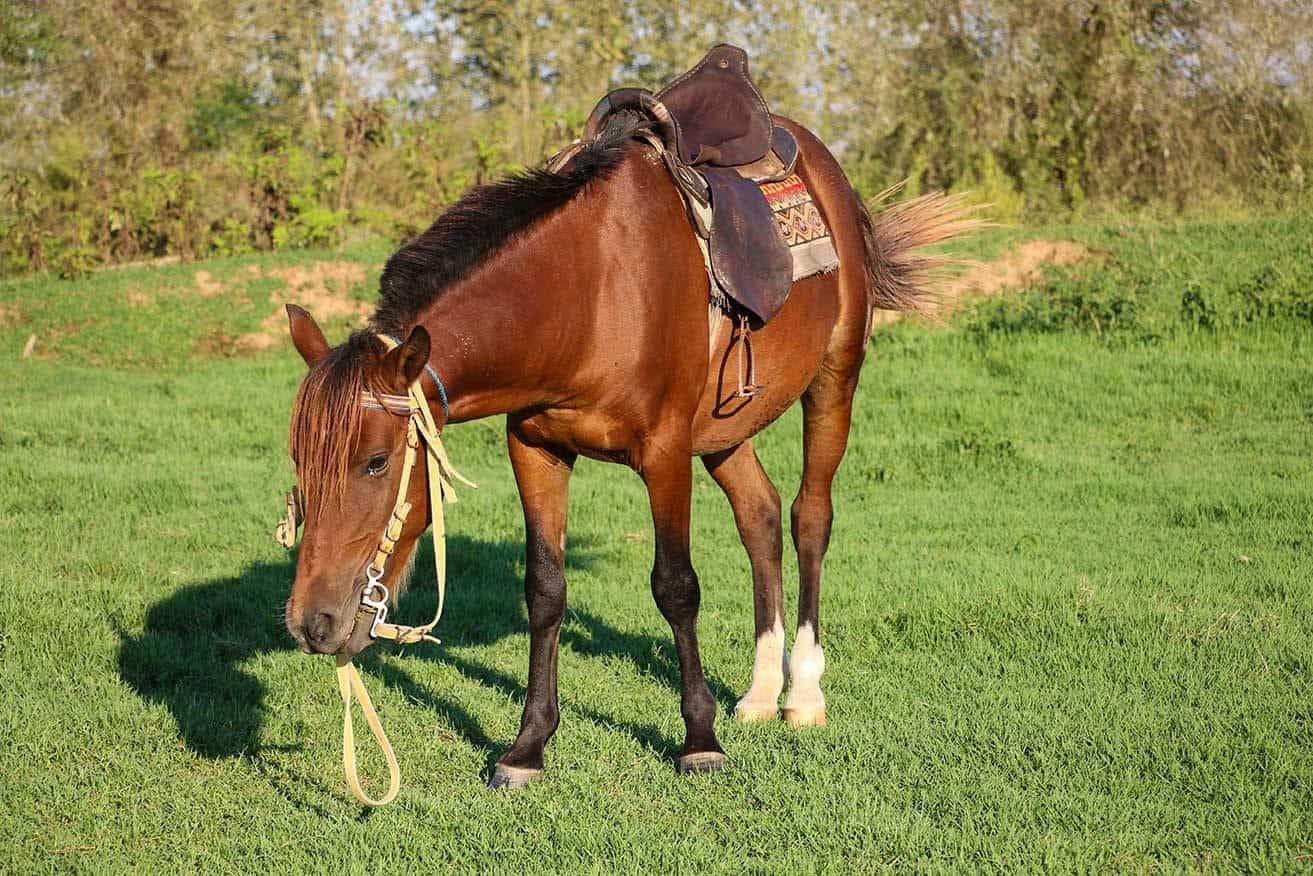
The Caspian Horse is thought to have the longest history of the miniature horses, and is possibly one of the oldest breed of horse!
The Caspian Horse, a hot blooded Arabian type, is a genetically distinct breed of miniature horse. It is closely related to the Arabian, and may be the ancestor of all modern hot blooded breeds of horses. It is possibly the most ancient miniature breed known today. It dates back 3000 years, or more, before the birth of Christ. At one time it was thought to be extinct, with only remnants of ancient artwork and documents from as early as the sixth century BC, to describe it.
It was in the mid 1960’s when an American horsewoman, Louise Firouz, brought about the recurrence and survival of this breed. She had moved to Iran with her Iranian husband that she met in college. While looking for horses for a children’s riding school she was founding there, she discovered a few classic Arabian looking very small horses near the south end of the Caspian Sea. Intrigued by the ancient lore of an extinct breed of horse, she took three back to her school, and by happy accident began the renewal of this breed.
The Caspian Horse has a delicate and refined look, but is in fact hardy and durable. They are a very energetic and social creatures and this must be considered when caring for them. They need interaction with other animals or people. and are especially well suited for children. With an easy going nature and boundless energy they make a good choice for enthusiastic children seeking a sociable companion to ride or drive.
In 2005 there were 540 registered Caspian Horses in North America, and with an active breeding program, about 75 more appear each year. Many of these are in Texas. All of the U.S. Caspians are registered with the International Caspian Horse Association and the Caspian Horse Society of the Americas. “The Caspian Horse Society of the Americas (CHSA) was incorporated May 26th, 1994 to provide an organization to promote the Caspian breed and to maintain a permanent registry in the Western Hemisphere. The CHSA is chartered under the laws of the State of Texas as a non-profit organization.”
Scientific Classification
| Kingdom: | Animalia |
| Phylum: | Chordata |
| Class: | Mammalia |
| Order: | Perissodactyla |
| Family: | Equidae |
| Genus: | Equus |
| Species: | caballus |

Horse Breeds
The Miniature Horses or Miniature Ponies should have the same proportions as a normal horse but be under 34 inches tall. They are too small to ride, but work wonderfully when hitched to a cart. They make wonderful pets, companion animals, and show animals. They can compete in everything from halter, driving, and jumping, games and obstacle courses, to conformation and showmanship.
The Mini Horse, though a bit of an odd ball, is generally considered to be a horse rather than a pony. So it is grouped with the light horses and with the ‘other’ type class.
Horse Backgrounds
The Caspian Horse dates back to 3000 years before the birth of Christ, and probably earlier. It is believed to be the horse described in ancient artwork and documents from as early as the sixth century BC. The seal of King Darius the Great (521-486 BC) depicts fine legged, dish faced horses thought to be Caspian Horses. These brave little horses were used to pull chariots in the days of the Persian Kings, valued highly because their small size allowed them to maneuver in the public arenas where they faced such dangers as captured lions.
The Islam defeat of the last Zoroastrian King began centuries of invasions and the little chariot horses became unnecessary. With the loss of the great literature of the time, the Caspian Horse was soon forgotten. Fortunately, a few managed to survive as feral horses in the Elburz Mountains, a major mountain range in northern Iran running west to east parallel with the south shore of the Caspian Sea.
In the mid 1960’s, thirteen centuries later, an American horsewoman Louise Firouz happened across them. Ms. Firouz had moved to Iran with her Iranian husband whom she met while in college. She was looking for horses for a children’s riding school she was founding there when she discovered a few classic Arabian looking very small horses. Intrigued by the ancient lore of an extinct breed of horse, she took three back to her school.
Firouz eventually managed to acquire a small herd, which was taken over by the Royal Horse Society of Iran in 1970. As the political turmoil in the region became increasingly dangerous for the Royal Family, Ms. Firouz managed to export nine stallions and fourteen mares to Europe, essentially saving the breed. In 1977 exports were stopped, and the royal families breeding herds were sold for meat and pack animals. Firouz tried again to start a foundation herd, but during the Iran-Iraq war the Revolutionary Guard confiscated them and sent them to the front lines to clear the minefields.
Fortunately, some of those horses sent to Europe made their way to the United States where they are being successfully bred. The history of this breed reads like an unbelievable Hollywood script; chock full of drama and intrigue.
Ms. Firouz passed away in 2008. Her story is told in more detail in the fascinating book by Brenda Dalton, The Caspian Horse.
Description
The Caspian Horse has been proven to be a genetically distinct breed of miniature horse with an ancient history. The face has a dished profile, small ears and a large jaw. The eyes are large and expressive. The graceful neck ties into a high wither and a straight narrow back and a tail set on high over strong hindquarters.
They stand between 10 and 12 hands high, but are true horses, not ponies. Piebald and skewbald are not allowed by the breed standard. Bay is the most common color, and many have a dorsal stripe and/or a minimal amount of white markings.
Horse Care and Feeding
They are extremely easy keepers. They have managed to survive for centuries on a minimum of forage so they are efficient eaters and need little or no grain supplement. Any supplements high in sugar or carbohydrates must be kept to an absolute minimum. They thrive on exercise and attention, and if this is provided they do well in either a stall or pasture environment.
Horse Training and Activities
Because of their small stature, riding of the Caspian should be limited to children and small adults. Caspian’s are talented at jumping, and make good small children’s hunters. They also make excellent lesson horses for children learning to ride. They are strong for their size, and they are terrific at pulling a cart or small carriage even with an adult driver. They are extremely sure footed on the trail and so make good pleasure horses.
The Caspian is gentle by nature with a kind, energetic disposition, so they also make great pets!

Common Health Problems
The most common health problem with this miniature horse is laminitis, usually due to overfeeding and under exercising.
Availability
The Caspian Horses are fairly available in the United States but are expensive.
Featured Image Credit: MAVRITSINA IRINA, Shutterstock