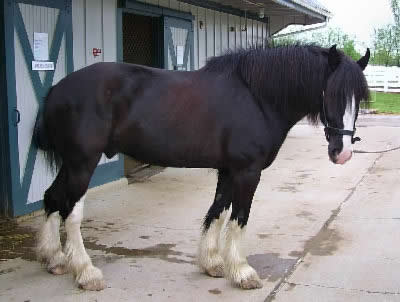
Draft Horses are very strong, heavy workhorses with a patient and docile demeanor!
Draft Horses are the largest of the horse breeds. They were bred for hard, heavy tasks like pulling heavy loads, plowing fields, and other tasks requiring a stout workhorse. They are also referred to a draught horse or a heavy horse, and are often named for the country where they originated.
The Draft horse breeds are called cold blood horse breeds in reference to their quiet and calm temperament. Heavy horse breeds weigh 1600 pounds or more. They stand about 15.2 to 20 hands high from the ground to their withers, where one hand equals 4 inches. They are slower, but much more powerful than the light horse breeds.
Draft horses are tall in stature, heavy boned, and extremely muscular. They have a shorter back and strong hindquarters. Their shoulders tend to be more upright, making their movement and conformation well suited for pulling. Many of the heavy horses have long hair called ‘feathering’ on their lower legs. The head profile is either straight or one that is convex, giving the “Roman nose” appearance.
There are a numerous heavy horse breeds. They varying in size and other characteristics, but all share some important traits that have made them invaluable in their service to man. They are very strong and patient, making them an excellent workhorse. They are used for farm work and commercial carriage horses.
The personality of the Draft horses is sweet tempered. They have a natural curiosity and willingness to learn, which has led to their being well suited to a variety of pursuits. For pleasure they are used for driving, trail riding, parades, and showing. Draft horses make wonderful companion horses and are favored for their docile demeanor.
Learn about all types of horse breeds
Draft Horses–Light Horses–Ponies
Horse Backgrounds
The use of Heavy Horses throughout history has been a critical aid in the civilization of man. The Draft Horse is well known as a workhorse. The familiar names of Draft Horse, Draught Horse, and Dray Horse describe these horse by what they were developed for, pulling a heavy load. Individual draft horse breeds are often named for the country where they originated.
The term ‘draft’ is defined as the act of pulling loads or something that is pulled or drawn. However it can actually apply to any animal that is used to pull or draw loads, such as dogs, oxen and other farm animals, as well as other smaller horses. “Dray” is a similar term, derived from the Anglo-Saxon term for to haul or to draw.
The heavier draft horse was developed from the bulkier type of equine found in the northern hemisphere. These hardy horses evolved to survive in a colder harsher climate. They are much heavier and broader than the light horses. The modern draft horse is believed to have the bloodlines of these earlier large equines. In the middle ages, horses of great strength and stamina became popular war horses, being easily able to carry a heavily armored knight into battle. As early as the roman times, Europeans used huge types of horses for heavy labor. They were used for pulling heavy loads in cities as well as for farm work.
Into the 1900’s the draft horses were used for practical work pulling wagons and plowing fields. Large farm horses demonstrating a calm, constant and unemotional temperament were used for pulling military wagons. After World War II and the development of the internal combustion engine, the need for draft horses diminished greatly. Many were sold to slaughter houses and the number of breeds began to drastically decline. Since the later part of the 1900’s, dedicated breeders have begun efforts to pull a number of breeds back from the brink of extinction.
Draft Horse Breeds
Today Heavy horses are still used on small farms, but they are most often seen by the public at shows. They are popular in pulling competitions and as show animals. Individual draft horse breeds are often named for the country where they originated.
The Belgian Draft horse is probably more plentiful than any other breed In the United States. It is still used on small farms as well as being shown publicly in Draft shows and pulling contests. The Percheron, which probably has the closest ties to the Medieval war horse, is another regular, doing work as well as seen publicly in Draft shows, pulling contests and jumping. The Shire, too, will often be a regular in draft shows and riding shows. But perhaps the most familiar of these Draft breeds is the Clydesdale, being represented by the highly publicized and famous Annheiser-Busch teams.
Popular Heavy horses found in North America include:
- Clydesdale
- Belgian
- Percheron
- Suffolk Punch
- Shire
- American Cream
- Spotted
- French Mulassier.
Draft horses breeds common in Europe, but not in North America include:
- Comtois
- Rhinelander
- Auxois
- Avelignese
- Ardennes
- Australian Draught Horse
- Boulonnai
- Breton
- Dutch Draught
- Dole Gudbrandsda
- Irish Draught
- Pinzgauer Noriker
- Trait Du Nord.
Equestrian Disciplines
Draft horses are adaptable to many situations and types of work. They lend themselves well to a variety of pursuits. As a workhorse they are used for farm work and commercial carriage horses. They have a graceful elegant style and are often exhibited in parades and used for showing.
Though most Draft horses are used for and excel at driving, they can also be ridden. People use them for trail riding and dressage. Some of the lighter breeds perform well under saddle and many are capable jumpers. With their calm personalities some are used for therapeutic riding programs, helping people with disabilities learn to walk by the feel of the horse’s movement. Draft horses are often crossed with lighter breeds to create a large light horse. By adding the strength of the draft horse, it creates a durable competitive sport horse.
Horse Care
The Draft horse is gentle natured with a sweet personality. There are a number of different breeds, with varying characteristics, but all share the common traits of strength, patience and a docile temperament. They are proud, alert, and intelligent and they are noted for having common sense. With a natural curiosity and willingness to learn, Draft horses make wonderful companion horses.
- Feeding:
Draft horses are big eaters. They will consume about twice as much as other horses They can easily eat about 25 to 50 pounds of hay a day, plus about 5 pounds of concentrated feed if they are being exercised. - Housing:
Because of their size, the draft horse needs a very large stall if kept inside. They need more room than other horses, for example a 24′ x 24′ stall would be the minimum size for a Clydesdale. If kept indoors they need to be turned out into a paddock daily.They will do very well in a pasture or on dry lot. - Ailments:
Most Draft horses are easy keepers. They are not particularly prone to health problems. Good grooming is essential, however, as their coats can get heavy in cold climates. Also the hair around their ankles can attract bacteria in the soil, making them susceptible to “scratches” or pododermititis. This problem is more prevalent in horses that are subjected to wet muddy conditions for extended periods of time. Horses with white feet seem also to be more susceptible to scratches.
References
- Animal World References – Horse Breeds
- Bonnie L. Hendricks, Anthony Austen Dent , International Encyclopedia of Horse Breeds, University of Oklahoma Press, (1995) 2007
- Maria Costantino, The Handbook of Horse Breeds, Barns and Noble, 2004
- John Diedrich, The Clydesdale Horse, Capstone Press: Mankato, Minnesota. 2005
- Draft horse, Wikipedia, The Free Encyclopedia