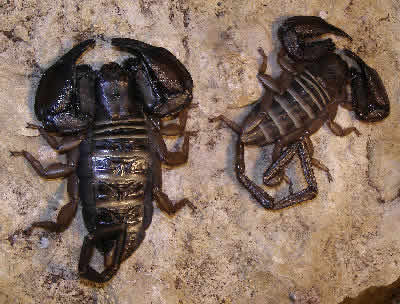
The Flat Rock Scorpion is one of the most fascinating and primitive scorpions in the world!
The Flat Rock Scorpions Hadogenes spp. are intriguing novelties. These species, found only in Africa, are the longest, and possibly the heaviest species of scorpions in the world. Males can reach over over 8″ (21 cm) while female typically reach between 6 to 7″ (15-20 cm) or more. The heaviest specimens can weigh up to 32 grams and these are probably some of the longest lived scorpions.
Flat Rock Scorpions come in many different color variations, dark or light color tones of browns, reds, and yellows to blacks, grays, greens and blues. Yet even more fascinating is their distinctive body shape. They are adapted to live in narrow cracks and crevices of rock piles. These scorpions have a wide, flat head and segmented body with big, flattened claws. They have stiff bristles over the body and a very long, spindly tail tipped with a small vesicle (sting).
There are approximately eighteen Hadogenes species with several found in the pet trade. Probably the best known is the Giant Flat Rock Scorpion H. troglodytes. Others familiar species include the Olive Keeled Flat Rock Scorpion or Banded Flat Rock Scorpion H. paucidens and the Giant Banded Flat Rock Scorpion H. bicolor.
South African Flat Rock Scorpions make an ideal pet for the beginner and advanced enthusiast alike. They almost never sting, though they may pinch. They live a long time, are hardy, and require very little maintenance.
For more Information on keeping scorpions, see:
Keeping Arachnids and Other Arthropods as Pets
- Kingdom: Animalia
- Phylum: Arthropoda
- Class: Arachnida
- Order: Scorpiones
- Family: Ischnuridae
- Genus: Hadogenes
- Species: troglodytes
Scientific Name
- Hadogenes bicolor – Purcell, 1899
- Hadogenes longimanus – Prendini, 2001
- Hadogenes newlandsi – Prendini, 2001
- Hadogenes polytrichobothrius – L. Prendini, 2006
- Hadogenes soutpansbergensis – L. Prendini, 2006
- Hadogenes angolensis – Lourenço, 1999
- Hadogenes bifossulatus – Roewer, 1943
- Hadogenes gracilis – Hewitt, 1909
- Hadogenes granulatus – Purcell, 1901
- Hadogenes gunningi – Purcell, 1899
- Hadogenes lawrencei – Newlands, 1972
- Hadogenes minor – Purcell, 1899
- Hadogenes paucidens – Pocock, 1896
- Hadogenes phyllodes – Thorell, 1876
- Hadogenes taeniurus – Thorell, 1876
- Hadogenes tityrus – Simon, 1888
- Hadogenes zumpti – Newlands & Cantrell, 1985
- Hadogenes trichiurus
- Hadogenes trichiurus trichiurus – Gervais, 1843
- Hadogenes trichiurus caffer – Hewitt, 1918
- Hadogenes trichiurus gracilioides – Hewitt, 1918
- Hadogenes trichiurus pallidus – Pocock, 1898
- Hadogenes trichiurus parvus – Hewitt, 1925
- Hadogenes trichiurus werneri – Fet, 1997
- Hadogenes trichiurus whitei – Purcell, 1899
- Hadogenes troglodytes
- Hadogenes troglodytes troglodytes – Peters, 1861
- Hadogenes troglodytes crassicaudatus – Hewitt, 1918
- Hadogenes troglodytes dentatus – Hewitt, 1918
- Hadogenes troglodytes letabensis – Werner, 1933
- Hadogenes troglodytes matoppoanus – Hewitt, 1918
- Hadogenes troglodytes zuluanus – Lawrence, 1937.
Habitat: Distribution/Background
The first of the Flat Rock Scorpions Hadogenes troglodytes was described by Peters in 1861. These scorpions are endemic to Africa, and are found across a wide range of southern Africa. Other common names they are known by are South African Flat Rock Scorpions.
Familiar Flat Rock Scorpion species include:
- Flat Rock Scorpion, Giant Flat Rock Scorpion Hadogenes troglodytes
This Flat Rock Scorpion is the best known of its species, and has the longest recorded body length of any scorpion. - Olive Keeled Flat Rock Scorpion, Banded Flat Rock Scorpion Hadogenes paucidens
Olive Keeled Flat Rock Scorpion is distinguished by the yellowish edges on each segment (tergite) of its body, giving it a striped appearance. - Giant Banded Flat Rock Scorpion Hadogenes bicolor
The Giant Banded Flat Rock Scorpion is bluish in color with yellowish colored chelicerae (mouth parts), legs and telson (middle lobe of the tail).
Status
The Hadogenes spp. are not on the IUCN Red List for Endangered Species. However one species, Hadogenes gracilis has a very restricted range in Mapumalanga and is possibly threatened with extinction because of mining destroying its habitat.
Description
The South African Flat Rock Scorpion is the longest and possibly the heaviest species of scorpion in the world, weighing up to 32 grams.. It has a strange, flattened segmented body (mesosoma), wide flattened head (prosoma), flattened claws (pedipalps), slender tail tipped with a small vesicle (sting), and stiff bristles over its body – all pointing to its lifestyle of living in the cracks and crevices of rock piles in its native Africa.
The Flat Rock Scorpion is sexually dimorphic. Males are easily distinguished from females due to a longer tail. Males show extreme elongation of the metasomal segments of the tail. This helps in not only making them longer than the female, but also makes this one of the largest and longest species in the world. They often keep these tails coiled around and close to their bodies. Some males have been reported to reach over can reach over 8″ (21 cm), while a female typically reaches between 6 – 7″+ (15-20 cm).
There are many different color varieties ranging from browns, reds, and yellows to blacks, grays, greens and blues in either a dark or light color forms. They can be very long lived, having a lifespan of up to 30 years or more in captivity.

Food and Feeding
In the wild, South African Flat Rock Scorpions feed almost exclusively on mollusks, but in captivity will switch fairly well to crickets and other insects including wax worms and mealworms.
Housing
This South African species is considered a lithophilic, or rock-dwelling species. Its long legs and compact body, with stiff setae and strong claws, help it to scurry quickly over rocks and stones in its rocky home. In nature, it is commonly found under stones in scraped out areas in the substrate.
They can be kept individually in a 5 to 10 gallon terrarium with a 3 – 4″ (8 – 10 cm) sand/soil substrate. Provide some sort of a shelter for them, ideally flat rocks such as slate can be used. Alternatively a piece of wood such as sheet of cork bark or similar shelter can be used. Also include a shallow bowl of water.
The Flat Rock Scorpions are agile climbers so be sure the enclosure has a secure covering, preferably of glass.
Temperature and humidity requirements:
The Flat Rock Scorpion is semi-aggressive. Though babies can be kept communally with the mother for several weeks, adults are best kept individually.
Cage Care
A good habit to get into is cleaning up any uneaten prey items the day after feeding your scorpion as decaying organic matter commonly attracts mites, fungus, mold and other potentially harmful organisms into the enclosure. If your pet has recently molted, remove uneaten prey items immediately. Newly molted scorpions are vulnerable until their exoskeletons hardens.
Behavior
The Flat Rock Scorpion is semi-aggressive. Though babies can be kept communally with the mother for several weeks, adults are best kept individually.
Handling
Flat Rock Scorpions seem somewhat reluctant to sting and like Emperor Scorpion, tend to use their strong claws to pinch as a defense. They don’t seem to enjoy being handled and will try to escape by crawling off the hand using its strong legs and even pushing with its long tail. As with most invertebrate pets, keep handling (and thus stress) to a minimum.
Reproduction
Females Flat Rock Scorpions, though as large and robust in body as the males, have tails that are much shorter than those of the males. The male quickly grasps the pincers of the female and begins a shaking action known as “juddering”. Then, after a short shoving match, the male deposits a spermatophore onto the substrate and positions the female over the packet of sperm. The female lowers her abdomen and picks up the spermatophore into her genital opening. The two separate and often beat a hasty retreat in opposite directions.
A strange habit is noted in the reproduction of the Flat Rock Scorpion species H. troglodytes. This species, perhaps as a water conservation measure in its dry, arid habitat, does not produce a great deal of the moisture that is normally associated with the birth membranes of baby scorpions. Thus, the “ease” of birth is seemingly compromised and the birth of the twelve to eighteen small scorpions can take as long as ten days.
Diseases: Ailments/Treatments
Scorpions are generally quite hardy and adaptable if they are provided with the right environment. A few signs that may indicate that your pet is not acting or feeling normal are a loss of appetite, acting listless or sluggish, having an overly swollen stomach, and missing or deformed limbs. Another problem can be an infestation of mites.
- Molting
One of the most common reasons for the death in scorpions is the molt. The scorpion has a tough outer covering, a cuticle, that forms a rigid exoskeleton. All scorpions must shed their old exoskeleton and secrete a new one in order to grow, this is called the molt. Scorpions will molt from 6 to 10 times during their lifetime. This molting process takes a lot of energy and they are very vulnerable for a couple of days after the molt until their new skin hardens
For about 24 hours prior to molting it is not unusual for a scorpion to get quite sluggish.
A difficult molt can result in lost or deformed limbs, or death. This is thought to be related to humidity levels. There can be either too much humidity or too little, depending on the species. In captivity a lot of immature scorpions die during the molting process. - Other Problems
Though many scorpions can go for long periods of time without eating, overfeeding can cause an overly swollen stomach as well as the loss of appetite, and even death. The stomach can be slightly swollen from regular eating, and this is not a problem.
Another problem can be an infestation of Mites. Uneaten food can attract mites, which are very dangerous and stressful to scorpions. Be sure to remove old food.
Availability
Currently, Flat Rock Scorpions are being imported in large numbers from Africa. Unfortunately, there have been very few captive breedings of this species. Hopefully as interest in scorpions grows, more and more specimens will be available as small, healthy captive-hatched scorpions.
References
- Animal-World Resources: Reptiles, Amphibians, and Land Invertebrates
- Russ Gurley, Tarantulas and Scorpions in Captivity, Living Art Pub, Serpent’s Tale NHBD , 2005
- Philip Brownell, Gary Polis, Scorpion Biology and Research,.Oxford University Press, USA 2001
- Philippe de Vosjoli, Arachnomannia, General Care and Maintenance of Tarantulas & Scorpion, Advanced Vivarium Systems, 1991
- V. Hull-Williams, “How to Keep Scorpions”, Fitzgerald Publishing, London, UK.
- Gary A. Polis, Biology of Scorpions, Stanford University Press 1990
- Hugh L Keegan, Scorpions of medical importance,.University Press of Mississippi 1980.
- J. L. Cloudsley-Thompson, Spiders, Scorpions, Centipedes, and Mites,.Pergamon Press 1968