
The Veiled Chameleon is designed, in body shape and color changing ability, to mimic leaves!
The Veiled Chameleon Chamaeleo calyptratus, also known as the Yemen Chameleon, is an exciting chameleon to keep. These lizards are tree-dwellers designed for camouflage in both body shape and coloration to blend in with their surroundings.
Veiled Chameleons have a flattened, arched body shape that models a leaf. Males are green marked with bold bands and splotches of brown, blue and gold. Females are green with white markings, or when in breeding mode, are dark green marked with yellow and blue. They have a fascinating color changing ability, the brighter the foliage, the brighter the chameleon. The surroundings however, are just one factor that can stimulate Veiled Chameleons to change color. Other factors that affect the prominence of their color include their mood, the temperature, and their overall health.
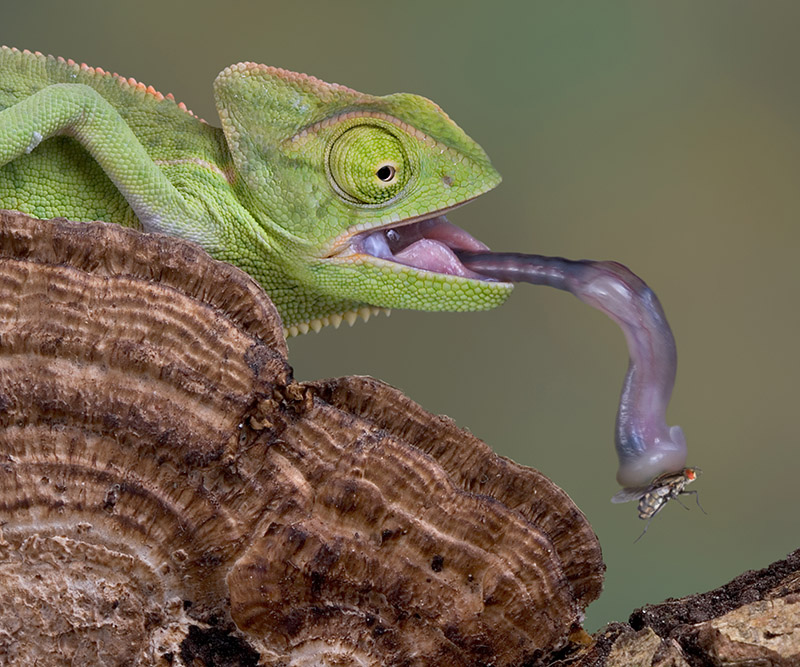
Veiled Chameleons not only have beautiful coloration, but are moderately large sized lizards. Typically males will reach up to 19″ (48 cm) in length, but they could reach up to 24″ (60 cm). Their feet are cleverly adapted to gracefully traverse leaf laden branches. Their eyes are cone shaped and can rotate and focus separately. They have a small opening at the end for the pupil, giving them keen eyesight. They are able to pinpoint small insect prey at long distances. Watching them eat and the speed at which their tongue darts from their mouths to catch prey, is astounding.
The Veiled Chameleon is generally one of the easier of the chameleon species to keep. It is tolerant of a relatively wide range of temperature conditions and has a high reproductive potential, but it does need a large space. They are also rather aggressive chameleons and should be kept alone as adults. Unlike most of their relatives this chameleon is an omnivore eating both insects and plant material.
- For more information on keeping Lizards see: Reptile Care: Keeping Reptiles and Amphibians as Pets
Scientific Classification
| Kingdom: | Animalia |
| Phylum: | Chordata |
| Class: | Reptilia |
| Order: | Squamata |
| Family: | Chamaeleonidae |
| Genus: | Chamaeleo |
| Species: | calyptratus |
Scientific Name

Habitat: Distribution/Background
The Veiled Chameleon Chamaeleo calyptratuswas described by Peters in 1870 and is also known as the Cone-head Chameleon and the Yemen Chameleon. Peters described a second subspecies, the Short-casqued Veiled Chameleon Chamaeleo calyptratus calcarifer in 1871.
The Veiled Chameleon Chamaeleo calyptratus is found in Saudi Arabia and Yemen. Veiled Chameleons were first imported into the United States in the spring of 1990. The San Diego Zoo reported eggs from a captive breeding in September of 1990, resulting in live young in 1991. This helped to establish this chameleon’s reputation of being hardy, tolerant, and easily cared for and bred.
There are two subspecies of Veiled Chameleon, the Veiled Chameleon, also called the Cone-head Chameleon or Yemen Chameleon C. c. calyptratus and the Short-casqued Veiled Chameleon C. c. calcarifer. As the common name of the second subspecies indicates, the main difference between the two species is the height of the cranial (top of head) crest or casque, with the higher crest belonging to the nominate species C. c. calyptratus.
Status
The Chamaeleo calyptratus is on the IUCN Red List for Endangered Species as Least Concern (LC). The Veiled Chameleon has a wide distribution and is adapted to many different habitats, including disturbed and human modified environments.
Description
Male Veiled chameleons always have a larger body and casque (head crest) than the females. A tarsal (heel) spur is present on males, even on hatchlings.
- Males
Males reach a total size of 12″ to 19″ by around 12 months of age and reach sexual maturity at around six months old. They are variable in color, including bold vertical bands consisting primarily of bright gold, blue, and green with yellow, orange, or black. Bicolored or tricolored males are occasionally seen. - Females
Females reach 8″ to 12″ at 12 months of age. They are usually light green with white-to-gold mottling with some light blue color on the dorsal crest. They reach sexual maturity at four to six months. - Neonates (newborns)
Newborn Veiled Chameleons emerge with a light-green coloration and measure 2″ to 3″ from nose to tail-tip. Patterns can be observed on sleeping neonates.
The Veiled Chameleons change color based upon their emotional state and the coloration of the foliage around them; the brighter the foliage, the brighter the chameleon.
Food and Feeding
The Veiled Chameleons are Omnivores, meaning that they eat insects and other invertebrates as well as plant material. For juveniles under 7 inches, crickets are the recommended food, as many juveniles have regurgitated any other offered food items. For adults, gut-loaded crickets and mealworms are eagerly accepted, as well as plant material such as live ficus and pothos leaves, and acacia fruit. Gut loading your crickets with fresh fruit, vegetables, fish flakes, and any of the commercially available gut load diets will increase their nutritional value.
With young specimens, it is important to dust the prey items with a high-quality vitamin mix, such as Herptivite or Miner-All. Keep in mind, however, that in the adult Veiled Chameleon, excess amounts of Vitamin D3 can lead to the calcification of internal organs. It is thus recommended that Vitamin D3 be provided to adults through UVB-emitting bulbs, versus the addition of a vitamin or calcium powder. The chameleons can regulate the amount of this vitamin through basking, though they cannot regulate what is on their food items.
This chameleon should be misted twice per day with dechlorinated water. Make sure to spray the leaves well, as this is how the chameleon will drink. A good dechlorinator is Repti-safe, as it also provides calcium and electrolytes.
As with any reptile, feces should be removed as soon as they are discovered. All of the substrate should be changed every three to four months. Your chameleon will most likely not have parasites as Veiled chameleons are typically only available as captive-hatched babies these days. It is a good idea, however, to keep the enclosure as clean as possible. Cleanliness is important for all captive reptiles..
Housing
Veiled chameleons are rather aggressive chameleons and should be kept alone as adults. Juveniles can be kept together until just before reaching sexual maturity.
You should give your chameleon as large a terrarium as possible with the minimum requirements for a male being 30″ wide, 60″ long, and 45″ high (measurements calculated with a 15″ male). The cage provided can be made of either a completely screened cage, or an aquarium with a screen top. These chameleons are escape artists, so a secure lid needs to be in place in any event.
Veiled chameleons do well with a mixed substrate, containing about ½ sand with ½ peat moss or Tropical Forest Bedding on the bottom (especially if you plan to grow live plants) and then a layer of sand on top for aesthetics. Calci-sand is not recommended, as there have been reported cases of calcium overload / impaction with this substrate.
Many chameleons will typically not drink out of a bowl so there is no necessity for a water bowl. Lots of climbing perches and vines, whether natural or artificial, should be provided as it is off of these leaves that the chameleon will drink. No food dish is necessary, as the prey items are best left wandering around in the enclosure.
Temperature, humidity, and Lighting requirements:
Though the ambient air temperature for the Veiled Chameleon should be in the 80’s during the day, these chameleons like a hot basking areas of 90{deg} to 100{deg}F [32{deg} to 38{deg}C] at one end of the enclosure. A basking spot can be provided by a heat lamp or heat emitter mounted outside the cage to prevent burns. The ambient temperatures should be in the 70’s at nighttime. Exposure to UV-B can be provided through full-spectrum lighting.
Veiled chameleons are adapted to be able to live in less humidity than would be normally expected of chameleons. They prefer humidity between 60% and 70%.

Cage Care
Cage maintenance is an important part of keeping reptiles healthy, and long-lived. Reptiles being kept in a confined area as pets need to be protected from harmful micro-organisms and parasites. The reptile cage needs daily and weekly maintenance. Check on a daily basis to make sure that the tank is clean. When the animal defecates, scoop out of the cage immediately.
Everything you put into their home should be washed and disinfected weekly. This includes dishes and cage decor. All of the substrate should be changed every three to four months. Never clean with a phenol such as Pine Sol. Chlorine and alcohol based cleaners are tolerated much better, but need to be thoroughly rinsed.
Behavior
The Veiled Chameleon can be quite aggressive with others of its species. It should be kept alone and out of sight of other chameleons. This can be accomplished with a visual barrier such as papering over the sides of its enclosure or simply keeping only one chameleon per room.
Handling
As with any chameleon, Veiled Chameleons can be taught to accept light handling. Children should not handle this animal without supervision.
Reproduction
The Veiled chameleon is unique among chameleons in the fact that they have specific breeding colors, instead of the displaying of more “passive” colors. The female’s passive color is light green with horizontal rows of white (or orange and yellow) patches or elongated spots. The breeding color of the female is the same but with the addition of robin’s egg blue markings along the back and tail, and with vertical streaks on the casque. Smaller blue lateral spots will be farther down on the sides of her body.
A male will brighten his colors, flatten his rib cage, and curl his tail. He’ll nod in a jerky motion and approach the female with a swinging gait. If the female is receptive, she will keep her colors and crawl slowly away. Mating will occur shortly after.
Clutch size ranges from 27 to 80 eggs every 90 to 120 days. Females will lay their eggs 20 to 30 days after mating or 90 to 120 days after the last clutch. As with many reptiles, Veiled chameleons can store sperm, meaning that they can fertilize up to two litters on average, from a single breeding.
For incubation, moistened perlite, sphagnum moss, peat moss, or vermiculite may be used, moist, but not wet. Overly-moistened substrate can cause molds and fungi to form. Eggs should be checked every two weeks or so. Incubation temperatures between 80 and 88{deg} F with a night-time drop to 74{deg} F yield offspring within 150 to 190 days. It is recommended, through thorough studies, that the eggs be placed no less than one inch apart in the incubation medium. Eggs incubated closer together hatch all at once, the first egg to hatch is believed to chemically stimulate the rest of the eggs to hatch. Research results indicate that when closer together there is only a 79% hatch rate, where as those incubated a bit more separate hatched over a 27-day period with a 95% hatch rate. The hatchlings from the more separated clutch were also larger and stronger. Two were lost from the first clutch, those closer together; and none from the second (Research performed by Petr Necas).
It is important to not remove any hatchling lizard from its egg. Premature removal from the egg takes away the neonate’s first meal; the remainder of yolk in the egg. It is normal for the babies to take up to a day from the puncturing of their egg to leaving the egg on their own. If the neonate has still not left the egg, you can increase the size of the hole in the egg, but do not remove the neonate.
Neonates (babies) will easily eat small crickets, houseflies (not blue bottle flies), and small snails. These can make up the bulk of their diet until they are 8″. Babies will commonly regurgitate waxworms and mealworms.

Diseases: Ailments/Treatments
Metabolic Bone Disease (MBD) is a common ailment seen in captive reptiles. Calcium should be offered or dusted over the food items once weekly to ensure that the chameleon consumes enough calcium. Vitamin D3 should be provided in conjunction with fluorescent UVB-emitting lighting to ensure absorption of the calcium. Respiratory infections, usually caused by constant cool temperatures, inadequate ventilation, or excessively wet substrate are treated by veterinarians with Baytril and other antibiotics.
Availability
Veiled Chameleons are available through pet stores and private breeders. Though less expensive than many of the other species, the prices for these chameleons are quite variable.
Featured Image Credit: Cathy Keifer, Shutterstock