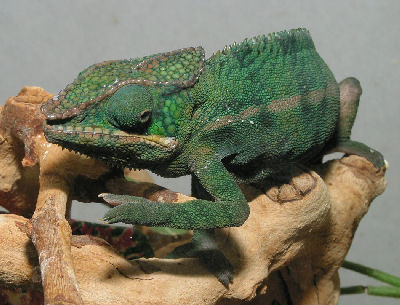
Panther Chameleons come in a rainbow of different colors, making them a joy to keep!
The Panther Chameleon Furcifer pardalis is a spectacularly colored lizard. They come in many shades and degrees of brilliant blues and greens, and even black. They can have patches of red, yellow and orange on the head, and can also have vertical bars of reds and blues. And as with any chameleon, watching their color change is always fascinating.
Panther Chameleons are moderately-sized lizards, typically males will reach about 17″ (45 cm) in length, though they could reach up to 22″ (56 cm). The males are more vibrantly colored than the females, though the coloring they have varies depending upon the region where they originate. Females, no matter what region they come from, tend to be brown or tan, sometimes with patches of pink or bright orange.
They have a friendly face and the male Panther Chameleons have slight ridges protruding from their head. They have cone shaped eyes that can rotate and focus separately on two different objects at the same time. There is a small opening at the end for the pupil, giving them keen eyesight with which they are able to pinpoint small insect prey at long distances. Watching them eat and the speed at which their tongue darts from their mouths to catch prey, is astounding.
The Panther Chameleon is amicable when it comes to handling. Captive-hatched specimens are typically hardy and relatively stress-free. They make wonderful pets for those willing to meet the chameleon’s requirements.
When Madagascar relaxed its restrictions on exporting reptiles, the Panther Chameleon was a popular export. Exportation numbers grew from 1986 to 1990 with more than 2,000 specimens being legally exported. Since this time, the Panther Chameleon has been bred in fairly large numbers by devoted reptile breeders and captive-hatched specimens are available to hobbyists.
For more information on keeping Lizards see:
Reptile Care: Keeping Reptiles and Amphibians as Pets
- Kingdom: Animalia
- Phylum: Chordata
- Class: Reptilia
- Order: Squamata
- Family: Chamaeleonidae
- Genus: Furcifer
- Species: pardalis
Scientific Name
Furcifer pardalis(Syn: Chamaeleo pardalis)
Habitat: Distribution/Background
The Panther Chameleon Furcifer pardalis was described by Cuvier in 1829. The Panther Chameleons are endemic to Madagascar. They dwell in the foliage of small trees and may be found much closer to the forest floor than many other chameleons.
Status
The Furcifer pardalis is on the IUCN Red List for Endangered Species as Least Concern (LC). The Panther Chameleon has a wide distribution across Madagascar and is common in disturbed and modified environments as well as natural habitats.
Description
The Panther Chameleon is rather large for a chameleon, varying in length from 13″ to 22″ (33 – 56 cm). The males have noticeable ridges on their heads which make up their ornamentation.
Colors vary regionally, with these differences being more obvious in the males.
- Nosey Be
Males from Nosey Be (see picture below) tend to be a blue-green in color with patches of red and yellow on the head. - Madagascar
Males from the coast of Madagascar tend to be green with vertical bars of red and/or blue. The head and tail are generally red, yellow, or orange. - Sambava
Males found to the south of Sambava (see picture below) are a dark green to black with no vertical bars. They have a lateral stripe in a lighter shade and they sometimes have a lighter dorsal crest.
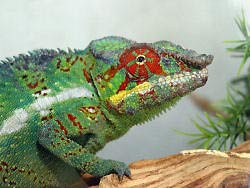 Panther Chameleon (Nosey Be)
The Panther Chameleons are sexually dimorphic, meaning that it is easy to tell the difference between males and females. The Panther Chameleons are sexually dimorphic, meaning that it is easy to tell the difference between males and females.
Females, especially when gravid, remain a gray, brown, pale orange, or faint green in color with non-distinct lateral stripes and vertical bars. When receptive to male courtship, their colors change to announce their receptiveness to the male’s advances.
Food and Feeding
Panther Chameleons are ready eaters of many commercially available prey items, including crickets, mealworms, wax worms, and newborn mice. Wax worms and mice should be fed sparingly, as diets with too many of these delicacies have been found to lead to grout.
WHLC_C1342_med.jpg) Panther Chameleon (Sambava)
Panther Chameleon (Sambava)These chameleons need to be fed two or three crickets each day with the adult intake being about 30 to 50 crickets a week. Once a week, other invertebrate prey items can be offered to add some variety to the diet.
As with most lizards, you need to supplement the food sources for your chameleon. Gut loading your crickets with fresh fruit, vegetables, fish flakes, and any of the commercially available gut load diets will increase their nutritional value. In addition to gut loading, you can dust the crickets in calcium and vitamins every few times you feed. You can also put these powdered supplements in a dish with the mealworms. RepCal and Herptivite are two excellent supplements.
Dechlorinated water should be kept available at all times. A good dechlorinator is Repti-safe, as it also provides calcium and electrolytes. The water dish should be refreshed daily.
Housing
Panther Chameleons are more active than regular chameleons and should therefore not be kept in a tree or an enclosed porch. They will often drop to the floor and wander away or into areas where they can hurt themselves. A minimum cage size of 24″ long by 18″ wide by 18″ high is necessary for an adult male. Three sides of the cage should be opaque so that the chameleon cannot see out. Chameleons will “paw” at the sides and front of a transparent terrarium, an agitated behavior that can quickly lead to stress.
Once you have your terrarium (aquariums work well, as humidity is almost impossible to maintain in the popular mesh cages), you have to select your substrate. A mix of sand and peat is a common substrate. Ecoearth, a shredded coconut bedding, works well and helps to provide humidity.The substrate should be kept moist, but not soggy. If it is kept too wet, it can easily grow mold.
Plants and branches should be provided for the chameleons to climb on and hide under. Make sure a branch is under the basking light so the chameleon can thermo-regulate.
Temperature, humidity, and Lighting requirements:
The preferred range of temperatures for Panther Chameleons is between 76{deg} and 82{deg} F. The chameleons need UV-B exposure daily, as well as a basking light at one end of the cage. Exposure to UV-B can be provided through fluorescent light for one hour a day, provided the light is no more than 30 cm away from the animal. The basking light should provide temperatures within the accepted range.
The humidity should be maintained at around 70%. The water bowl can be used to help humidify the cage. Flukers (and other companies) produce a bubbling bowl that will put more moisture into the cage. If your humidity is not quite up to 70%, mist the enclosure, especially the leaves of the plants inside, daily. If the humidity is still too low, a humidifier might be necessary.
Cage Care
Cage maintenance is an important part of keeping reptiles healthy, and long-lived. Reptiles being kept in a confined area as pets need to be protected from harmful micro-organisms and parasites. The reptile cage needs daily and weekly maintenance. Provide fresh food and water in clean dishes everyday. Check on a daily basis to make sure that the tank is clean. When the animal defecates, scoop out of the cage immediately.
Everything you put into their home should be washed and disinfected weekly. This includes dishes and cage decor. All of the substrate should be changed every three to four months. Never clean with a phenol such as Pine Sol. Chlorine and alcohol based cleaners are tolerated much better, but need to be thoroughly rinsed.
Behavior
Panther Chameleons do best when kept individually in moderately sized (18″ by 18″ / 24″ by 18″) enclosures. There is some controversy about males and females being kept together. Sometimes, even being in continuous sight of a male will stress the female to the point of not eating. She will then starve to death, often even refusing to be force fed, though accepting liquid supplements such as Hydro-life.
Females can usually be kept together, and juveniles can be kept with others of their same age. For breeding purposes, a male can be established in a larger cage (24″ by 24″ or larger) and the female can be introduced for breeding and then removed.
Handling
Panther Chameleons will quickly warm up to gentle handling. If you are nervous at first, hold the chameleon over the terrarium so it can easily return to a branch or plant within the cage or over another soft surface. Be careful not to handle your chameleon in colder temperatures, or limit the length of exposure to the cold so that they can warm up again.
Reproduction
When trying to see if the female Panther Chameleon will be receptive, observe her colors. When her color brightens and her patterns disappear, especially when not in the presence of a male, she is ready to mate. Typically, the female is introduced into the male’s enclosure when a keeper feels that the two are healthy, conditioned well, and the female is receptive. The pair can remain together until they have mated a few times or until the female displays a non-receptive color.
At three to six weeks after copulation, the female grows restless. At this time add a dish of egg-laying medium (peat moss and sphagnum moss mixture, vermiculite and peat moss, or others) from 6″ to 12″ (15 – 30 cm) deep. Do not allow insects access to the egg-laying container, as they can disturb the female causing her to abandon her egg-laying process. The eggs take between seven and ten months to hatch at 65{deg} to 78{deg} F (18 – 25{deg} C).
The neonates (baby chameleons) may not leave the egg for a day or two after splitting the shell. Do not disturb them at this stage, as they are absorbing the yolk which will make up their first meal. Do not attempt to assist them out of their egg, as this can cause them to leave the egg without first absorbing the yolk. Let them come out on their own, which they will do soon enough. They will adapt to a 2-gallon enclosure with no substrate and ample climbing branches easily.
Diseases: Ailments/Treatments
The Panther Chameleon is fairly hardy in captivity with relatively few problems if kept properly. Some of most common problems encountered with Panther Chameleons include gout, Vitamin D3 and calcium deficiencies, electrolyte deficiency, metabolic bone disease (MBD), acidosis, and alkalosis. All of these can be avoided with proper care and nutrition, and a good clean environment.
Availability
Panther Chameleons are available through wholesalers and private breeders in the $150 to $425 price range depending on age, locality, and sex.
References
- Animal-World References: Reptiles, Amphibians, and Land Invertebrates
- F. LeBerre, R. D. Bartlett, and P. Bartlett, The Chameleon Handbook. Barron’s Educational Series, Inc. 2005
- P. Necas, , Chameleons: Nature’s Hidden Jewels. Edition Chimaira / Serpents Tale, 2004
- L.J. Davison, Chameleons: Their Care and Breeding. Hancock House Publishing, 1997
- P. de Vosjoli and G. Ferguson, Care and Breeding of Chameleons. Advanced Vivarium Systems, 1996
- J. Martin, Masters of Disguise (A Natural History of Chameleons). Facts On File, Inc., New York, 1992