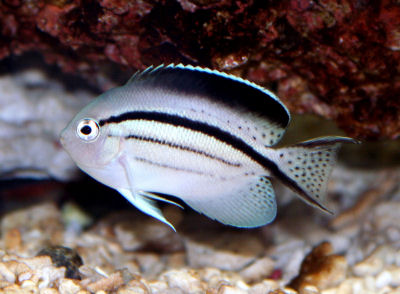
The Lamarck’s Angelfish is a pretty Swallowtail Angelfish that is reef safe and very durable!
The Lamarck’s Angelfish Genicanthus lamarck is one of the delicate looking swallowtail angels from the Genicanthus genus. These beautiful fish are almost teardrop-shaped, with long flowing filaments extending off the tail fin of the males. They are a good sized angelfish, reaching up to 9.8 inches (25 cm). Other common names they are known by are quite descriptive including Blackstriped Angelfish and Freckletail Lyretail Angelfish.
They lack the vibrant colors found on many angelfish species, but they have a unique beauty of their own created by a strong black and white patterning. It’s pretty white body is contrasted with up to six horizontal black stripes. The top dorsal fin is also black and there’s black spotting to the rear, on the fins and the tail. On females, the wide uppermost black stripe makes a graceful arc across the body. It crosses down over the caudal peduncle and out along the lower part of the tail fin, and is complemented by another black stripe on the upper part of the tail fin. Males lack the arcing crossover stripe of the female, rather their stripes are thin and horizontal.
This is one of the hardier angelfish and moderately easy to keep. It’s a great choice fora beginner that can provide a large enough tank. This fish will need an aquarium that is at least 75 gallons or more with lots of open areas for swimming. But it is somewhat shy, so will need rockwork formed to create plenty of caves and hiding places. In a tank of 100 gallons or more they can be kept in pairs or in a small group with a ratio of one male to several females. Females are not aggressive toward each other but two males will spar. Eventually one of the males will then revert to a female.
The swallowtail angelfish from the Genicanthus group are the only angels that are zooplanktivores, meaning they eat tiny invertebrates that float freely in the water column. Thus they spend time during the day free swimming in open waters, hiding as needed and taking refuge in the coral reefs at night. They will easily accept food particles in the aquarium water so are easy to feed. They also rarely feed on corals or other sessile invertebrates, so are an ideal candidate for the reef aquarium as well.
Get a healthy angelfish right at the start and you will be rewarded with a durable, attractive, and long lived aquarium pet. When obtaining this angelfish be sure to observe it closely to choose a healthy specimen. Do not select a specimen that swims head down or wedges itself between rocks instead of swimming. This indicates a swim bladder issue and those fish should be avoided. Also avoid fish with fins that are tattered or that have any redness on the skin or fins.
For more Information on keeping saltwater fish see:
Marine Aquarium Basics: Guide to a Healthy Saltwater Aquarium
Shows two Lamarck’s Angelfish with one starting to show signs of becoming a male.
- Kingdom: Animalia
- Phylum: Chordata
- Class: Actinopterygii
- Order: Perciformes
- Family: Pomacanthidae
- Genus: Genicanthus
- Species: lamarck
- Aquarist Experience Level: Beginner
- Aquarium Hardiness: Moderately hardy
- Minimum Tank Size: 75 gal (284 L)
- Size of fish – inches: 9.8 inches (24.99 cm)
- Temperament: Peaceful
- Temperature: 72.0 to 81.0° F (22.2 to 27.2° C)
- Range ph: 8.0-8.4
- Diet Type: Omnivore
- My Aquarium – Enter your aquarium to see if this fish is compatible!
- Beginner Fish – Saltwater fish for beginners
- Community Fish – Peaceful Saltwater fish
- Hardy Fish – Hardy Saltwater fish
- Similar size fish – Fish that are 1 inch bigger or smaller
- Coldwater Fish – Looking for cold water fish? (65 °)
Habitat: Distribution / Background
The Lamarck’s Angelfish Genicanthus lamarck was first described by Lacepede in 1802. This angelfish is a member of the Pomacanthidae family of the Genicanthus genus, known as the Swallowtail or Lyretail Angelfish. It is on the IUCN Red List as Least Concerned (LC) with a stable population. The common names it is known by include Blackstriped Angelfish, Freckletail Lyretail Angelfish, Lamark Angelfish, and Black Striped Angelfish, yet the most common name is Lamarck’s Angelfish.
The Lamarck’s Angelfish is found in the Indo-West Pacific from the Indo-Malayan regions and eastward to Vanuatu, then from southern Japan south to the Great Barrier Reef in Australia. They are unique in that they live in a wide variety of habitats.Habitats theyare found in include coastal reefs, which at times has very turbid conditions, reef crests, and deep reefs near steep slopes.
They are found in depths from 33 to 131 feet (10 – 40 m) living alone or in small or large groups, as well as pairs in areas wherethere is a low population. They feed in the water column on zooplankton during the day which can consist of diatoms, tiny crustaceans, protozoans, and the eggs and larval stages of other animals.
- Scientific Name: Genicanthus lamarck
- Social Grouping: Pairs – They are found alone, in small or large groups, or as pairs in areas where there is a low population.
- IUCN Red List: LC – Least Concern – Stable population.
Description
The Lamarck’s Angelfish are very different in shape than most angelfish. They have an almost teardrop shape body with the head area being more rounded, then it tapers back nearing the tail fin. As with the Swallowtail Angelfish or Lyretail Angelfish, their tailfin is crescent shaped. They grow to a maximum length of 9.84″ (25 cm). The lifespan of this species is not known, but the average lifespan of angelfish is 10 to 15 years with proper care.
The male and female have slightly different patterning. They are both white with 3 to 6 horizontal black stripes, one black stripe running along the top of their dorsal fin, and a crescent shaped tail fin. Both males and larger females have a yellow spot on the top of the head that can either fade or become brighter during social interactions.
- Females
On females, the wide uppermost black stripe makes a graceful arc across the body. It crosses down over the caudal peduncle. Her tail fin is trimmed top and bottom in a wide, more prominent black edging. The rest of her crescent shaped tail is a whitish transparent color with black to brown speckles. The female lacks the blue spot at the pectoral fin base that is seen on the male. - Males
Males lack the arcing crossover stripe of the female, rather their stripes are thin and horizontal. The upper and lower edges of the male?s tail fin is lined in blue, with a very thin black edging. The rest of the crescent shaped tail has a purplish transparent color and black speckling. The male has longer tail fin streamers than the female, and a blue area at the base of his pectoral fins.
- Size of fish – inches: 9.8 inches (24.99 cm)
- Lifespan: 0 years – The average lifespan of angelfish is 10 to 15 years.
Fish Keeping Difficulty
These Blackstriped Angelfish are moderately hardy. They are suggested for a beginning marine aquarist that has a large aquarium to house them in. They can be easy to care for if you are careful to get a healthy individual who is alert and curious. They need to be fed several times a day. They also like strong water movement and need good water quality.
Do not purchase a Lamarck’s Angelfish that swims head down or wedges themselves between rocks instead of swimming. This would be a swim bladder issue and they should be avoided. Also avoid if fins are tattered or there is any redness on the skin or fins.

- Aquarium Hardiness: Moderately hardy
- Aquarist Experience Level: Beginner
Foods and Feeding
The Lamarck’s Angelfish is is an omnivore. but lIke all the Swallowtail Angelfish from the Genicanthus genus, they are zooplanktivores in the wild, meaning they eat tiny critters that float freely in the water column. In captivity they will feed on meaty foods along with some diatoms and algae in the tank.
It is important that you feed angelfish a variety of good foods; all kinds of live, frozen, and prepared formula foods. Best to feed small amounts two to three times a day times a day. You can offer finely chopped fresh shrimp and fish, frozen brine shrimp and frozen foods that have spirulina. A good formula that can be made at home consists of mussels, shrimp, squid, and spinach. There are also several good commercial foods available including Formula II and Angel Formula. Live brine shrimp or black worms and mysis shrimp can be given on occasion. It is best to feed small amounts two or three times per day. Higher temperatures may make feeding them several times a day necessary.
- Diet Type: Omnivore – Feed protein based foods that have spirulina algae added, such as those designed specifically for angelfish.
- Flake Food: Yes
- Tablet / Pellet: Yes
- Live foods (fishes, shrimps, worms): Some of Diet – Live foods can help illicit a feeding response, and can also be offered as a treat occasionally.
- Vegetable Food: Some of Diet
- Meaty Food: Most of Diet – Provide mysis, brine shrimp, finely chopped shrimp and fish.
- Feeding Frequency: Several feedings per day – Best to feed small amounts two to three times a day times a day. Higher temperatures may make feeding them several times a day necessary.
Aquarium Care
The Lamarck’s Angelfish is fairly easy to keep. They do well when provided good water conditions and are pretty hardy if that and several feedings a day are provided. Do bi-weekly water changes of 10% to 15%, or 30% monthly in the minimum sized tank.
- Water Changes: Bi-weekly – Water changes of 10% to 15% bi-weekly, or 30% monthly are recommended.
Aquarium Setup
They will do well in a typical reef setting with live rock and places to hide,but also make sure there is a lot of openarea for swimming. The Lamarck’s Angelfish live at deeper depths in the wild, and in areas with turbid waters. Provide some overhangs for them to get relief from the light in a reef until they get a chance to adjust. Also provide areas of strong water movement in the tank during the day. Using pumps on timers that can be turned off after 8 to 10 hours is suggested. Well oxygenated water is optimal. Lids are necessary as they will jump out of open aquariums on occasion.
A minimum of 75 gallons is needed for one fish. Provide water parameters of: 72-81° F, pH 8.0-8.4, sg 1.023-1.025.They can be kept in pairs or one male to several females in tanks over 100 gallons. With 2 females, one will turn to male. Juveniles to not require any special considerations.

- Minimum Tank Size: 75 gal (284 L) – A minimum of 75 gallons is needed for one fish. They can be kept in pairs or one male to several females in tanks over 100 gallons.
- Suitable for Nano Tank: No
- Live Rock Requirement: Typical Plus Hiding Places
- Substrate Type: Any
- Lighting Needs: Any – May need time to acclimate to bright reef tank conditions, so provide shelter.
- Temperature: 72.0 to 81.0° F (22.2 to 27.2° C)
- Breeding Temperature: 70.0° F
- Specific gravity: 1.023-1.025 SG
- Range ph: 8.0-8.4
- Brackish: No
- Water Movement: Moderate – Adding some powerheads on a timer can be used to provide brisk water movement during the day.
- Water Region: Middle
Social Behaviors
The Lamarck’s Angelfish are generally peaceful angels. They can be kept singly in a 75 gallon tank, or in pairs or a small group of one male to several females in tanks over 100 gallons. Females are not aggressive toward each other, but 2 males will spar, resulting in one turning back to female.
They ignore most fish, but they will chase small docile planktivores like fairy wrasses, flasher wrasses, anthias, tilefish, Chromis damselfish, fire gobies and Creole Wrasses. This makes sense, since being a planktivore, the Lamarck’s Angelfish does not want the competition. They are fine in a reef tank, making them the perfect angel for you reef lovers.
- Venomous: No
- Temperament: Peaceful
- Compatible with:
- Same species – conspecifics: Yes – Two males will fight, but one will turn to female eventually.
- Peaceful fish (gobies, dartfish, assessors, fairy wrasses): Threat – They will chase small docile planktivores such as small fairy wrasses, anthias, etc.
- Semi-Aggressive (anthias, clownfish, dwarf angels): Threat
- Safe
- Large Semi-Aggressive (tangs, large angels, large wrasses): Safe
- Large Aggressive, Predatory (lionfish, groupers, soapfish): Monitor – Safe as long as the predatory fish is not large enough to eat the Lamarck’s Angelfish.
- Threat – Angelfish will out compete slow eaters for food.
- Anemones: Safe
- Mushroom Anemones – Corallimorphs: Safe
- LPS corals: Safe
- SPS corals: Safe
- Gorgonians, Sea Fans: Safe
- Leather Corals: Safe
- Soft Corals (xenias, tree corals): Monitor
- Star Polyps, Organ Pipe Coral: Safe
- Zoanthids – Button Polyps, Sea Mats: Safe
- Sponges, Tunicates: Monitor
- Shrimps, Crabs, Snails: Safe
- Starfish: Safe
- Feather Dusters, Bristle Worms, Flatworms: Safe
- Clams, Scallops, Oysters: Safe
- Copepods, Amphipods, Mini Brittle Stars: Safe
Sex: Sexual differences
The Lamarck’s Angelfish is one of the few angelfish that displays sexual dimorphism. The male has long tail fin streamers and a blue spot at the base of their pectoral fin. Females have a wide arcing horizontal stripe that crosses over the caudal peduncle, while the males stripes are all thin with no crossover. The male and female have often been described as different species because of these differences.
Breeding / Reproduction
The Lamarck’s Angelfish has been bred in captivity, but only in a very large aquarium. A successful breeding was accomplished in a 1,300 gallon (5,000 l) display aquarium. Most home aquarists will not have a tank large enough to encourage spawning with this angelfish.
Angelfish are broadcast spawners, releasing eggs and sperm simultaneously at dusk. They dance then rise into the water column and release their eggs and sperm near the top of the water. Spawning starts before sunset with females extending all her fins as she swims next to the male. The male will go under the female and nuzzle her belly, then darts down about 2.3†to 3.9†(6 to 10 cm). The female then turns to her side and both release a white cloud of gametes containing sperm and eggs. Both males and females will mate with several others on the same evening. This constant courtship may be why they are so plentiful in the wild.
- Ease of Breeding: Moderate – They have been bred in captivity, but only in a extremely large display type tanks of 1300 gallons or more.
Fish Diseases
Lamarck’s Angelfish, like other saltwater angelfish, are prone to any disease that captive saltwater environments have to offer. They are most likely to be affected if they are stressed from inappropriate housing or tank mates. Providing an angelfish with clean water, a proper decor with places to hide, and regular feeding is the best way to prevent illness. Calm angelfish are healthy fish. If not stressed, they will have a stronger immune system to prevent infections. To avoid a condition called nutritional blindness in angelfish, which can occur around 6 to 8 months after taken into captivity, feed green leafy food that have Vitamin A, as well as making sure there is plenty of natural occurring algae in the tank.
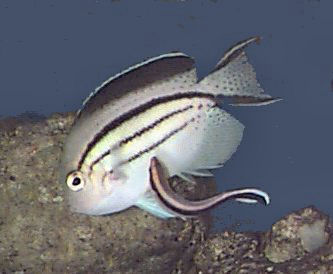 Lamarck’s Angelfish – Female being
cleaned by a Bluestreak Cleaner Wrasse Photo © Animal-World: Courtesy David Brough
White Spot Disease Cryptocaryon irritans, also known as Marine Ich, Saltwater Ich, or Crypt is the most common disease that is generally associated with marine tangs and angelfish. Symptoms of Marine Ick are constant scratching, culminating with lots of white dots. These dots disappear for a few days, only to return with double the number. This results in the fish suffocating from these parasites blocking the gills from providing oxygen.
Another common disease is Marine Velvet or Velvet Disease Oodinium ocellatum, (syn: Amyloodinium ocellatum or Branchiophilus maris), which is a parasitic skin flagellate. Symptoms of Marine Velvet are a peppery coating giving a yellow to light brown “dust” on body, clamped fins, respiratory distress (breathing hard as seen as frequent or quick gill movements), cloudiness of eyes, glancing off decor or substrate, and possible weight loss.
A viral infection, Lymphocystis, looks like small cauliflower-shaped nodules on the fins and mouth. These nodules are not harmful and come and go. The only time action may be needed is if they were on the mouth area of the fish, preventing it from eating for a prolonged period of time. It’s best to do water changes to help the fish’s natural immune system kick in.
Monogenetic flukes are the most common parasitic infections angelfish are prone to contracting. Parasites on marine fish kept with live rock or in any type of reef environment can be extremely difficult to treat. Typical treatments like copper and formalin solutions, as well as quinine based drugs are harmful to other marine creatures. However drugs such as metronidazole provide an effective and safe treatment for several protozoan and anaerobic bacterial diseases. Metronidazole works by ceasing the growth of bacteria and protozoa. Metronidazole is an antibiotic for anaerobic bacteria with anti-protozoal properties. This drug is reef safe, and medications are either added to the water or mixed with the fish food. Some available products that contain metronidazole include Seachem Metronidazole, Seachem AquaZole, Thomas Laboratories’ Fish Zole and National Fish Pharmaceutical’s Metro-Pro.
For external parasites you can slowly increasing the temperature of your tank to at least 82° F (28° C). That will prevent the parasite from completing its life cycle which includes the attachment to fish. A further combination of the higher temperatures with medicated food will provide timely relief.The Seachem Metronidazole medications works well in combination with another Seachem product called Focus, which is a bonding agent. This treatment can be used in a reef aquarium since the medication is bound to the food, which even if the corals eat, will not hurt them. Mix Focus in a ratio of 5 to 1 with their Metronidazole (5 parts Focus to one part Metro), then mix this with 1 tablespoon of food. Feed the medicated food to the fish 3 times a day for at least a week or until symptoms are gone.
Fish problems can be broken into one of (or a combination of) these types: parasites, bacterial disease, fungal disease, or physical ailments caused from deficiencies in diet as well as wounds and injuries. For more information on diseases that saltwater angelfish are susceptible to, see Aquarium Fish Diseases and Treatments.
Availability
The Lamarck’s Angelfish is readily available online and in stores, and is modestly priced.
References
- Animal-World References: Marine and Reef
- Genicanthus lamarck (Lacepede, 1802) Blackstriped angelfish , Fishbase
- Genicanthus lamarck, IUNC Red List, International Union for Conservation of Nature and Natural Resources
- Scott W. Michael, The 101 Best Saltwater Fishes: How to Choose & Keep Hardy, Brilliant, Fascinating Species That Will Thrive in Your Home , TFH Publications, 2007
- Scott W. Michael, Angelfishes & Butterflyfishes: Reef Fishes Series , Microcosm Ltd, 2004
- Scott W. Michael, Marine Fishes: 500+ Essential-To-Know Aquarium Species, T.F.H Publications inc., 1999
- Mark Allen, Roger Steene and Gerald R. Allen, A Guide to Angelfishes and Butterflyfishes , Odyssey Publishing, 1998
- Roger Steene, Gerald R. Allen, Hans A. Baensch, Butterfly and Angelfishes of the World, Volume 1, John Wiley & Sons, 1980
- Lamarck’s Angelfish, Genicanthus lamarack, Aquatic Community