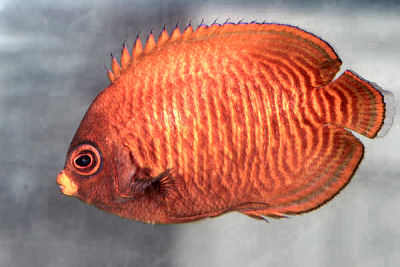
The Golden Angelfish is uncomplicated in its color pattern, but it is quite spectacular as an aquarium pet!
The Golden Angelfish Centropyge aurantia is a very pretty fish. Its coloration is very simple, but also very rich in deep orangish browns laced with golden to burnt red irregular stripes. It is one of the higher bodied dwarf angelfish, similar to a few others such as the Colin’s Pygmy Angelfish C. colini, and it too is fairly small. It will only grow to about 4 inches (10 cm) in length.
This angel was discovered in the early 1970’s when Randall and Wass were collecting several fish from an area near the reefs of American Samoa. At that time they used cyanide, a now less exceptable method of capture. During their collection they unexpectedly found dead Golden Angelfish among the other fish they were collecting. These fish are so secretive that even now some drugs may be used as a methodof capture. Sadly due to this poisoning many may die in 2 to 4 months. However if you can getyour fish to adapt to aquarium foods after a few weeks and keep it alive for more than 4 months, you can end up with a hardy little angelfish.
This dwarf angel is known by several descriptive names including Golden Pygmy Angelfish, Velvet Dwarf Angel, Golden Dwarf Angelfish, and Aurinatus Angelfish derived from its scientific name. Yet despite being dubbed as “golden” in these common names, the term “aurantia: actually means orange in New Latin rather than golden. It is similar in appearance and coloring to the Fisher’s Pygmy Angelfish Centropyge fisheri, which has an overlapping distribution. But this species can be distinguished from the Golden Angel by a dark spot near its pectoral fin.
Theseextremely shy angelfish require very stable water conditions and optimal water quality, soare best kept by advanced aquarists. They will make hardy aquarium inhabitants once acclimated but that is very challenging. They can be difficult to get eating, often refusing food until they expire.Offering many different foods to find something they will eat can cause the quality of the water to deteriorate quickly, so continued attention to water quality is very important. To keep them unstressed they also need more hiding places than what would be needed for other dwarf angelfish. They must be provided with large amounts of rock creating numerous caves and crevices for hiding places,and that will go far in helping them adjust.
A 30 gallon tank is minimum for a Golden Angelfish that is kept by itself, and maybewith very small peaceful 2″ goby companions. A 55 gallon aquarium or more would be needed to keep it with other fish like clownfish, anthias, other gobies or blennies, and a 75 gallon tank will work for a male and female pair. Only keep them with peaceful fish. These timid fellows will not do well with boisterous tank mates. The larger spaces ofbigger volumetanks allow the angel to have its own “territory†and not be as worried about its food/territory being overtaken by other fish. Otherwise stress and subsequent illness will be the result for your beautiful dwarf angel. They will swim from hiding place to hiding place and after a long while, when they have adapted, they may swim in the open during feeding.
This dwarf angelfish can be kept in a fish only aquarium, and sometimes in a reef. Many aquarists have found few problems with corals being eaten after prepared foods are accepted. Yet each individual fish will have its own nibbling tendencies, so It may or may not harm stony coral polyps. After introducing a coral, keep a close eye on it to see how your fish will behave.
For more Information on keeping saltwater fish see:
Marine Aquarium Basics: Guide to a Healthy Saltwater Aquarium
This video shows a a Golden Angelfish in a fish only tank. The fish all seem to be getting along with little aggression. These are a very cool color dwarf angelfish, sort of like a dark orange to rusty color. They do well in tanks of at least 50 gallons. This may very well be a quarantine tank with fish awaiting an obviously needed much larger tank.
- Kingdom: Animalia
- Phylum: Chordata
- Class: Actinopterygii
- Order: Perciformes
- Family: Pomacanthidae
- Genus: Centropyge
- Species: aurantia
- Aquarist Experience Level: Advanced
- Aquarium Hardiness: Difficult
- Minimum Tank Size: 30 gal (114 L)
- Size of fish – inches: 3.9 inches (10.01 cm)
- Temperament: Peaceful
- Temperature: 73.0 to 81.0° F (22.8 to 27.2° C)
- Range ph: 8.0-8.4
- Diet Type: Omnivore
- My Aquarium – Enter your aquarium to see if this fish is compatible!
- Beginner Fish – Saltwater fish for beginners
- Community Fish – Peaceful Saltwater fish
- Hardy Fish – Hardy Saltwater fish
- Similar size fish – Fish that are 1 inch bigger or smaller
- Coldwater Fish – Looking for cold water fish? (65 °)
Habitat: Distribution / Background
The Golden Angelfish Centropyge aurantia was first described by Randall and Wass in 1974. They are found in the Western Pacific from the northern Great barrier Reef to Samoa, which includes Indonesia and Belau. In the Western Pacific they occur in American Samoa and are also found in Papua New Guinea, the Solomon Islands, northern Great Barrier Reef of Australia, Palau and Pohnpei. In Indonesia it as been recorded from various localities including Sulawesi, Bali, Lombok, Komodo and Flores. In Pohnpei and Palau of Micronesia it is rare and these islands also are very distant.
Randall and Wass first described this angelfish when they were collecting many fish species with drugs on the reefs of American Samoa. At first they did not notice its existence while they were diving in the field until they unexpectedly found dead specimens as they were collecting. This species is on the IUCN Red List as Least Concern (LC) as this dwarf angelfish has a wide distribution and presumably a large population. There is limited collection for the pet industry but there are no major threats currently identified.
Other common names it is known by are Golden Pygmy Angelfish, Velvet Dwarf Angel, Golden Dwarf Angelfish, and Aurinatus Angelfish. The term “aurantia” means orange in New Latin, which probably referred to the more vibrant color morph. Other colors that are darker or lighter do vary, but it is possible the vibrant orange color was one of the first colors seen. Other colors that are closer to brown have a gold look to it, thus may be how the common names arose.
These dwarfs are found in deeply hidden reef crevices, in beds of coral rubble or swimming among sponges and branching stony corals on seaward reef slopes. In northern Sulawesi, they live in large monotypic stands of Porite coral that have fused columns. Depths that they are found range from 9.8 to 197 feet (3 – 60 m), and typically feed on algae, some coral polyps, sponges and diatoms. Like other Centropyge, in their natural habitat they may be found alone, but are more than likely found in pairs or in small harems. This is not confirmed in the wild since these are very cryptic fish.
- Scientific Name: Centropyge aurantia
- Social Grouping: Varies – Are found solitary but may, like other Centropyge, form pairs or harems from 3 to 7 individuals.
- IUCN Red List: LC – Least Concern – A stable population.
Description
The Golden Angelfish has the typical shape for dwarf angels. It has a small elongated oval shaped body, though it is relatively deep bodied, and has rounded fins. The species has a relatively higher body that can be seen in the head area (less pointed head area). It is similar in shape to the Peppermint Angelfish C. boylei, Colin’s Pygmy Angelfish C. colini, Barred Angelfish C. multifasciata and Purplemask Angelfish C. venusta. It reaches almost 4 inches (10 cm) in length. This Angelfish will live 6 years in the wild, but may live for 10 or more years in the aquairum with good care.
This dwarf angelfish is uniformly orange to brownish orange with numerous vertical contrasting yellow, orange or burnt red striping. The striping and main body color are the same tone throughout the body. The face and head are sometimes slightly darker. The dorsal, anal and tail fin have the same striping as the body, except the stripes run parallel to the body instead of vertically. The pectoral and pelvic fin are solid and typically the darker of the two colors seen on the body or can be clearish, depending on the specimen.
Dr. Bruce Carlson (former director of Waikiki Aquarium) photographed one specimen in the Solomon Islands that was completely dark orange (B. Carlson, pers. comm.; H. Tanaka, 1999). There was also a blackish specimen that turned to normal coloration in a few weeks in an aquarium (R. Pyle, 1993).
At first glance this species can be confused with some color variations of other common dwarf angels when they are void of purple color. These include color morphs of the Coral BeautyCentropyge bispinsus, Rusty AngelfishCentropyge ferrugatus, and the Shephard’s AngelfishCentropyge shelpardi. What sets the Golden Angelfish apart is the fact that their two colors are continuous throughout, not fading or changing color or pattern on the body. The irregular striped patterning is continuous throughout the body (with the exception of the darker face area) and does not change,nor is itinterrupted at the belly area.
- Size of fish – inches: 3.9 inches (10.01 cm)
- Lifespan: 6 years – In the wild they live about 6 years, but can live up to 10 years or more in captivity.
Fish Keeping Difficulty
This species is more difficult to keep than other dwarf angelfish and should only be attempted by advanced aquarists. This is a result of the way they are typically captured, which is with cyanide poisoning. This poison inhibits oxygen from transporting easily by the fish’s blood, which damages their digestive tract and harms liver function. According to one source, of all the fish caught in this manner 90% will die. Findinga speciemennot collected with poisoning can be a challenge, but it is worth it.
Special care is needed to get this fish to eat when you first acquire it. They often refuse foods for a long time and in some cases a fish will eventually starve itself to death. The aquarist must be just as stubborn and not give up trying various foods. Once acclimated and eating, it will show itself when being fed. Pristine and highly oxygenated water is very important for success, and many hiding places need to be constructed for them to feel secure.
It is a very shy species and needs many crevices to hide even as an adult. It is best kept alone in the beginning. Take care to keep this shy dwarf only with peaceful fish, since aggressive fish will only cause the angelfish to hide all day and not come out for food and will starve. This is true even after acclimation. Once this angelfish is successfully acclimated it will become fairly hardy pet. It may harm polyps of some stony and soft coral species, so it is not recommended for reef-type aquariums unless closely monitored.
Being a deepwater fish, this species is prone to suffering from decompression maladies. When selecting a specimen make sure you choose one that swims normally and does not have a hard time adjusting its place in the water column. The belly should not be pinched in, as this would indicate it has not been fed in quite a while. The specimen you acquire should meet these basic criteria and should be eating at the store.
“The first time I saw this lovely fish was on Bali Island, Indonesia while I was traveling with my wife in February, 1990. It was sold as Engel Melah (meaning Black Angel in Indonesia) at a dealer in Denpasar, in the center of the island. They held literally hundreds of tanks of marine fishes and export them mainly to the Mainland USA. Information with photos and videotapes of this specimen were provided to Richard Pyle and he wrote a popular article on this pretty pet in detail in 1993. I have kept ten specimens of 4.5-7cm long and many of them refused any food, a few did well, and one lived for nearly 2 years.” Hiroyuki Tanaka
- Aquarium Hardiness: Difficult – Most of the Centropyge members are very colorful but unfortunately some, like this species, are rather difficult to keep for a long period.
- Aquarist Experience Level: Advanced
Foods and Feeding
The Golden Angelfish is an omnivore. Feeding them several times a day and offering a variety of good foods is important even with amply algae in the tank. Provide a varied diet consisting of dried flakes, frozen prepared diets for sponge and algae eaters, and some meaty foods like mysis shrimp, fortified brine shrimp, and meaty crustaceans such as shaved shrimp and clams. There are several good commercial foods available including Formula II and Angel Formula.
To encourage a feed response, try cracking open a clam or other marine flesh. Once it is successfully adjusted to aquarium foods, it will become a hardy fish. if it is a tiny juvenile provide it with foods three to four times everyday. When it is full grown, if there is plenty of natural foods in the tank feed at least twice a day, but more if it feeds primarily on offered foods.
- Diet Type: Omnivore – Feed products that have sponge material and spirulina added.
- Flake Food: Yes
- Tablet / Pellet: Yes
- Live foods (fishes, shrimps, worms): Some of Diet – You can feed live foods like mysis shrimp and clam meat to illicit a feeding response.
- Vegetable Food: Half of Diet
- Meaty Food: Half of Diet
- Feeding Frequency: Several feedings per day – Juveniles need to be fed three to four times a day.
Aquarium Care
The Golden Angelfish is a more difficult angelfish species to keep and both water quality and tank size are important. Smaller tanks can have erratic water quality, which is detrimental to its acclimation and survival. For the first 4 months, in tanks that are 30 gallons change 10% of the water every week, and for 55 gallon tanks change 10 – 15% of the water of the water bi-weekly. After 4 months normal water changes of 10 – 15 % bi-weekly or 20% monthly will be acceptable. Larger tanks, 75 gallons or more, can be routinely done at 20-30% a month. Sudden massive water changes can cause trouble.
When performing water changes you can clean one side of the tank by vacuuming the rock and sand, then during the next water change clean the other side the same way. Keep the pH at 8.0 to 8.4 and the salinity should be minimum 1.023. This is especially important for these deeper dwelling fish as deeper water means a higher salinity level. The salinity is closer to a specific gravity of 1.025 in their deeperocean habitat.
- Water Changes: Bi-weekly – Once acclimated, do bi-weekly water changes of 10-15% in tanks up to 55 gallons, tanks that are 75 gallons or more can be done routinely at 20-30% a month.
Aquarium Setup
Although this fish can be kept in a 30 gallon tank by themselves or with other fish that are tiny, like 2†gobies, a 55 gallon is preferable to keeping water quality high and parameters stable. They can be kept with other non-aggressive fish in a tank that is at least 55 gallons. If keeping a male and female pair, a tank over 75 gallons is suggested. It is not advisable to keep them with other dwarf angelfish since they are so shy and may not eat if threatened. Keeping them alone in the beginning will help them to acclimate, then keep only with peaceful fish.
This is a deep water fish that is used to an ocean environment that is much more stable than an aquarium. In nature the salinity is closer to 1.024 to 1.025 and the pH is higher. The aquarium needs to be at least 6 months old or more to provide the best habitat. It is very shy, so will need many places that form caves, crevices, and nooks. It needs much more in the way of rock structures than other dwarf angelfish. The lighting should be low at least until they are adjusted. It loves darker areas of the tank and will spend all its time darting from one hiding place to another. The tank should be situated in an area without a lot of noise and movement so as not to scare this angelfish into never coming out.
- Minimum Tank Size: 30 gal (114 L) – In a 30 gallon tank this angelfish should be kept singly or possibly with a small 2″ goby. In 55 gallons, peaceful fish can be added. A male and female pair can be kept in a tank that is 75 gallons but do not house with other Centropyge.
- Suitable for Nano Tank: No
- Live Rock Requirement: Typical Plus Hiding Places – Hiding places are key to helping dwarf angelfish feel secure and also helps supply natural algal food. This angelfish will need more hiding places formed than other dwarf angels.
- Substrate Type: Any – They appreciate areas of rubble rock with algae growth and detritus to feed on.
- Lighting Needs: Moderate – normal lighting – Prefers a dim-light tank but can also be kept under normal lighting once acclimated. Dim or blue lighting is predominant in its natural deep water environment and is best for helping them spawn.
- Temperature: 73.0 to 81.0° F (22.8 to 27.2° C) – 73Ëš F (23Ëš C) 81Ëš F (27Ëš C)
- Breeding Temperature: 0.0° F
- Specific gravity: 1.023-1.025 SG – Angelfish do not do well long term with specific gravity lower than 1.023.
- Range ph: 8.0-8.4 – Coming from deeper waters where the pH is higher, pH levels lower than 8.0 would not be recommended.
- Brackish: No
- Water Movement: Any – Water movement is not a significant factor but slow-moving water is preferable.
- Water Region: Bottom – They will spend most of their time in the rocks/ corals, but it will venture to the surface for foods when it is well acclimated and may swim in mid areas, but it will stay near the rock work.
Social Behaviors
The Golden Angelfish is recommended for fish only community aquariums, housed with other peaceful species, or in and selective reef aquariums. If kept with aggressive fish it will become stressed and not come out to eat, so can starve and succumb to illness. In a smaller 30 gallon tank they can be kept with one or two other very diminutive fish such as clown gobies and other nano sized fish. A 55 gallon tank or larger is needed for larger tankmates, and larger tankswill support more caves and crevices so the angelfish won’t feel stressed. It is not suggested to house it with other dwarf angelfish unless as a male/female pair in a 75 gallon or larger tank.
Select tank mates that are essentially non-aggressive. Larger and rather territorial angelfishes like Pomacanthus and Holacanthus are not recommended even when they are juveniles. Smaller and the ‘weaker’ cardinalfish, gobies, tilefish, non-aggressive butterflyfish, fairy basslets, fairy and flasher wrasses can be good candidates for tankmates. Larger wrasses and fast swimming fish can intimidate this dwarf angel. Watch your angelfish and if it will not come out and feed within a week, remove the wrasse or other active tankmate. Small but very aggressive fishes like dottybacks should also be avoided.
It does well in a coral-rich tank with sessile invertebrates, but it may eat some species of hard and soft corals. Not every fish is going to damage corals, but the behavior of each individual fish will be different. If you do want to keep it in a reef observe its behavior towards the corals closely, removing it to a fish only tank if it tends to pick at them for any length of time.
- Venomous: No
- Temperament: Peaceful
- Compatible with:
- Same species – conspecifics: Sometimes – A male/female pair can be kept in a tank over 75 gallons (284 l), but males will fight.
- Peaceful fish (gobies, dartfish, assessors, fairy wrasses): Safe – Safe in larger aquariums over 55 gallons.
- Semi-Aggressive (anthias, clownfish, dwarf angels): Monitor – Any fish that spooks your Golden Angelfish into hiding, for what ever reason should be removed.
- Threat – These fish will frighten this angel in to hiding. It will remain hidden and will not eat, resulting in starvation.
- Large Semi-Aggressive (tangs, large angels, large wrasses): Monitor – Any fish that frightens this angelfish into hiding, for what ever reason should be removed.
- Large Aggressive, Predatory (lionfish, groupers, soapfish): Threat
- Threat – Angel fish will out compete slow moving fish for food.
- Anemones: Safe – As long as a clownfish is guarding the anemone, it should be okay.
- Mushroom Anemones – Corallimorphs: Monitor – May eat waste exuding from mushrooms, which is not harmful, just keep an eye on the fish.
- LPS corals: Monitor – They may graze on the slime they exude preventing them from opening fully, which can cause eventual death of the coral.
- SPS corals: Monitor – May eat slime layer, causing coral to close and eventually die. In a very large system, the damage may not be as severe.
- Gorgonians, Sea Fans: Monitor – They may graze on the slime they exude preventing them from opening fully, which can cause eventual death of the coral.
- Leather Corals: Safe – Should be safe with most from the Sinularia, Sarcophytom, Cladiella, and Paralemnalia genera, but still monitor for individual preferences.
- Soft Corals (xenias, tree corals): Monitor – Safe with most from the Effatounaria genus, but still monitor for individual preferences.
- Star Polyps, Organ Pipe Coral: Monitor – May nip at polyps if not well fed.
- Zoanthids – Button Polyps, Sea Mats: Monitor – May nip at polyps if not well fed.
- Sponges, Tunicates: Threat
- Shrimps, Crabs, Snails: Safe – Only the smallest shrimp may be at risk. Large ornamental shrimp should be left alone.
- Starfish: Safe
- Feather Dusters, Bristle Worms, Flatworms: Monitor – May nip at appendages if not well fed.
- Clams, Scallops, Oysters: Threat – Most dwarf angels eat the slime layer of clams, causing clam to close and eventually die.
- Copepods, Amphipods, Mini Brittle Stars: Safe – Will not decimate populations as it is not a obligate eater of these foods.
Sex: Sexual differences
The male is generally larger than female, but color does not indicate sex. Like all Centropyge, these fish are born as female. As they grow in a group, the larger and more dominant fish will become male and the others will remain female. If the male dies, the next dominant female in the hierarchy will turn to male within a short time. Putting a larger and smaller fish together is the best way to get a pair, possibly in about two months.
Some have suggested putting 2 fish in a smaller tank for a few minutes at the store and watching them interact. If they attack each other, it can be assumed they are not going to live happily ever after!
Breeding / Reproduction
No report for reproductive behavior or for aquatic cultivation is known for this angelfish, although some other species have been successfully bred. In the wild, perhaps it has the same manner as other members of the genus, but this timid species is scarcely observed by divers. For more information see, Marine Fish Breeding: Angelfish.
In their natural habitat, most dwarf angelfish will form pairs or harems from 3 to 7 members. Males start grunting as they rush and circle with a female, then at dusk the male will conduct an elaborate mating ritual and will eventually spawn with each of the females individually. They are pelagic spawners, with the male and his selected female rising up several feet above the reef, then the male will nuzzle the females belly to encourage her to release her eggs by nuzzling her for 2 to 18 seconds. When ready he shoots forward to be belly to belly with the female, at which time both release eggs and sperm into the water column. The eggs are fertilized and continue to rise up to the plankton rich surface and start developing. After the little dance, they rush back to the bottom of the reef and the male will chase the female for a short time before moving on to the next female in his harem.
- Ease of Breeding: Difficult
Fish Diseases
Providing a dwarf angelfish with plenty of places to hide and clean water is the best way to prevent illness. Calm fish are healthy fish. If not stressed, they will have a stronger immune system to prevent infections. Like other saltwater angelfish, dwarf angelfish can suffer any disease that captive saltwater environments have to offer. Fish problems can be broken into one of (or a combination of) these types: parasites, bacterial and fungal disease, or physical ailments (wounds and injuries). To learn all about fish problems and find specific answers, see Aquarium Fish Diseases and Treatments.
The best and first defense to prevent diseases is a quarantine period before introducing a new fish. Quarantine tanks should be bare with a PVC tube where the fish can hide. Do regular water changes every day or so. Secondly, fresh water dips can also help to kill anything that is on their body that may spread. PH and temperature must be the same (just use baking soda to bring up the PH if you have soft water but use a test). Start with 5 minutes and up to 15 minutes if they are not showing any signs of distress. This is really only needed if you see anything on their body or if the back fin is starting to fray.
Dwarf angelfish diseases and treatments:
- Parasitic and Protozoan diseases
Dwarf angelfish are prone to parasites like White Spot Disease Cryptocaryon irritans, also known as Marine Ich, Saltwater Ich, or Crypt. Another common disease is Marine Velvet or Velvet Disease Oodinium ocellatum, (syn: Amyloodinium ocellatum or Branchiophilus maris), which is a parasitic skin flagellate. These are two of the most common diseases.
– Symptoms of White Spot Disease are constant scratching and flashing, culminating with numerous white dots all over the body and fins. These dots disappear for a few days, only to return with double the number. This results in the fish suffocating from these parasites blocking the gills from providing oxygen.
– Symptoms of Marine Velvet are a peppery coating giving a yellow to light brown “dust” on body, clamped fins, respiratory distress (breathing hard as seen as frequent or quick gill movements), cloudiness of eyes, glancing off decor or substrate, and possible weight loss.- Treatment of parasites
For external parasites you can slowly increasing the temperature of your tank to at least 82° F (28° C). That will prevent the parasite from completing its life cycle which includes the attachment to fish. A further combination of the higher temperatures with medicated food will provide timely relief.
Parasites on marine fish kept with live rock or in any type of reef environment can be extremely difficult to treat. Typical treatments like copper and formalin solutions, as well as quinine based drugs are harmful to other marine creatures. However drugs such as metronidazole provide an effective and safe treatment for several protozoan and anaerobic bacterial diseases.
Metronidazole works by ceasing the growth of bacteria and protozoa. Metronidazole is an antibiotic for anaerobic bacteria with anti-protozoal properties. This drug is reef safe, and medications are either added to the water or mixed with the fish food. Some available products that contain metronidazole include Seachem Metronidazole, Seachem AquaZole, Thomas Laboratories’ Fish Zole and National Fish Pharmaceutical’s Metro-Pro.
The Seachem Metronidazole medications works well in combination with another Seachem product called Focus, which is a bonding agent. This treatment can be used in a reef aquarium since the medication is bound to the food, which even if the corals eat, will not hurt them. Mix Focus in a ratio of 5 to 1 with their Metronidazole (5 parts Focus to one part Metro), then mix this with 1 tablespoon of food. Feed the medicated food to the fish 3 times a day for at least a week or until symptoms are gone.
- Treatment of parasites
- Bacterial Diseases
As with all dwarf angels, they are also vulnerable to bacterial and fungal diseases. Bacterial infections are often a secondary infection resulting from damage caused by a parasitic or protozoan disease. One of concern is the Vibrio bacteria, which starts as an internal infection, turns into Dropsy, Popeye, Bleeding or Red Streaks on the skin. It is a very fast acting bacteria that will kill your angelfish in days. One way it typically starts is with an innocently frayed back fin. This disease will quickly spread and kill a fish within 2 days.- Treatment of bacterial diseases
Fresh water dips are an important step to kill anything that is on their body that may spread. PH and temperature must be the same (just use baking soda to bring up the PH if you have soft water but use a test). Start with 5 minutes and up to 15 minutes if they are not showing any signs of distress. This is really only needed if you see anything on their body or if the back fin is starting to fray. Only treat in 1/2 doses any medications containing cleated copper as all angelfish are sensitive to this element in it’s free form.
For dropsy, popeye, fin/tail rot and septicemia, which are at time secondary infections, another product you can use along with Seachems Metronidazole or alone is Seachems Kanaplex. You still need to use Focus to bond the Kanaplex to the food. Kanaplex, when used with Metronidazole in the same food, would be 2 scoops of Focus, 1 scoop of Kanaplex and 1 scoop of Metronidazole, yet this combination should only be fed once a day for 7 days, since Kanaplex should only be used for 7 days maximum. If you need to continue past 7 days, use only Metronidazole in a separate mixture for further treatment. This product can also be added to the water (without focus) if the fish is not eating.
- Treatment of bacterial diseases
- Physical Ailments
Physical Ailments are often the result of the environment, either water conditions or incompatible tankmates. Poor quality water conditions can lead to fish gasping, not eating, jumping out of the tank, and more. Dwarf angelfish when very stressed or being picked on will hover in the upper corner of the tank and should be removed if the fish bullying your angelfish is not. Tank mate problems can result in nipped fins and bite wounds..- Treatment for physical ailments
Look for and remove bully fish.
Products on the market to help include stress relievers like Melafix, Wound Treat, and Bio Bandage.
- Treatment for physical ailments
Availability
The Golden Angelfish are fairly rare and very expensive. This is a spectacular fish but oserve them carefully and chose one that looks plump and is alert. Some fish stores will order one for you, and if they are willing to let you leave it at the store with a deposit for at least one week, that would be advisable.
References
- Animal-World References: Marine and Reef
- Centropyge aurantia (Randall & Wass, 1974) Golden angelfish, Fishbase
- Centropyge aurantia, IUNC Red List, International Union for Conservation of Nature and Natural Resources
- Helmut Debelius, Rudie H. Kuiter, World Atlas of Marine Fishes, Hollywood Import & Export, Inc., 2006
- Scott W. Michael, Reef Aquarium Fishes: 500+ Essential-to-Know Species, Microcosm Ltd, 2006
- John E. Randall, Reef and Shore Fishes of the South Pacific: New Caledonia to Tahiti and the Pitcairn Islands, University of Hawaii Press, 2005
- Scott W. Michael, Angelfishes & Butterflyfishes: Reef Fishes Series , Microcosm Ltd, 2004
- Mark Allen, Roger Steene, Gerald R. Allen, A Guide to Angelfishes and Butterflyfishes , Odyssey Publishing, 1998
- Dr. Warren E. Burgess, Dr. Herbert R. Axelrod, Raymond E. Hunziker III, Dr. Burgess’s Atlas of Marine Aquarium Fishes, T.F.H Publications inc., 1990
- Roger Steene, Gerald R. Allen, Hans A. Baensch, Butterfly and Angelfishes of the World, Volume 1, John Wiley & Sons, 1980
- J. Charles Delbeek M.Sc., Rare Fish at the Waikiki Aquarium: A Long History, Advanced Aquarist, Pomacanthus Publications
- Bob Goemans, Centropyge aurantius, Saltcorner Aquarium Library
- Pygmy Angels, Centropyge Species Raised at RCT, Reef Culture Technologies
- Frank Schneidewind, Kaiserfische, (in German) 1999.
- Randall, J. and Wass, R., Two new pomacanthid fishes of the genus Centropyge from Oceania, Jap. J. Ichthyol. 21(3): 137-144., 1974.
- Tanaka, H., The Golden Angelfish, Centropyge aurantia, Randall & Wass. Freshw. Mar. Aquar. Mag. 16 (11) : 104-112, 2001
- Pyle, R., Rare & Unusual Marines; The Golden Angelfish Centropyge aurantius, Aqua, Thailand. (in Thai). 1933