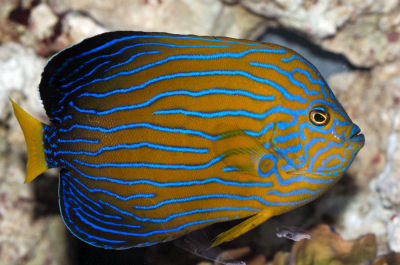
The Blue-striped Angelfish is hardy and beautiful, easily recognized by its distinctive electric blue lines!
The Blue-Striped Angelfish Chaetodontoplus septentrionalis is a mid-sized angel with an absolutely stunning adult coloration. Its adorned with brilliant blue horizontal stripes contrasted against an orange to brownish body. Hence it is also known as the Blueline Angelfish or Blue-lined Angelfish. The face is variable and can have squiggly blue stripes, irregular blue spots, or can even be a solid blue. It grows just shy of 10 inches (25 cm) in length, and is quite hardy once its initial shyness has abated and it begins to feed. With its distinctive beauty and hardy nature, it makes a spectacular aquarium showpiece.
Juveniles are attractive too, being mostly black with bright bold yellow accents. They start out with a yellow band at the rear of the head, a yellow tail fin, and yellow margins along the back of the dorsal and anal fins. But as they mature they begin the fascinating metamorphosis into adult coloration. At about 1 inch or so (2.5 – 3 cm) their color begins to lighten, becoming a brown with faint blue stripes along the body and on the face. Gradually the yellow markings fade from all but the tail fin, replaced by vibrant blue stripes on a yellow or orangish brown background.
This angelfish is moderately hardy with fairly easy care, making it a great choice for an intermediate aquarist. Provide a tank that is 75 gallons or more with plenty of rockwork creating nooks and crannies for hiding places. A mature tank with abundant algae growth is needed for long term success. They are not susceptible to parasites or disease but still need good water quality maintained.
Though rather shy at first, they will become bolder as they become comfortable. Most available specimens are raised in captivity. The larvae is routinely caught and these tank raised fish are quite durable. These hardy fish have even spawned in captivity in very large tanks. They do well in captivity once they are feeding and can live for a long period if properly cared for. You will do best obtaining a juvenile or sub-adult as those more than 6 inches (15 cm) in length, might not accept any food.
This angelfish can be kept in a community aquarium with peaceful to semi-aggressive tankmates. Generally it will do well with other angelfish members and also with smaller non-aggressive species. However an established adult can become moody and aggressive, so adding this fish last is wise. They will not get along with fish that have a similar shape. Also very aggressive larger angelfish are not suggested. A male/female pair will need a tank of 180 gallons or more. To keep them with others from the same genus will require a tank over 250 to 300 gallon, and the others need to be added first and be well established before adding a Blue Stripe Angel. They can be kept in selective reef tanks but may pick at some live corals.
For more Information on keeping saltwater fish see:
Marine Aquarium Basics: Guide to a Healthy Saltwater Aquarium
- Kingdom: Animalia
- Phylum: Chordata
- Class: Actinopterygii
- Order: Perciformes
- Family: Pomacanthidae
- Genus: Chaetodontoplus
- Species: septentrionalis
- Aquarist Experience Level: Intermediate
- Aquarium Hardiness: Moderately hardy
- Minimum Tank Size: 75 gal (284 L)
- Size of fish – inches: 9.8 inches (24.99 cm)
- Temperament: Semi-aggressive
- Temperature: 65.0 to 75.0° F (18.3 to 23.9° C)
- Range ph: 7.8-8.4
- Diet Type: Omnivore
- My Aquarium – Enter your aquarium to see if this fish is compatible!
- Beginner Fish – Saltwater fish for beginners
- Community Fish – Peaceful Saltwater fish
- Hardy Fish – Hardy Saltwater fish
- Similar size fish – Fish that are 1 inch bigger or smaller
- Coldwater Fish – Looking for cold water fish? (65 °)
Habitat: Distribution / Background
The Blue-Striped Angelfish Chaetodontoplus septentrionalis was described by Temminck and Schlegel in 1844. They are found in the Western Pacific from northern parts of the Malay Peninsula, Vietnam, Tawian, China and southern Japan. This species is on the IUCN Red List as Least Concern (LC) as it has a large population with a wide distribution and there are no major threats currently identified. Other common names it is known by include Bluestripe Angelfish, Blueline Angelfish, Blue-lined Angelfish, and Bluelined Angelfish. In Malaysia they are referred to as the Coralfish.
Adults are commonly seen on rocky reef areas that have large boulders and stones, but also will inhabit rubble slopes. They occur at depths between 6.6 to 164 feet (2 – 50 m). Juveniles are more likely to be found on rocky patch reefs near crevices and are more common at 49 feet (15 m) or more. Juveniles are found singly, but will inhabit the same area as an adult with no aggression. Adults are found singly or in pairs, and on rare occasions in a group of three.
Both juveniles and adults eat benthic algae and weeds, as well as zoobenthos consisting of sponges, tunicates and ascidians (sea squirts). Som will also nibble on black corals and sea whips. Adult pairs will feed together, but may stray around 20 feet apart. Then periodically they will reunite by one fish rushing toward the other and circling it quickly, then both go back to foraging.
- Scientific Name: Chaetodontoplus septentrionalis
- Social Grouping: Varies – Juveniles are solitary. Adults can be found alone, in pairs, and once in a while in a trio.
- IUCN Red List: LC – Least Concern – A stable population.
Description
The Blue-Striped Angelfish is a deep bodied, elongated, flat fish with rounded continuous dorsal and anal fins extending along the length of the body, and a rounded caudal fin. It will reach 9.8″ (25 cm) in length. Although it is not known how long this marine angelfish lives, others from this genus have been known to live up from 8 – 12 years in captivity.
The Blue-striped Angelfish or Blue-lined Angelfish adult is an overall brown to brownish yellow with blue horizontal lines on their sides. Many of these lines are curving and some may be interrupted.The caudal fin is entirely yellow with a narrow blue edge. The pelvic fins are yellow, the pectoral fins duskier with a black spot encircled by blue at base, and the dorsal and anal fins are a blackish blue with several narrower blue lines. The face and head are yellowish brown with a mix of blue stripes and dots. Individual specimens may have regular striping on the face, a solid blue face, or what looks like small irregular bright blue circles with centers being the same color as the body.
WMA_AP15UA_med.jpg)
Blue-striped Angelfish
(Juvenile, 4 cm)
Collected in Miyazaki, Japan
Photo Courtesy: Hiroyuki Tanaka
Juveniles are black overall and have a vertical yellow band behind the eye extending from the forehead to the chest. They also have a yellow tail fin and yellow margins along the back of the dorsal and anal fins. At about 1 to 1 1/2 inches (25 – 30 cm) their color begins to lighten, becoming a orangish brown with faint blue stripes along the body and on the face. These lines will increase in number with growth and the yellow markings will fade from all but the tail fin, replaced by vibrant blue stripes. As juveniles they look very similar to young Black Velvet AngelfishChaetodontoplus melanosoma, but the Black Velvet juvenile is distinguished by a black patch in the center of its tailfin.
The adults look very similar to their close relative the Orangeface Angelfish Chaetodontoplus chrysocephalus. The Orangeface angel is distinguished by a darker body and more blue lines that are closer together, and a pronounced orangish head. These two species occur in the same habitats and are sometimes seen swimming together in pairs. This has led to much debate and the suggestion that they are variations of the same species, with the Orangeface being the color form of a mature male.
There is much variability in the color pattern of the Orangeface that it;s also thought there could be more than one species lumped together. A variety found around Japan, and possibly occurring along the coast of Taiwan and mainland China, has been called the Maze Angelfish and described as Chaetodontoplus cephalareticulatus, but it’s not yet recognized as a valid species.
- Size of fish – inches: 9.8 inches (24.99 cm)
- Lifespan: 8 years – Although it is not known how long this marine angelfish lives, others from this genus have been known to live up from 8 – 12 years in captivity.
Fish Keeping Difficulty
These angelfish are moderately hardy to care for, needing a minimum tank size of 75 gallons (283 l). Choosing a juvenile to sub-adult that will eat at the store is wise. Juvenile Blue-striped Angelfish are fairly easily maintained in the aquarium but almost all of the large individuals need special care. Smaller fish are not as fussy as adults and offering a variety of good quality foods is a key element in keeping them successfully. Adults do not adjust as easily, if at all. They often refuse any food except possibly some live corals, sponges, and small invertebrates.
A protein skimmer is suggested to keep water quality high since they need to be fed fairly often. One thing that sets them apart from other angelfish is that they will tolerate a wider pH range. They can be kept at a pH level between 7.8 to 8.4, though it should be consistent.
- Aquarium Hardiness: Moderately hardy
- Aquarist Experience Level: Intermediate
Foods and Feeding
The Blue-striped Angelfish are omnivores, in the wild they eat primarily sponges and tunicates, but have also been observed nibbling on macroalgae, black corals, and sea whips. In nature they are also known to feed off both rocks and sand substrates, but show a prefererence for the rocks. Provide a varied diet. Juveniles often accept dried flakes, meaty foods, frozen prepared diets for sponge and algae eaters, frozen shrimps, and may also feed on tablets.
Feed picky new individuals sponge encrusted or algae covered rocks, or even live brine shrimp to encourage initial feeding response. Bi-valves, which are alive when cracked open are also appreciated, but removed any uneaten flesh within 15 minutes. Once eating, offer small amounts of food three to five times a day. They can be fed less often if there is plenty of edible algae growing in the tank.
- Diet Type: Omnivore – Feed preparations that have sponge and spirulina algae added, specifically for angelfish.
- Flake Food: Yes
- Tablet / Pellet: Yes
- Live foods (fishes, shrimps, worms): Some of Diet – Live foods such as brine shrimp and clams, cracked open in the shell, can help encourage an initial feeding response.
- Vegetable Food: Half of Diet
- Meaty Food: Half of Diet
- Feeding Frequency: Several feedings per day – Feed 3 – 5 times a day initially, less once established and if there is plenty of algae growing on the rocks.
Aquarium Care
These angelfish require good water quality. Regular water changes that maintain proper water parameters are key in helping to keep this angelfish healthy. They like temperatures between 63˚ and 75˚F (17˚ – 24˚ C) with normal parameters for salinity. Biweekly water changes of 10-15% are fine for juveniles, but large specimens need small, more frequent water changes. A 5% water change on a weekly basis is recommended if tank is 75 gallons or less. They like temperatures between 63˚ and 75˚F (17˚ – 24˚ C) with normal parameters for salinity.
- Water Changes: Bi-weekly – Water changes of 10-15% bi-weekly are suggested for larger tanks of 75 gallons or more.
Aquarium Setup
Blue-striped Angelfish need a minimum tank size of 75 gallons (283 l). This fish needs lots of open space for free swimming with large specimens and some places in the decor for juveniles to hide in. The aquarium needs to be mature with plenty of algae growth on live rock. Form hiding places with the rockwork where juveniles can retreat when feeling threatened. If keeping as a male and female pair, the tank should be 180 gallons (681 l) or more. This species dwells in subtropical to temperate areas in nature. They do best in temperatures from 65˚F to 75˚F (17˚ – 24˚ C) making them an almost cold water fish. Their salinity requirement is in the normal range and no specific water movement is needed.
- Minimum Tank Size: 75 gal (284 L) – A male/female pair will need an aquarium that is 180 gallons or more.
- Suitable for Nano Tank: No
- Live Rock Requirement: Typical Plus Hiding Places – Juveniles need nooks and crannies to retreat into.
- Substrate Type: Any
- Lighting Needs: Any – Lighting is needed to provide algae growth on live rock.
- Temperature: 65.0 to 75.0° F (18.3 to 23.9° C)
- Specific gravity: 1.023-1.025 SG
- Range ph: 7.8-8.4
- Brackish: No
- Water Movement: Any
- Water Region: All – They will spend time in all parts of the aquarium.
Social Behaviors
The Blue-striped Angelfish can be kept in a fish only tank or selective reef set ups. Although shy initially, they will become bolder as they acclimate. This angelfish is more aggressive than others in its genus, but less aggressive than Pomacanthus and Holacanthus angels. Once they become adults and are fully acclimated, they can be aggressive toward anything that is added after them.
Smaller and non-aggressive fish like cardinalfish, gobies, tilefish, damselfish, butterflyfish, fairy basslets, wrasses, etc. will be good tank mates. Do not house with butterflyfish, angelfish and others that have a similar shape or feed off the substrate. Large basses, aggressive fish like dottybacks, and larger and territorial angelfishes like Pomacanthus are not recommended as tank mates.
An adult and a juvenile can co-habitat fine but not two juveniles together. A pair may also be okay together if the aquarium is very large and there are crevices for retreat, but the pair must be introduced to the aquarium at the same time. They can be house with others in their genus in very large systems with plenty of places to hide. Add the less aggressive species from this genus at the same time first, and once fully acclimated, then add the Blue-striped Angelfish and other similarly tempered angels from this genus together.
The angelfish is not 100% reef safe as it will feed on some corals and sessile invertebrates. They will nip at hard corals, tubeworms, and clams. In a selectively set up reef tank soft corals such as those from the Cladiella, Lemnalia, Lobophytum, and Sinularia genera are not bothered and mushroom corals are ignored. A few individuals may nip at an anemone’s disk if it is not guarded by a clownfish with a pugnacious personality. They don’t bother invertebrates such as snails, crabs, or shrimp.
- Venomous: No
- Temperament: Semi-aggressive – More aggressive than other angelfish from their genus.
- Compatible with:
- Same species – conspecifics: Sometimes – In a tank over 180 gallons, a mated male/female pair may be kept. Keeping it with others of the same genus will take in tanks that are 250 to 300 gallons that has plenty of places to hide, and adding the less aggressive species first.
- Peaceful fish (gobies, dartfish, assessors, fairy wrasses): Safe
- Semi-Aggressive (anthias, clownfish, dwarf angels): Monitor – May be aggressive toward dwarf angelfish feeding off the substrate, possibly because it may see them as potential food rivals.
- Safe
- Large Semi-Aggressive (tangs, large angels, large wrasses): Safe – Safe as long as other angelfish or butterflyfish do not have the same shape or coloring
- Large Aggressive, Predatory (lionfish, groupers, soapfish): Monitor – Make sure they are not chasing or stressing your Blue-stripe angelfish.
- Threat – Angelfish will out compete these animals for food.
- Anemones: Monitor – May be okay if there is a pugnacious clownfish guarding the anemone.
- Mushroom Anemones – Corallimorphs: Safe
- LPS corals: Threat
- SPS corals: Threat
- Gorgonians, Sea Fans: Threat
- Leather Corals: Safe
- Soft Corals (xenias, tree corals): Threat – Should not bother corals from the Lobophytum, Cladilla, Lemnalia, and Sinularia genera.
- Star Polyps, Organ Pipe Coral: Threat
- Zoanthids – Button Polyps, Sea Mats: Threat
- Sponges, Tunicates: Threat
- Shrimps, Crabs, Snails: Safe
- Starfish: Safe
- Feather Dusters, Bristle Worms, Flatworms: Threat
- Clams, Scallops, Oysters: Threat
- Copepods, Amphipods, Mini Brittle Stars: Safe
Sex: Sexual differences
No sexual differences are known, but it is often reported by divers in southern Japan that the species is seen swimming in pairs. Some have stated the male is larger.
Breeding / Reproduction
Not yet bred in captivity, but larvae has been captured and raised in captivity. In captivity they have been reported to court and spawn, with a known spawning in at least one public aquarium. In courtship the male displays in front of the female with fins erect, and sometimes will lay down on his side on the substrate. Like other angelfish, in the final stages before actual spawning the male exhibits a “soaring” display.
- Ease of Breeding: Difficult
Fish Diseases
Although the Blue-Stripe Angelfish is quite hardy, at times illnesses can arise. Like other saltwater angelfish they are prone to any disease that captive saltwater environments have to offer. They are most likely to be affected if they are stressed from inappropriate housing or tank mates. Providing an angelfish with clean water, a proper decor with places to hide, and regular feeding is the best way to prevent illness. Calm angelfish are healthy fish. If not stressed, they will have a stronger immune system to prevent infections. To avoid a condition called nutritional blindness in angelfish, which can occur around 6 to 8 months after taken into captivity, feed green leafy food that have Vitamin A, as well as making sure there is plenty of natural occurring algae in the tank.
White Spot Disease Cryptocaryon irritans, also known as Marine Ich, Saltwater Ich, or Crypt is the most common disease that is generally associated with marine tangs and angelfish. Symptoms of Marine Ick are constant scratching, culminating with lots of white dots. These dots disappear for a few days, only to return with double the number. This results in the fish suffocating from these parasites blocking the gills from providing oxygen.
Another common disease is Marine Velvet or Velvet Disease Oodinium ocellatum, (syn: Amyloodinium ocellatum or Branchiophilus maris), which is a parasitic skin flagellate. Symptoms of Marine Velvet are a peppery coating giving a yellow to light brown “dust” on body, clamped fins, respiratory distress (breathing hard as seen as frequent or quick gill movements), cloudiness of eyes, glancing off decor or substrate, and possible weight loss.
A viral infection, Lymphocystis, looks like small cauliflower-shaped nodules on the fins and mouth. These nodules are not harmful and come and go. The only time action may be needed is if they were on the mouth area of the fish, preventing it from eating for a prolonged period of time. It’s best to do water changes to help the fish’s natural immune system kick in.
Monogenetic flukes are the most common parasitic infections angelfish are prone to contracting. Parasites on marine fish kept with live rock or in any type of reef environment can be extremely difficult to treat. Typical treatments like copper and formalin solutions, as well as quinine based drugs are harmful to other marine creatures. However drugs such as metronidazole provide an effective and safe treatment for several protozoan and anaerobic bacterial diseases. Metronidazole works by ceasing the growth of bacteria and protozoa. Metronidazole is an antibiotic for anaerobic bacteria with anti-protozoal properties. This drug is reef safe, and medications are either added to the water or mixed with the fish food. Some available products that contain metronidazole include Seachem Metronidazole, Seachem AquaZole, Thomas Laboratories’ Fish Zole and National Fish Pharmaceutical’s Metro-Pro.
For external parasites you can slowly increasing the temperature of your tank to at least 82° F (28° C). That will prevent the parasite from completing its life cycle which includes the attachment to fish. A further combination of the higher temperatures with medicated food will provide timely relief. The Seachem Metronidazole medications works well in combination with another Seachem product called Focus, which is a bonding agent. This treatment can be used in a reef aquarium since the medication is bound to the food, which even if the corals eat, will not hurt them. Mix Focus in a ratio of 5 to 1 with their Metronidazole (5 parts Focus to one part Metro), then mix this with 1 tablespoon of food. Feed the medicated food to the fish 3 times a day for at least a week or until symptoms are gone.
Fish problems can be broken into one of (or a combination of) these types: parasites, bacterial disease, fungal disease, or physical ailments caused from deficiencies in diet as well as wounds and injuries. For more information on diseases that saltwater angelfish are susceptible to, see Aquarium Fish Diseases and Treatments.
Availability
The Blue-striped Angelfish or Blue-lined Angelfish is occasionally available in stores and online. They range in price from moderate to expensive, depending on where they come from.
References
- Animal-World References: Marine and Reef
- Chaetodontoplus septentrionalis (Temminck & Schlegel, 1844) Bluestriped angelfish, Fishbase
- Chaetodontoplus septentrionalis, IUNC Red List, International Union for Conservation of Nature and Natural Resources
- Helmut Debelius, Rudie H. Kuiter, World Atlas of Marine Fishes, Hollywood Import & Export, Inc., 2006
- Scott W. Michael, Angelfishes & Butterflyfishes: Reef Fishes Series , Microcosm Ltd, 2004
- Mark Allen, Roger Steene, Gerald R. Allen, A Guide to Angelfishes and Butterflyfishes , Odyssey Publishing, 1998
- Dr. Warren E. Burgess, Dr. Herbert R. Axelrod, Raymond E. Hunziker III, Dr. Burgess’s Atlas of Marine Aquarium Fishes, T.F.H Publications inc., 1990
- Dr. Gerald R. Allen, Butterfly and Angelfishes of the World Volume 2, Aquarium Systems; 3rd edition,1985
- H. Debelius, H. Tanaka and R. Kuiter, Angelfishes, A Comprehensive Guide to Pomacanthidae, TMC-Publishing, UK, 2003
- Frank Schneidewind, Kaiserfische, (in German) 1999