
In their natural environments plants have no problem propagating or reproducing themselves, because all the conditions are practically ideal for them!
Many common plant species will reproduce on their own in a healthy aquarium. However it is often harder to obtain ideal conditions in the aquarium for all types of aquatic plants to readily propagate. Some aquarium plants will reproduce freely without assistance, while others will do better with some help.
There are a several types of plant propagation.
Reproduction is either by sexual or asexual means. Sexual propagation involves flowers and seed formation. Asexual propagation in plants, also called vegetative propagation, is without seed but through runners, offsets, and plantlets. Plant propagation techniques done with cuttings or rhizome dividing is artificial propagation.
Aquatic plants tend to favor asexual (vegetative propagation) or artificial propagation. Only a few depend on seed as their main method of plant propagation. In general, propagating aquarium plants is much easier when separating a part of the original plant and re-planting it, than by trying to grow new plants from seeds.

Asexual Propagation
Most aquarium plants reproduce asexually, meaning that the offspring are genetically identical to the parent plant. This is also known as vegetative propagation. There are three different ways for aquarium plants to reproduce this way:
Runners (slips)
One way is for them to produce runners, which grow out from the base of the parent plant and then produce what are called “slips” at the end of the runners. These slips can eventually anchor themselves in the substrate and survive on their own. Sometimes the runners that are between the parent plant and the slips break away from the slips, and sometimes they just continue to grow and produce more slips. Usually, it is best to separate a slip and plant it on its own once it is about a quarter the size of the parent plant.
Offsets
Another asexual way that plants reproduce that is very similar to producing runners is producing offsets. Offsets also grow off of the main plant, but they grow extremely close to it and do not wander like runners do. These offsets can be removed from the parent plant and planted elsewhere in the aquarium.
Adventitious plantlets
The last asexual way of reproduction is when small plantlets form on the parent plant, called adventitious plantlets. These can grow on any part of the plant, i.e. nodes, roots, leaves, or stems. After it has grown for a while, naturally its attachment to the parent plant will die off and it will be removed, however in aquariums you should remove them once they are about 3-4 cm and replant them yourself to ensure survival.

Artificial Propagation
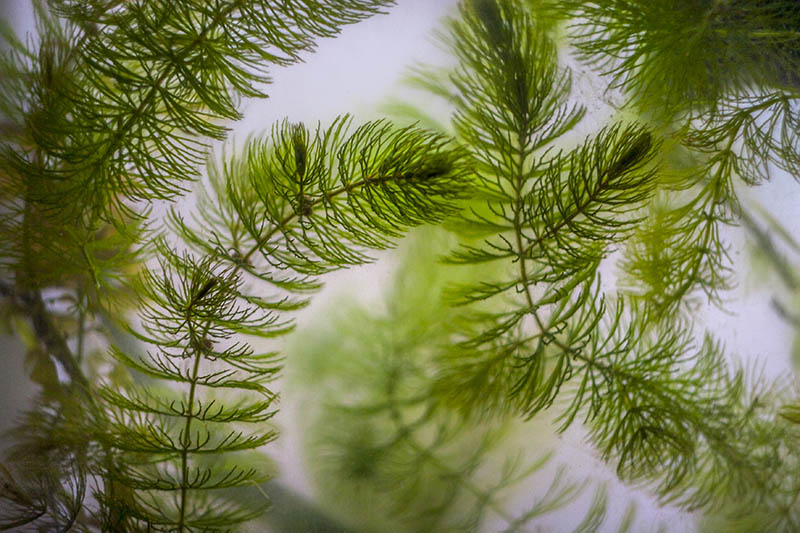
It is also often quite easy to artificially propagate many aquarium plants by simply cutting part of it off and replanting it (stem plants are the easiest to do this with); or by dividing the rhizome in two and replanting the two pieces (ferns and mosses can be propagated this way).
Cuttings
The best place to take cuttings is from the top stems, however you can also take cuttings from side shoots and the middle stems as well, they are just not usually as strong as those from the top stems.
To take a cutting, cut part of the plant off just above a node and remove any leaves around nodes that are directly above this. This is the area where the new roots will grow. Then plant the cutting into the substrate so that the nodes where you removed the leaves is just covered.
Rhizome dividing
Plants that have rhizomes can also be artificially propagated by dividing the rhizome in two. You can do this by removing the plant from the substrate and carefully cutting the rhizome, being careful that both pieces have at least one good shoot growing from them. Then re-plant each piece of the parent plant.
Seed Propagation
Propagating plants by way of seeds is often difficult to do, however it can be done. If you are trying to reproduce plants that propagate sexually, you should have at least two of those plants, and they should be able to produce flowers above the water surface.
Parent plants
Provide a low enough water level that the plants can easily grow strong aerial stems above water. After flowers have been produced, you must then transfer pollen from the stamen to the stigmas using a watercolor brush, cotton swab, or your finger depending on how large the flowers are.
Seedlings
Seeds should be produced if pollination is successful and you’ll want to plant them as quickly as possible. First, plant the seeds in damp soil rather than soil immersed in water. Once they start to grow above the soil, add a small amount of water. As the plants grow, continually add just enough water to keep them submerged in water.
Featured Image Credit: Joan Carles Juarez, Shutterstock