
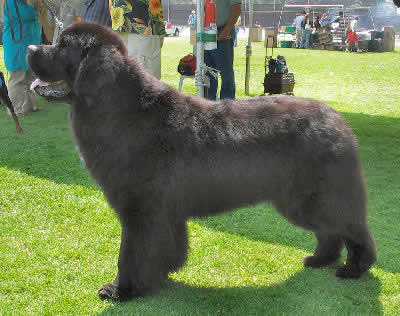
The Newfoundland is a calm, dignified dog that’s reknown for its water rescue capabilities!
The Newfoundland dog is favored by fishermen, frequently kept as a companion and helper. It is a very large dog with great strength, a double thick coat, and is a master at swimming long distances. It also has a calm temperament is calm and is dependable. This is a working dog with the perfect combination of traits for water rescues and life saving, and it excels at it.
The Newfoundland is very protective of its family. It gets along well with strangers, both humans and animals, as long as they do not present a threat. But the Newfie prefers to keep a separation between its family and any intruders. It will place itself physically between its family and strangers rather than bark, growl or bite. When selecting a Newfoundland, look for joint dysplasia and heart problems.
- Kingdom: Animalia
- Phylum: Chordata
- Class: Mammalia
- Order: Carnivora
- Family: Canidae
- Genus: Canis
- Species: lupus familiaris
Common Name(s)
Breed Type
The Newfoundland dog is a working breed. This breed is known for its water rescue capabilities, and it has also been a frequent companion and helper for fishermen. The Newfoundland is best suited to cool climates.
Background
The Newfoundland breed originated on the island of Newfoundland. Its ancestors include the St. John’s Dog and large Mastiffs. The Newfoundland was used to pull fishing nets and equipment, and has also been involved in numerous large water rescue operations.
Popular hybrids include the Bernefie, a cross between the Newfoundland and the Bernese Mountain Dog.
Description
The Newfoundland is a large dog with a long, wavy coat. Colors include black, black and blue, bronze, brown and gray. Those with a white coat with black markings are called Landseer, and in some countries are considered a separate breed. The head and muzzle are broad, the ears small and pendant, and the eyes dark brown. The nose is usually black, but is brown on bronze Newfies. Males are 27-29 inches tall and weigh 130-150 pounds. Females measure 25-27 inches tall and weigh 100-120 pounds.
Care and Feeding
The Newfoundland’s diet should contain fish, pork, poultry and lamb, and should provide ample fat. The Newfoundland needs to be brushed at least once a week, and more when shedding. Occasional dry shampoo is best to keep from stripping away the coat’s oils. The Newfoundland’s hind dewclaws should be removed.
Annual checkups are advised. Vaccinations should be administered on the following schedule:
- 6-8 weeks: Distemper, Leptospirosis, Hepatitis, Parainfluenza, Parvo, and Corona virus (DHLPPC)
- 10-12 weeks: Second DHLPPC
- 14-16 weeks: Third DHLPPC and rabies
- Annually: DHLPPC and rabies booster
Newfoundlands shed their undercoats in the spring and fall. Frequent vacuuming will be required at these times if kept indoors.
Housing Your Dog
The Newfoundland can live indoors in a small space as long as it gets adequate exercise. This breed needs a cool environment, and must have shade if outdoors in hot weather.
Social Behaviors
Newfoundlands are great with children. They also do well with other pets. Males are sometimes aggressive with other male dogs.
Handling and Training
The Newfoundland is sometimes hard to train. Patience is essential. This breed is sensitive to the tone of its trainer’s voice.
Activities
A daily walk is important to keep your Newfoundland healthy. This breed also loves the opportunity to swim.
Breeding/Reproduction
When selecting a mate for your Newfoundland, hip dysplasia and heart disease are the most common defects to look for. Tests can reveal tendencies toward these ailments.
Common Health Problems
It is important not to allow your Newfoundland to become overweight. This can contribute to hip dysplasia, and can exacerbate heart problems.
Availability
Newfoundlands are hard to find in some areas, but breeders can be located online. Prices are usually $800 to $1,500.
References
- Liz Palika, The Howell Book of Dogs: The Definitive Reference to 300 Breeds and Varieties , Howell Book House, 2007
- American Kennel Club, The Complete Dog Book: 20th Edition (Complete Dog Book) , Ballantine Books, 2006
- Kristin Mehus-Roe, The Original Dog Bible: The Definitive Source to All Things Dog, BowTie Press, 2005
- Newfoundland“, Copyright Dog Breed Info Center
- Newfoundland (dog), Wikipedia
- Newfoundland Puppies for Sale, Copyright PuppyFind.com, LLC
Featured Image Credit: Liliya Kulianionak, Shutterstock