
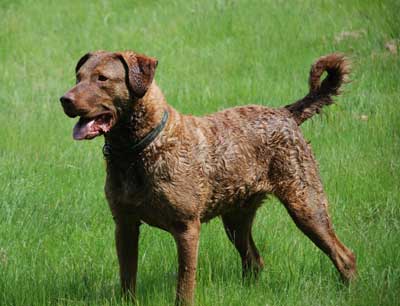
The Chesapeake Bay Retriever is famed for its willingness and ability, to hunt in really bad weather!
The Chesapeake Bay Retriever is a sporting dog. The breed is believed to have started with two Newfoundlands that were rescued from a shipwreck off the Maryland coast, which were then bred to local retrievers. This produced excellent hunting dogs with incredible endurance. The Chessie is a multi-talented dog, used not only for hunting but for tracking, retrieving, field sports, and obedience.
Chessies are loving, friendly and courageous dogs. They enjoy outdoor activities such as swimming, making them a good choice for the active dog lover. It is also popular among hunters as it is happy to retrieve in wet, cold or icy conditions. Other talents include watchdogging, schutzhund, and field sports. They are best suited to cool climates, but can handle warmer weather as long as they can take a frequent swim. Although more willful and aggressive than many types of retrievers, with proper socialization the Chesapeake makes a great family pet.
When selecting a Chesapeake Bay Retriever, check bloodlines for hip dysplasia and eye problems. Regional alopecia is also a fairly common hereditary disorder for this breed.
- Kingdom: Animalia
- Phylum: Chordata
- Class: Mammalia
- Order: Carnivora
- Family: Canidae
- Genus: Canis
- Species: lupus familiaris
Common Name(s)
Miniature Pinscher, Min Pin, Mini Pinscher, and Zwergpinscher
Breed Type
The Chesapeake Bay Retriever is a sporting dog, famed for its willingness and ability to hunt effectively in adverse weather conditions. This breed is best suited to cool climates, but can handle warmer weather if given the opportunity to swim frequently.
Background
The Chesapeake Bay Retriever originated in the early 1800s. The breed is believed to have started with two Newfoundlands that were rescued from a shipwreck off the Maryland coast. These dogs were bred to local retrievers, producing excellent hunting dogs with incredible endurance. The Chessie’s talents include tracking, retrieving, field sports, and obedience.
Description
Chesapeake Bay Retrievers are mid-sized, muscular dogs with broad heads and medium muzzles. Their ears are small and hang down, and their eyes have a yellowish tint. Their tails are long, and their coats are short, water resistant, and a little wavy. Colors include shades of brown, red and tan, sometimes with white on the chest and feet.
Chessie males are 23 to 26 inches tall and weigh 65 to 80 pounds. Females are 21 to 24 inches tall and weigh 55 to 70 pounds.
Care and Feeding
Chesapeake Bay Retrievers thrive on diets that include poultry fats and protein, brown rice, and wheat. Regular brushing will help keep your Chesapeake’s coat free of dead hairs and looking good. Baths should be given judiciously, as they are necessary to prevent odor, yet can strip the protective oils from the coat. Rear dewclaws are usually removed from this retriever when they are puppies. Front dewclaws may also be removed, especially if the dog will be doing any hunting.
Chessies need annual checkups to stay in good health. Vaccinations are due as follows:
- 6-8 weeks: Distemper, Leptospirosis, Hepatitis, Parainfluenza, Parvo, and Corona virus (DHLPPC)
- 10-12 weeks: Second DHLPPC
- 14-16 weeks: Third DHLPPC and rabies
- Annually: DHLPPC and rabies booster
A Chessie will shed moderately. If kept indoors, regular vacuuming is important.
Housing Your Dog
The willful Chessie can be rather difficult to train. The handler must be authoritative and consistent, yet gentle, in order for training to be effective. Obedience training is highly recommended for this breed.
Social Behaviors
Chesapeake Bay Retrievers do well with children, and with other pets that they are socialized with as puppies. They may chase cats and other pets, however, if they are unfamiliar. They can also be territorial around strange dogs and humans, although they rarely start fights unprovoked. Training and socialization are absolutely essential with this breed.
Handling and Training
Chesapeake Bay Retrievers do well with children, and with other pets that they are socialized with as puppies. They may chase cats and other pets, however, if they are unfamiliar. They can also be territorial around strange dogs and humans, although they rarely start fights unprovoked. Training and socialization are absolutely essential with this breed.
Activities
Chesapeake Bay Retrievers need a great deal of exercise. Daily walks are essential, and swimming is recommended if possible.
Breeding/Reproduction
When selecting a mate for your Chesapeake Bay Retriever, be sure to request hip dysplasia test results. Other hereditary problems to be aware of include several different eye problems and Von Willebrand’s disease.
Common Health Problems
Cataracts are rather common in this breed, but may be removed with surgery if necessary. Dogs with Von Willebrand’s disease should be carefully monitored for cuts to prevent excessive bleeding.
Availability
Chesapeake Bay Retrievers may be hard to find in some areas, but breeders can be found online. Prices vary.
References
“Chesapeake Bay Retriever“, Dog Breed Info Center, Copyright 1998-2008
Cusick, William D., “What to Feed a Chesapeake Bay Retriever“, Referenced online, 2008
“Chesapeake Bay Retriever Puppies for Sale“, Copyright PuppyFind.com, LLC, Referenced online, 2008
“Chesapeake Bay Retriever“, Wikipedia, Copyright 2008
Featured Image Credit: MH STOCK, Shutterstock