
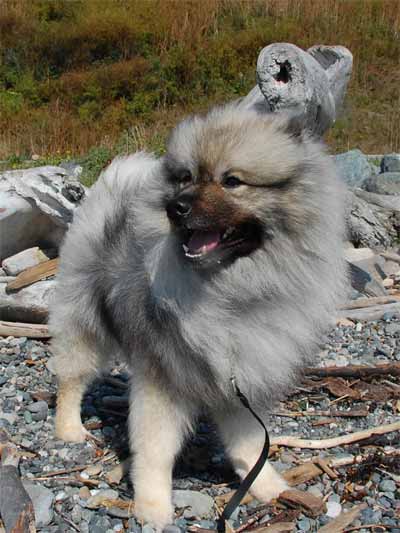
The Keeshond is primarily a companion dog today, but they once worked for Dutch sailors!
Though it is a type of German Spitz, the Keeshond actually originated in the Netherlands. In its lineage this Spitz tyoe includes the Samoyed, Chow Chow, Elkhound, and Pomeranian. It was named after Kees de Gyselaer, the leader of the Dutch rebellion during the French Revolution. Favored by him, it became a mascot for the rebels. After the Revolution it became extinct. It was not until the 1920s, when it was introduced in the United States, that it regain momentum.
The Keeshond has a sweet and outgoing personality. These affectionate dogs make excellent family pets, and they can be trained as watchdogs. It is a lively breed that loves to entertain and is often trained to do tricks. It tends to get along with everyone, and though it will alert you to strangers it is not aggressive. This breed is great with children and usually other pets.
When selecting a Keeshond, look for signs of hip and knee problems, epilepsy, and thyroid disorders.
- Kingdom: Animalia
- Phylum: Chordata
- Class: Mammalia
- Order: Carnivora
- Family: Canidae
- Genus: Canis
- Species: lupus familiaris
Common Name(s)
Keeshond, German Spitz, Wolfsspitz, Dutch Barge Dog, Smiling Dutchman, Keeshonden
Breed Type
The Keeshond is a non-sporting breed. Primarily a companion dog, the Keeshond once worked for Dutch sailors. Keeshonden are best suited to cool climates.
Background
The Keeshond originated in the Netherlands, but is a type of German Spitz. Its lineage includes the Samoyed, Chow Chow, Elkhound and Pomeranian. The breed was favored by (and named after) Kees de Gyselaer, the leader of the Dutch rebellion during the French Revolution, and became a mascot for the rebels.
The Keeshond nearly became extinct after the Revolution, and did not regain momentum until the 1920s, when it was introduced in the United States. The breed gained AKC recognition in 1930, thanks to the efforts of Carl Hinderer, who brought his kennel over from Germany.
Description
The Keeshond has a compact build. Its head is wedge-shaped with upright, triangular ears, chestnut eyes, medium muzzle and an animated face. The tail is curled up over the back. The coat is full, straight, and medium length, with a thick ruff, plumed tail and feathering on the legs. Females have a less pronounced ruff than males. Coloring is gray, black, and cream with black tips, with markings similar to those of the wolf.
Keeshonden are 16 to 19 inches tall. Weight standards vary according to source. The FCI calls for a weight of 35 to 45 pounds, while some other clubs call for a weight of 55 to 66 pounds.
Care and Feeding
The Keeshond needs plenty of fatty acids in its diet, and their foods should have a low carbohydrate to protein ratio. Recommended food sources include fish, poultry, rice, and beets. Be careful not to overfeed, as this breed is prone to becoming overweight. Bloat is also a concern due to the dog’s build, so you may want to feed two or three small meals per day instead of one large one. Daily brushing is important to keep your Keeshond looking its best. Baths should be given only when needed.
Keeshonds need yearly checkups to maintain good health. Vaccinations are due on the following schedule:
- 6-8 weeks: Distemper, Leptospirosis, Hepatitis, Parainfluenza, Parvo, and Corona virus (DHLPPC)
- 10-12 weeks: Second DHLPPC
- 14-16 weeks: Third DHLPPC and rabies
- Annually: DHLPPC and rabies booster
The Keeshond sheds heavily twice a year. Its hair may be difficult to remove from furniture.
Housing Your Dog
Keeshonden may live indoors or out, as long as they have frequent exercise and interaction with humans. They need adequate space outside to run and play.
Social Behaviors
Keeshonden are very friendly and tend to get along with everybody. They are great with kids. They will alert you to the presence of strangers, but are non-aggressive. They usually get along very well with other pets.
Handling and Training
This intelligent breed is easy to train with consistency and positive reinforcement. The Keeshond excels at obedience and performance of any kind.
Activities
A daily walk is important to keep your Keeshond in good spirits. Regular off-leash play sessions are also advised. It is important not to overwork a Keeshond, as this can lead to knee problems. In hot weather, they can also become overheated due to their thick coats.
Breeding/Reproduction
When choosing a mate for your Keeshond, check bloodlines for thyroid problems, hip dysplasia, and epilepsy.
Common Health Problems
Thyroid and pituitary gland problems are fairly common in this breed. Both can be treated with medication. Keeshonden are also prone to bloat, a condition that causes the stomach to twist and can be fatal. It can be prevented by avoiding overfeeding. But it is important to know the signs and have your veterinarian’s emergency number handy for quick treatment if it does occur.
Availability
Keeshonden are difficult to find in some areas. Breeders may be located online. Prices are usually between $500 and $800.
References
“Keeshond“, Dog Breed Info Center, Copyright 1998-2008
Cusick, William D., “What to Feed a Keeshond“, Referenced online, 2008
“Keeshond Puppies for Sale“, Copyright PuppyFind.com, LLC, Referenced online, 2008
“Keeshond“, Wikipedia, Copyright 2008
Featured Image Credit: stockfoto, Shutterstock