
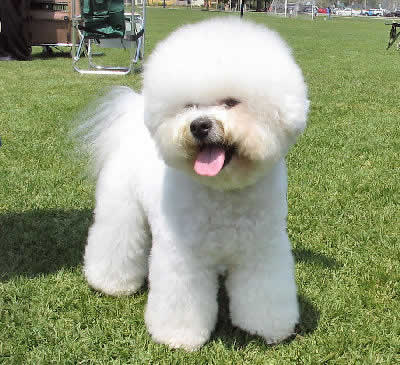
The small sized Bichon Frise has a compact cuddly appearance, with a personality to match.
Bichon Frises are sociable and happy dogs. They are charming and gentle, and they enjoy going everywhere with their families. They get along well in the company of other dogs and pets and are also good with children. The Bichon Frise is an obedient breed that excels at learning tricks, but are known to be quite difficult to totally housebreak.
When choosing a Bichon Frise, look for eye, ear, and skin problems. This breed is also prone to epilepsy and dislocated kneecaps.
- Kingdom: Animalia
- Phylum: Chordata
- Class: Mammalia
- Order: Carnivora
- Family: Canidae
- Genus: Canis
- Species: lupus familiaris
Common Name(s)
Bichon Frise, Bichon a Poil Frise, Bichon Tenerife
Breed Type
The Bichon Frise is a non-sporting breed that makes a wonderful companion and show dog. These sociable dogs do best indoors.
Background
The Bichon Frise was first bred in 14th century Spain. A cross between the Barbet Water Spaniel and the Poodle, the breed was often bartered among sailors. The Bichon Frise made its way to France in the 16th century, where it was often trained for the circus.
Popular hybrids of the breed include the Bichon-A-Ranian, the Cavachon, and the Bichon Poo.
Description
Bichon Frises are usually white in color, but some have cream, gray or apricot hairs mixed in. They have fluffy, loosely curled coats. The Bichon’s eyes are dark and round, its ears medium length and covered with hair, and its muzzle moderate and blunt. The breed averages 9-12 inches tall and weighs 7-12 pounds.
Care and Feeding
The Bichon Frise’s diet should consist of foods derived from poultry, lamb, fish, rice and wheat. This breed requires frequent grooming, with professional grooming and bathing recommended monthly. It is important to pay special attention to keeping the hair around the eyes and ears trimmed.
The Bichon needs annual checkups to stay healthy. Vaccinations are administered as follows:
- 6-8 weeks: Distemper, Leptospirosis, Hepatitis, Parainfluenza, Parvo, and Corona virus (DHLPPC)
- 10-12 weeks: Second DHLPPC
- 14-16 weeks: Third DHLPPC and rabies
- Annually: DHLPPC and rabies booster
The Bichon does not shed often, and its fur is unlikely to cause allergic reactions. No special cleaning is necessary when you have this breed in your home.
Housing Your Dog
The Bichon Frise is an indoor dog, and it can flourish in small spaces. Due to their small size, it is important to look out for them underfoot and on couches or chairs.
Social Behaviors
Bichon Frises are very social animals, and they love the company of humans, dogs, and other pets. They do very well with children.
Handling and Training
Bichons are fairly easy to train for the most part. They are, however, notoriously difficult to housebreak. Crate training is advisable. Some owners claim that their Bichon Frises were never completely housebroken.
Activities
The Bichon Frise is an active breed and needs a walk each day. They enjoy playing outdoors off-leash on occasion.
Breeding/Reproduction
On the whole, Bichons are healthy dogs with few hereditary health problems. Cancer and blood disorders are the main concerns when selecting a mate for breeding purposes.
Common Health Problems
Bichons are prone to allergies, particularly skin allergies. They are often sensitive to flea bites. More serious but rather infrequent health concerns include epilepsy, blood disorders and cancer.
Availability
Bichon Frises are hard to find in some areas, but can usually be located online. Prices average $400 to $600.
References
“Bichon Frise“, Wikipedia, Copyright 2008
“Bichon Frise“, Dog Breed Info Center, Copyright 1998-2008
Cusick, William D., “What to Feed a Bichon Frise“, Referenced online, 2008
Welton, Michelle, “Bichon Frise: What’s Good About ‘Em? What’s Bad About ‘Em?“, Copyright 2000-2008
“Bichon Frise Puppies for Sale“, Copyright PuppyFind.com, LLC, Referenced online, 2008
Featured Image Credit: Spill Photography, Shutterstock