Dogs Comparison Shopping
Pet Care Home
Animal-World
Information
Bookmark and Share
Special Features
Pet Dogs

Animal-World > Dog Breeds > Herding Dogs > German Shepherd Dog


German Shepherd Dog

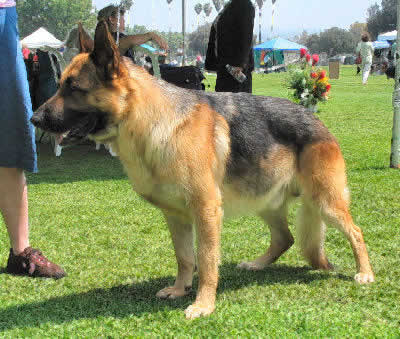
Alsation ~ GSD ~ Deutscher Schaferhund Family: Canidae German Sheperd Picture Canis familiaris Photo © Animal-World: Courtesy Justin Brough
Latest Reader Comment - See More
I have a german shepherd/border collie/labrodor puppie, very fun and active, and  riley  2009-04-16

   The German Shepherd is a well-balanced dog in both temperament and physical appearance.

  Being even more even-tempered than some of the other herding breeds, the handsome German Shepherd Dog is an excellent family pet. It is also highly intelligent and trainable, making it a great herding and work dog. These qualities make this breed a favorite of many dog enthusiasts.

  The German Shepherd is a highly trainable, intelligent, and loyal breed. It is generally friendly and even-tempered, though is a protective guard dog when needed. Its trainable nature makes it a great pick for a range of work or competitions. Due to its well-balanced nature and many positive qualities, it is a highly favored dog by many pet owners throughout the world.

Drs. Foster and Smith Inc.

Common Name(s)
  German Shepherd Dog, Alsation, GSD, Deutscher Schaferhund

Breed Type
  This breed is a member of the herding dogs. These dogs were bred for herding cattle or sheep, which explains many of their characteristics. They are extremely active, intelligent, and driven to work. If not provided with an organized activity, such as herding trials or Flyball, these dogs are likely to find something less desirable to do, such as digging up gardens or chewing on shoes. Herding dogs are still currently used to herd livestock, but they can also be great pets for active owners with the time and energy to meet their needs.

Background
  The German Shepherd was bred from a variety of shepherd dogs, including long-haired, short-haired, and wire-haired types, in the 1890’s by a group of dog enthusiasts in Germany called the Phylanx Society. However, the group did not last long enough to establish the German Shepherd as a new breed. Rather, it was Captain Max von Stephanitz who recognized the valuable qualities of the breed and formed the first German Shepherd Society (Verein fur deutsche Schaferhunde) in 1899. The original dog was named Hektor Linksrhein and renamed Horand v Grafeth by von Stephanitz.
  The breeding programs that ensued sought to maintain the main qualities of utility and intelligence that were present in this first specimen. These qualities have made the German Shepherd not only an excellent sheep herder, but also an exceptional police, military, guide, and search and rescue dog.

Description
  The German Shepherd is a large, muscular dog, weighing 60-140 pounds and measuring 22 to 26 from paw to shoulder with females slightly smaller than males. The ears are large and stand straight up, the eyes are dark and almond-shaped, and the nose is black. The neck is long, as well as the tail, which is set low and curves slightly.
  The coat can be medium or long in length, but the medium-length variety is more widely accepted by shows. The coat is generally straight, though it can be slightly wavy. Color types include black, black and tan, and sable, cream, and white, though the cream and white varieties are not accepted by many breeders and registries. This breed’s lifespan is 10-15 years.

Care and Feeding
  This breed requires no special diet and moderate grooming. It sheds throughout the year, needing weekly grooming, except in the summer, when shedding is more profuse and daily brushing is appropriate.
  German shepherds need regular checkups. Vaccinations are due as follows:

  • 6-8 weeks: Distemper, Leptospirosis, Hepatitis, Parainfluenza, Parvo, and Corona virus (DHLPPC)
  • 10-12 weeks: Second DHLPPC
  • 14-16 weeks: Third DHLPPC and rabies
  • Annually: DHLPPC and rabies booster

Housing Your Dog
  German shepherds can adapt to city, suburban, or rural life, though they need a large area in order to accommodate their high activity level.

Social Behaviors
  This German Shepherd is friendly with people it knows. It can be wary of strangers, though it warms up to them quickly. It will show aggression when it feels the need to protect someone. Its even temperament makes it a great guide dog, since that line of work requires work in the community around many people.

Handling and Training
  The German Shepherd benefits from socialization and a basic training program. It responds much better to treats and affection for desirable behaviors than punishment for undesirable behaviors.


Dogs Comparison Shopping

Activities
  This breed needs activity for both its body and mind. Daily walks are appreciated, but it also needs some sort of mental activity, such as playing Frisbee or training for agility trials if not employed in regular work.

Breeding/Reproduction
  This breed has an average litter size of 5-10 pups.

Common Health Problems
  German Shepherds are at risk for hip and elbow dysplasia. Hip and elbow dysplasia, caused by looseness in the hip or elbow joint, can cause discomfort after exercise, an altered gait, and even an inability to walk. A veterinarian can diagnose and prescribe treatment for this disease, which may include weight management, exercise, massage, supplements, and surgery.

Availability
  German Shepherds are readily available from breeders found locally or on the internet. Prices range from around $100 for an adult pet, $250-$600 for pet quality puppies, and $700-1500 for show or breeder quality puppies.

References
Fletcher, W. R. (1977). Dogs of the World. Toronto: Ridge Press.
Larkin, P. (2002). The Ultimate Encyclopedia of Dogs: Dog Breeds & Dog Care. London: Hermes House.
Mehus-Roe, K. (2005). Dog Bible: The Definitive Source for All Things Dog. Irvine, California: Bowtie Press.
Tortora, D. F., Ph.D. (1980). The Right Dog for You: Choosing a Breed that Matches Your Personality, Family, and Lifestyle. New York: Simon & Schuster.
History of the Breed, http://www.germanshepherds.com/thegsd/history/ (2008), Germanshepherds.com.

Author: Ruth Bratcher
Latest Comments
I have a german shepherd/border collie/labrodor puppie, very fun and active, and pretty
riley
2009-04-16
My male German Shepherd is so smart, when he was a puppy, I had to work at keeping one step ahead of him. He is always waiting for a command, like, c'mon, let me know what you want me to do already, laugh! High energery, physically and mentally. When we play ball, I purposely will throw it in an area where he really has to work to find it, he loves it! It may take awhile for him to find it, but his tail is constantly wagging, and of course he always gets his ball!
Shavauna
2008-07-23
My German Shepherd came to me from a humane shelter which I helped out at. I found him scared of people, which turned anyone away from this beautiful dog. I worked with him as much as I could. I had to sit in his kennell and talk for days with my back to him. He finally came around to me but still wouldn't go to anyone else. I had to adopt him or he'd have to go down. I adopted him and he's finally forgiven people for what was done to him. Now he's the most loving, friendly and playful dog anyone has ever met. I would encourage anyone wanting a great family pet to get a German Shepherd. My sister loves it when he herds my little nephew.
lance
2008-06-19
Very intelligent dog
Anonymous
2008-05-28
I have one!
Anonymous
2008-05-14
Some of the coolest comments:
Socialization is a must, the more positive experiences around different people, different animals, sights, noises, etc that a GSD puppy experiences as he grows up, the more confident and stable in temperament that dog will be. Obedience training is also a must. A GSD is much like a smart 3-year old child, he will test you to see what he can get away with and push you as far as you let him. Positive consistent obedience training until a dog reliably and quickly obeys you, will help you and your dog form a good master=dog bond, can PREVENT many problems from occurring and in some cases may even save your dog's life. Once you've lived with a well-trained dog, you will never want to live with an untrained dog again!!! A GSD NEEDS things such as obedience exercises to learn and do, to keep him from getting bored. A bored dog, especially one used to doing as it pleases, is likely to wreak havoc on its environment as it digs, howls, barks, chews things up, and engages in other undesirable behaviors to relieve its boredom. GSDs come in a variety of colors and patterns. The dominant pattern for distribution of the black markings over the red/tan/cream/silver ground color of the GSD, is the agouti (called sable in the USA and grau or gray in Germany=neither which correctly describes the pattern). Second to agouti is the two-tone pattern with the two colors, the ground color and the black markings being fairly clearly divided (the familiar black and tan dog is of this pattern). Third comes the darker dogs, blankets and bicolors (for which there is no standardized degree of black, thus what different people claim is a blanket or a bi, may differ from others opinions of what constitutes a blanket or bi. Most recessive in this series is the solid black which frequently isn't actually solid black but shows hints of ground color, often called shadings or bleedthrough, in the lower legs, inside of the hindlegs, and around the anus. The ground colors are red/tan/cream and silver, with variations in intensity and clarity. Puppies ground colors are usually muddied, with grayish tinges, and intensify and get clearer as the puppy grows. The marking color is usually black, although there are two different recessive dilutions, liver and blue. Liver or blue merely changes the black pigment on a GSD to blue or liver. An agouti/sable puppy is born fairly dark, then the black tipping fades until the puppy at 7 to 8 weeks of age is a dull grayish tan with very little black on it. The black tipping comes back in and the puppy darkens again at around 4 months of age. There is another stage at around 7 months of age where the black tipping in an agouti/sable puppy fades again, but the second fading of the black is much less obvious than the first one. After that the puppy's color will get richer and darker and as an adult the puppy will overall be approximately as dark as he was as a newborn. There is also some minor seasonal variation in the appearance of the black tipping. An agouti/sable may appear lighter in overall color in the winter when he has a lot of undercoat, and darker in the summer when all that light undercoat has shed out! A two-tone puppy is born much darker than he will be as an adult. As the puppy grows, the ground color (red/tan/cream/silver) steadily spreads upward and outward. Thus, a puppy that is destined to be a saddle black and tan adult, will be quite dark with the black color extending to the elbows and will steadily keep getting lighter in appearance until he reaches his adult saddle pattern. White is on a totally separate locus. A white GSD is a GSD of any of the possible agouti series colors/pattern combinations from agouti/sable to solid black, that has its pattern and colors masked by the white gene, just as if you would drop a white sheet over the dog. White dogs whose ground colors are genetically reds or rich tans, tend to have reddish, orangish, etc tinges in their coats. Whiter whites are usually genetically creams and silvers (ground colors are what affects the degree of white in a white dog, not the black marking color/pattern) Mutations in colors/patterns are always possible in the GSD, just as they are in any species. Recent color/pattern mutations include the Panda shepherd, a mutation for large white markings and sometimes change of eye color to blue and also at least two instances, one positively confirmed by DNA, of spontaneous mutation of ground color to brindle.
The Whisperer
2009-05-19

Click to see more Herding Dogs
Back to Herding Dogs


Dogs Comparison Shopping

Copyright © [Animal-World] 1998-2008. All rights reserved.