
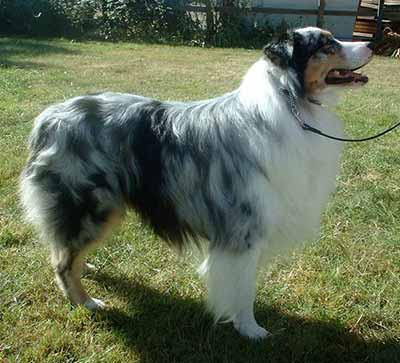
Surprisingly, the Australian Shepherd did not originate in Australia. It was developed entirely in the United States!
These are herding dog breeds, so are working dogs and are very energetic. They needs lots of exercise and ideally they would have some sort of work to do or get daily walks or jogs. They also need ample time to romp and play off-leash. They are popular among ranchers due to their skill in herding and are also great at sports.
Australian Shepherds are playful, easygoing companions. They are wonderful pets for children due to their gentleness and high energy level. This breed is very intelligent, loyal, and eager to please. Training is usually quite easy. Aussies are protective and suspicious of strangers though, so socializing them well as puppies will help prevent aggression.
When choosing an Australian Shepherd, look for signs of eye problems. Blindness and deafness is common in mostly white Aussies. Other health concerns to be aware of include hip dysplasia, thyroid problems, skin disorders, and respiratory problems.
- Kingdom: Animalia
- Phylum: Chordata
- Class: Mammalia
- Order: Carnivora
- Family: Canidae
- Genus: Canis
- Species: lupus familiaris
Common Name(s)
Australian Shepherd and Aussie
Breed Type
The Australian Shepherd is a working dog. Popular among ranchers due to its skill in herding, the Aussie is also great at sports. This breed is adaptable to a variety of climates.
Background
The Australian Shepherd did not originate in Australia but rather was developed entirely in the United States. Some say its name comes from its lineage, others say it is because of the blue merle coloring of some Aussies, and still others believe it is a result of the breed’s popularity among Australian ranchers who relocated to the U.S.
The Australian Shepherd’s history is rather vague as well. It is accepted that the breed was developed in the late nineteenth and early twentieth centuries, but it is unclear exactly which breeds were crossed to create it. Likely candidates include the sheepdogs of Spain and Collies.
Description
The Australian Shepherd is a dog of medium size with a well balanced build. Its muzzle is fairly long and tapered, its ears set high and triangular, and its eyes medium and oval. Eyes may be brown, blue or amber, and are often marbled or flecked.
The Aussie’s coat may be straight or a little wavy. It is short and smooth with the exceptions of the back of the forelegs, breeches, mane and frill. Many Australian Shepherds have naturally short tails, and those that do not are usually docked shortly after birth. Coat colors include blue merle, red merle, solid black, and solid red, and may have white markings or copper points.
Aussies with two copies of the merle gene will turn out mostly white. Some unscrupulous or ill-advised breeders sell these dogs at a premium due to their rarity, but most of these dogs suffer from serious health problems.
Care and Feeding
Australian Shepherds do well on diets that include lamb, poultry, oats, potato and wheat. Aussies are easy to groom, requiring only occasional brushing and as-needed bathing. For longer or feathered coats, brushing is more important to help avoid matting and tangling.
Many Australian Shepherds are born with short tails, but tails over 4 inches long are usually docked at 2 to 3 days of age. Rear dewclaws are usually removed, and front dewclaws may or may not be removed when the dog is very young.
Australian Shepherds need yearly checkups to stay healthy. Vaccinations are due as follows:
- 6-8 weeks: Distemper, Leptospirosis, Hepatitis, Parainfluenza, Parvo, and Corona virus (DHLPPC)
- 10-12 weeks: Second DHLPPC
- 14-16 weeks: Third DHLPPC and rabies
- Annually: DHLPPC and rabies booster
Aussies shed moderately. If kept indoors, regular vacuuming of carpet and furniture is recommended. Some Australian Shepherds have allergies, so extra cleaning may be necessary.
Housing Your Dog
This active breed needs plenty of space, so it does not make a good apartment dog. A large yard is recommended.
Social Behaviors
Australian Shepherds are loyal and loving toward their families. With proper socialization, they also get along with strangers. They usually do well with other animals, although they may chase or nip them due to their herding instincts.
Handling and Training
These smart dogs can learn to do almost anything. They are hard-working and love to make their owners happy, so training is usually a joy.
Activities
Aussies are very energetic, so they need lots and lots of exercise. They should ideally have some sort of work to do. They need daily walks or jogs, and should have ample time to romp and play off-leash.
Breeding/Reproduction
Australian Shepherds have an average of seven puppies per litter. When selecting a mate for your Aussie, check bloodlines for eye problems, hip dysplasia, and thyroid problems. It’s not advisable to breed two merle Aussies together, because this increases the chance of blindness, deafness, and other health problems in the offspring.
Common Health Problems
The most common health issue in Australian Shepherds is eye problems. The most serious include Collie eye anomaly and cataracts. Hip dysplasia, Pelger-Huet syndrome, and thyroid problems are also sometimes found in the breed. All of these problems become less prevalent with proper selective breeding.
Australian Shepherds are also prone to toxicity from certain drugs, including heartworm medications. Tests are available that can determine whether a particular dog is susceptible to this.
Availability
Australian Shepherds are easy to find in most areas. They usually sell for $300 to $600.
References
“Australian Shepherd“, Dog Breed Info Center, Copyright 1998-2008
Cusick, William D., “What to Feed an Australian Shepherd“, Referenced online, 2008
Welton, Michelle, “Australian Shepherds: What’s Good About ‘Em? What’s Bad About ‘Em?“, Copyright 2000-2008
“Australian Shepherd Puppies for Sale“, Copyright PuppyFind.com, LLC, Referenced online, 2008
“Australian Shepherd“, Wikipedia, Copyright 2008
Featured Image Credit: AlbanyColley, Pixabay