
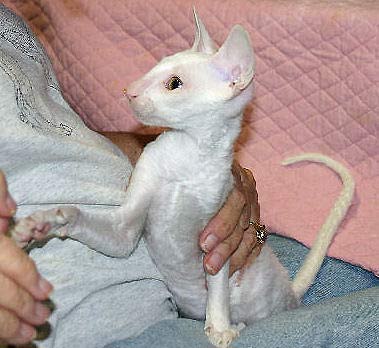
The Cornish Rex Cat is a very unique looking breed, delicately built but very athletic!
The Cornish Rex is a gentle, friendly cat that makes it a good family pet. The great pet qualities of this breed are highlighted by the appearance of its short wavy looking coat. It stands out from other cat breeds because its coat is primarily made up of soft down hairs, its undercoat. and it has virtually no awn or guard hairs. This breeds coat requires very little maintenance. Despite the downy undercoat, an interesting fact about this breed is that it is less likely than other cat breeds to cause an allergic reaction in people who are allergic to cats.
Cornish Rex cats have an interesting body shape. They have a long slender body and tail, and long slender legs, but they are muscular and heavy around the hips. The head is triangular shaped with two big, oval shaped eyes, a long nose, and large ears. This cat requires little grooming and does not shed very much. In fact, it is important not to over-groom a Cornish Rex. The wavy coat pattern is encouraged with firm stroking, yet too much brushing can cause bald spots.
A social cat, the Cornish Rex enjoys being around people and other animals. It is a gentle, loving cat that bonds to the whole family. This cat breed is agile and playful, and enjoys being active. Some say that it is a lap cat, while others say that it prefers play to cuddling. It likes being indoors and does very well when kept inside, in fact it does not handle extremes of heat or cold. Still it does enjoy going outside to run around when the weather is mild. The Cornish Rex is also talkative and has a voice similar to the Siamese, but is not as high-pitched.
The Cornish Rex started out as a mutation breed cat. It originated in 1950 as a spontaneous genetic mutation from typical farm cats in Cornwall, England. Later it was selectively bred with a variety of other cat breeds including the Burmese, Siamese, Russian Blue, and British Shorthairs to improve its stamina. Its name came from a combination of the town Cornwall, and from the curly pattern of its coat. This similar curly pattern is seen in Rex Rabbits. Thus the name Cornish and Rex. The Cornish Rex appears to be very similar to the Devon Rex, but these two breeds do not have the same gene that’s responsible for their curly coats. On the other hand, it is closely related to the German Rex, which does share the same curly-coat gene.The Cornish Rex is currently found in England, the United States, and Australia.
For information about keeping a pet cat, see:
Cat Care: How to Take Care of a Cat
- Kingdom: Animalia
- Phylum: Chordata
- Class: Mammalia
- Order: Carnivora
- Family: Felidae
- Genus: Felis
- Species: domesticus
Background
The Cornish Rex originated from a spontaneous genetic mutation in a litter of typical farm cats born on July 21st 1950 in Cornwall, England. The first Cornish rex was named Kallibunker and his mother was Serena. He was a red tabby with an unusual curly coat. The owner, Mrs. Nina Ennismore, bred Kallibunker with his mother, which produced two more curly coated kittens. Continued breeding established the Cornish Rex breed.
The breed was given its name because it originated in Cornwall and Mrs. Ennismore believed that its coat was similar to the coat of Rex Rabbits. However, if a Rex Rabbit was found to have a curly coat, it was considered faulty. A more accurate name would have been Asterex, the name of another breed of rabbit that is known for its wavy fur. Despite this discrepancy, “Cornish Rex” has prevailed as the name for this breed.
The Cornish Rex was recognized as an official breed in America in 1964 and in Britain in 1967. Sadly, there was a lack of enthusiasm for this breed in its early years, and its father, Kallibunker, and most of the other Cornish Rexes were put to sleep in 1956. Mrs. Ennismore had acquired 40 cats and could not afford to keep all of them, so most of them were destroyed. Thankfully, enough of them were saved to preserve the breed.
Since this breed was known for a lack of stamina, it was selectively bred with Burmese, Siamese, Russian Blue, and British Shorthairs. The Cornish Rex is closely related to the German Rex. They share the same curly-coat gene. While the Cornish Rex appears to be very similar to the Devon Rex, they do not share the same gene for their curly coats.
Description
The Cornish Rex is known for its unique coat. At first glance, it just looks like this breed has a wavy coat. However, it is distinct from other breeds in that it has a short and wavy coat with no guard hairs. The average cat has down hairs (the undercoat) and awn hairs and guard hairs (the top coat). The Cornish rex has few awn hairs and no guard hairs, making his coat mostly comprised of down hairs. These hairs are thinner than other cats’ hairs, being only about 60 percent of the thickness of the average cat hair. This fact, along with the fact that they are mostly down hairs, makes the Cornish Rex’s coat very delicate and soft. All colors and patterns are accepted in this breed. Some examples include Red, Shaded Silver, Blue Smoke, Brown Patched Tabby, Calico, Blue-Cream, and Van Bi-color.
The Cornish Rex has a small to medium sized body. The torso is long and slender, while the hips are heavy and muscular. The back is naturally arched. This breed has a medium sized head that is triangular and longer than it is wide. The eyes are medium to large sized and oval in shape. The nose is long and the ears are large. The whiskers and eyebrows are crinkled. The legs and tail are long and slender. This cat weighs about 6 to 10 pounds. Males are larger than females. Its lifespan is 12 to 15 years.
Glossary terms:
- Down Hairs: The fine, fluffy hairs that are closest to the skin of the animal and comprise the undercoat.
- Awn Hairs: The hairs that are longer than the down hairs and shorter than the guard hairs that help protect the down
hairs and provide insulation. They are a part of the top-coat. - Guard Hairs: The longer, coarse hairs that help protect the undercoat and are a part of the top-coat.
Care and Feeding
The Cornish Rex enjoys meat over other food groups. However, it does not require a special diet.
Housing Your Cat
Due to its delicate coat, this breed does not fare well in extreme weather conditions. It should be kept out of extreme heat and cold and should be provided with extra warmth when it is cold inside. The Cornish Rex enjoys being indoors, and can be kept as an apartment cat. It is also an active breed, so it enjoys time outdoors in mild weather.
Maintenance
The Cornish Rex requires minimal grooming. Excessive brushing can cause bald spots to develop. Firm stoking of the coat can promote the wavy pattern.
Social Behaviors
This is a social breed. It enjoys being around people and animals. Its gentle and friendly nature makes it a good family cat. It has been described as “individualistic”, though it likes playing and being around others.
Activities
The Cornish Rex is active and playful. It enjoys playing, so it should be provided with toys and a scratching post indoors.
Breeding/Reproduction
This breed should only be bred with the same breed. Litters contain 3 to 6 kittens. Cornish Rex females are excellent mothers.
Common Health Problems
This breed is somewhat fragile, due to its delicate coat. Its coat is more easily damaged than other breeds’ coats and it has little protection from hot and cold weather. However, it is a generally healthy cat with a long life-span. The first Cornish Rexes were known to have little stamina, but they were bred with other breeds to improve the stock. The current Cornish Rex is an active, agile cat that has no problem with stamina.
Availability
This breed can be found from breeders on the internet or in your local area. The price of a Cornish Rex ranges from about $200 to $1200.
References
- See Animal-World References: Cat Breeds – Exotic Cats
- Bruce Fogle, CATolog, DK ADULT, 2002.
- Mordecai Siegal, Simon & Schuster’s Guide To Cats , Simon & Schuster, 1983
Featured Image Credit: Grigorita Ko, Shutterstock