
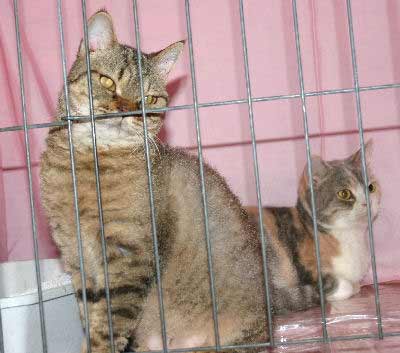
The American Wirehair Cat is a fairly recently developed breed with a bold, unusual appearance!
The American Wirehair Cat has a wonderfully springy coat of delicate wiry hair, similar to the coat of a lamb. Each hair is crimped, bent, hooked, or curled. This distinctive wiry hair along with a medium length coat sets this breed apart from its relative, the American Shorthair Cat, which is the cat breed that it was developed from. Despite the texture of its coat, it requires very little grooming.
Just like the American Shorthair, the American Wirehair is a highly desirable family cat. It has a rather wild appearance, yet this breed is known for being friendly, gentle, and playful. This is especially true for the second and later generations of this breed mostly seen to day. First generations were said to be a little wilder and rougher.
This is an endearing, loving cat breed. The American Wirehair Cat is very active yet not hyper, and loves to be the center of attention. Unlike some other breeds, it becomes attached to all members of the family as long as it is treated well. It is a playful cat that is interested in the world. This breed has a soft voice and is also a good mouser. It makes a great pet cat for a family, couples, or individuals.
The American Wirehair is a spontaneous genetic mutation of domestic breed cats. It was developed from the American Shorthair Cat. Its wiry hair is the result of a mutation on a dominant gene. This bouncy “lamb” type coat mutation, though a recent development in cats, is not unheard of in other small animals. A similar type of coat mutation has also been developed in some other furry species as well, an example is the Teddy Guinea Pig.
This mutation breed cat is “made in America”. The American Wirehair originated on a farm in New York in 1966 and became officially recognized by the Cat Fanciers’ Association in 1977. Although this breed is well-known, It is still a fairly uncommon breed in America, the United States and Canada, and is extremely rare in the rest of the world. But with its excellent pet cat qualities, it has a great future.
For information about keeping a pet cat, see:
Cat Care: How to Take Care of a Cat
- Kingdom: Animalia
- Phylum: Chordata
- Class: Mammalia
- Order: Carnivora
- Family: Felidae
- Genus: Felis
- Species: domesticus
Background
The first known American Wirehair, named Adam, was born in 1966 on a farm in New York. The kitten was born to two straight-haired American Shorthair parents, Bootsie and Fluffy, and was the only wirehaired kitten in the litter. He was red and white. The wiry hair is caused by a mutation on a dominant gene.
Adam was bred with a female straight-haired kitten from the same litter named Tip-Toe. They successfully produced wire-haired kittens, and by 1969, a true-breeding American Wirehair had emerged. In 1977 the Cat Fanciers’ Association recognized it as an official breed. It is still an uncommon cat in the United States, but is a rare cat nearly anywhere else in the world. The common name of this mutation breed cat is American Wirehair, or American Wirehair Cat.
Other unique and interesting coats are the result of either mutation cat breeds or hybrid cat breeds. Another breed with a wiry coat is the Bramble Cat, which is actually a newer hybrid cat breed developed by crossing several breeds, including the Peterbald (a mutation hairless cat) and the Bengal Cat (a hybrid cat). These distinctive cat breeds have wavy or curly coats or can be hairless cats, and include:
- Cornish Rex – a mutation cat breed with a fine undercoat of wavy thin hairs.
- Devon Rex – a mutation cat breed with a fine undercoat of wavy thin hairs as well as some guard hairs, giving it a bit more lumpy appearance than the Cornish Rex.
- Sphynx or Canadian Hairless – this cat is not truly hairless, but has a “peach fuzz” type of coat and somewhat wrinkly skin. This is a mutation cat breed whose characteristic hairlessness is caused by a recessive gene.
- Donskoy, Don Hairless, or Don Sphynx – a hairless cat, but that has a “peach fuzz” type of coat. This is mutation cat breeds characteristic hairlessness is caused by a dominant gene.
- Peterbald or Russian Peterbald – this is a hybrid cat breed, created by crossing a Donskoy or Don Hairless with Siamese cats and Oriental cats.
- Levkoy or Ukrainian Levkoy Cat – this newer hybrid cat breed is hairless cat with folded ears. It is created by crossing a crossing of a lop-eared cat with a Sphynx cat. These cats are seen predominantly in the east European country of Ukraine, by 2008 there were over 200 registered within the Ukraine and Russia.
Description
The defining feature of the American Wirehair Cat is of course its wiry, springy fur that resembles the coat of a lamb. The wiry appearance is created by the fact that each hair is either curly or hooked. Unlike the American Shorthair, the American Wirehair’s coat is of medium length. The hair is coarser on the head, flanks, and base of the tail, but is soft on the underbelly and chin. The coat can have any color form that the American Shorthair has, except for patched tabby. Some examples of acceptable colors include White, Cream, Shaded Silver, Black Smoke, Classic Tabby Pattern, Calico, and Blue-Cream.
Apart from its unique coat, the American Wirehair is similar to the American Shorthair in most other aspects. It is a medium to large cat and weighs from 8 to 15 pounds. It has a muscular body. The head is medium-sized, broad, and round. The eyes are large, round, and wide-set. It is highly desirable for it to have curly whiskers. The males are larger than the females and have defined jowls. This breed’s approximate lifespan is 15 years.
Glossary terms:
- Flank: The area on the side of an animal between the last rib and hip.
Care and Feeding
This breed has no special dietary needs.
Housing Your Cat
The American Wirehair enjoys being indoors, but also enjoys going outside. It should be allowed to go outside, at least into a yard, but will not become distraught if it is not allowed to run free all of the time.
Maintenance
American Wirehairs require minimal grooming. They should be brushed and combed once a week. Their wiry coat can be damaged easily, so care should be taken to not damage it. Occasionally they may need a bath because of their oily skin.
Social Behaviors
Like the American Shorthair, this breed enjoys being around people and other animals, but does not require an excessive amount of attention.
Activities
This breed enjoys playing, so it should be provided with toys and time to play with its owner. It should also be provided time outside to exercise. A scratching post is also a good indoor addition.
Breeding/Reproduction
American Wirehairs are excellent parents. Kittens can be weaned at 8 weeks, but it is preferable to wait until they are 12 weeks old.
Glossary terms:
- True-breeding cat: A cat that will pass on a certain trait, such as being wirehaired, to all future offspring, if bred with another true-breeding cat for the same trait.
Common Health Problems
The American Wirehair is a resilient, healthy cat that suffers from no special illnesses. As mentioned earlier, its wiry coat can be damaged easily, but this concern is mainly cosmetic. It should not affect the health of the cat. Some of these cats may suffer from skin-related allergies.
Availability
The American Wirehair is a difficult breed to find, due to its scarce existence. However, it is possible to find one on the internet or from a local breeder with persistence. Again, due to their rare nature, you can expect their purchase price to be fairly high.
References
- See Animal-World References: Cat Breeds – Exotic Cats
- Bruce Fogle, CATolog, DK ADULT, 2002.
- Mordecai Siegal, Simon & Schuster’s Guide To Cats , Simon & Schuster, 1983
Featured Image Credit: Azovsky, Shutterstock