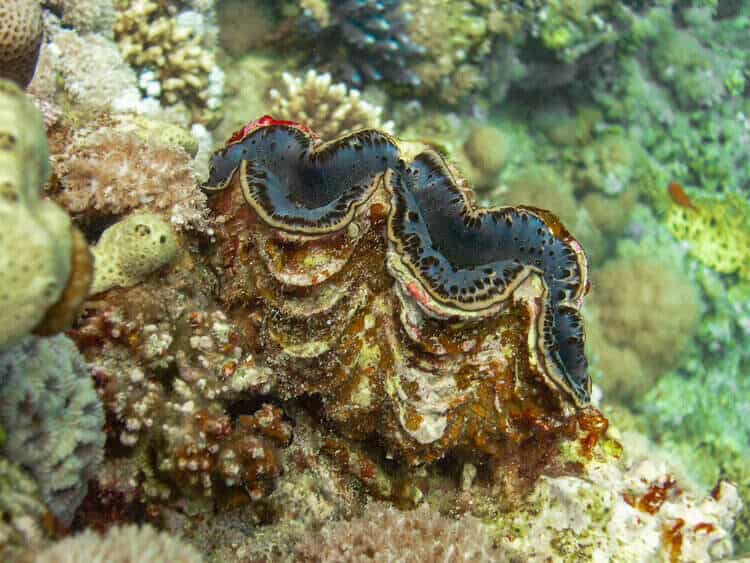
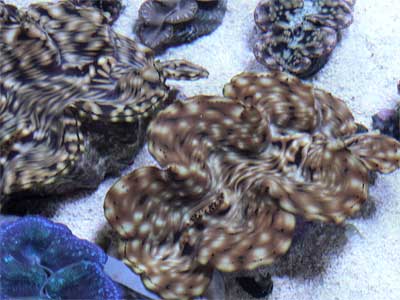
The Squamosa Clam is not overly flashy, but it has a very distinctive, simple beauty of its own!
The Squamosa Clam Tridacna squamosa is a subtle beauty. It is most commonly found with a warm brown mantle patterned with many golden brown or yellow wavy lines. Yet one of its most most striking attributes can be the contrast on the mantle. The darker background is generally accented with lighter colored spots and wavy lines, however, it can also be strong in color. There are varieties with green and blue spotting, and they have also occurred with rose and purple coloring.
The shell of the Squamosa Clam is also quite intriguing, with distinctions unique to this Tridacna clam species. The symmetrical shell has large leaf-like fluted scales, call scutes. In the wild these scutes provide shelter for other small animals such as little crabs and clams, and other invertebrates.
This is one of the giant clams, along with the Hippopus ClamHippopus hippopus, that is highly favored by curio and shell collectors. With its leaf-like scutes, it is described by a number of names reflecting its appearance. In fact, the name ‘squamosa’ is latin meaning ‘scale’. Common names include the Fluted Giant Clam, Scaly Clam, Scaled Giant Clam, Scaled Clam, and Fluted Clam. Aquacultured Squamosa Clams will also be referenced to as the Squamosa Clam Cultured.
The Squamosa Clam can be a good choice for a beginning saltwater aquarist with a good sized tank. It’s a durable clam that usually does well in reef aquariums and will commonly reach about 12″ in length. These giant clams can get much larger in the wild, reaching just over 17 1/2,” but that takes over 60 to 70 years. Like the Giant ClamTridacna gigas, it is very hardy, however, unlike the the Giant Clam it is a slow grower and will not quickly outgrow your aquarium.
Given a large tank with strong lighting and careful attention, Squamosa Clams require little else in the way of care. Their ability to close completely also sets them apart from other clams. They will also reward their owner with their interesting relationship with small creatures that hide in their shell.
For more about keeping Tridacna Clams, see:
Giant Clam Care: Caring For Tridacnid Clams
Squamosa Clams usually will reach around 12″ in captivity. They can reach almost 18,” although it will take 60 to 70 years to do so! This video shows the beauty of the Squamosa Clam in great detail. Provide a tank that is at least 100 gallons for stable water and very strong light. These are considered a beginners clam, and strong light, an at least 6 month old tank and only turbulent water flow that can be low to high is required. Straight water shooting from a pump will cause the clam to eventually die over time for various reasons. The beauty of this clam is also seen in it’s shell!
- Kingdom: Animalia
- Phylum: Mollusca
- Class: Bivalvia
- Order: Veneroida
- Family: Cardiidae
- Genus: Tridacna
- Species: squamosa
- Minimum Tank Size: 100 gal (379 L)
- Aquarist Experience Level: Beginner
- Temperament: Peaceful
- Temperature: 74.0 to 83.0° F (23.3 to 28.3° C)
- Size of organism – inches: 17.7 inches (45.01 cm)
- Diet Type: Omnivore
- Suitable for Nano Tank: No
Habitat: Distribution / Background
The Squamosa Clam Tridacna squamosa was described by Lamarck in 1819. This genus is referred to as the “giant clams,†and its species name ‘squamosa’ is latin meaning “scale.” They are found in the Red Sea and from the east coast of Africa to the Indo-Pacific, Marshall Islands and Polynesia; then as far north as southern Japan and south as far as the Great Barrier Reef.
As with the Maxima ClamT. maxima, these are one of the most widespread of the giant clams. The T. squamosa also have outstanding shells with large, exaggerated scutes. Along with the Hippopus ClamHippopus hippopus, they are highly favored by curio collectors. They are sought after by the shell trade and are frequently imported from the Philippines.
This species is listed on the IUCN Red List as Least Concern (LC), with the designation Lower Risk/conservation dependent (LR/cd). However, it is listed as ‘Endangered’ on the Red List of threatened animals of Singapore, where it is called the Fluted Giant Clam. With its leaf-like scutes, the Squamosa Clam is described by a number of other common names reflecting its appearance, including the Scaled Clam, Fluted Clam, Scaled Giant Clam, and Scaly Clam. Aquacultured Squamosa Clams will also be referenced to as the Squamosa Clam Cultured.
Squamosa Clams can be found at depths from 1 to 50 feet (0 to 15 m), but are most commonly found in water shallower than 20 feet (6 meters). They occur in the sheltered areas of many different environments. They are found inside and outside of lagoons, patch reefs, reef flats and steep walls. They will be couched on rubble, soft or sandy bottoms, coral groves, or coral.
Although they are often attached to a hard substrate by their byssus threads, especially when young, they are usually found lying on the substrate and often amongst Acropora corals. As juveniles they have a larger byssal opening, however large adults do not have this opening, using their weight to keep them in place. They will also open and close their shell to right themselves if they are pushed over. Predators are small pyramidellid snails that bore into their tissue and feed on their bodily fluids. While this is less of a problem in the wild, it is more of an issue in enclosed systems.
- Scientific Name: Tridacna squamosa
- IUCN Red List: LC – Least Concern – Considered endangered (EN) in Singapore. They are now aquacultured.
Description
Squamosa Clams, also known as Scaly Clam or Fluted Clam, will typically reach around 12†(30 cm) in captivity. However, after 50 to 70 years, they may very well reach their maximum size of over 17.72†(45 cm) in the wild. They become sexually mature at about 6.3 to 7.8†(16 to 20 cmm), which is around the time they are 3 to 5 years old. They are all born male and then turn to female as needed. Many aquarists have kept Tridacna squamosa clams for decades, however this genus will live over 200 years in the ocean.
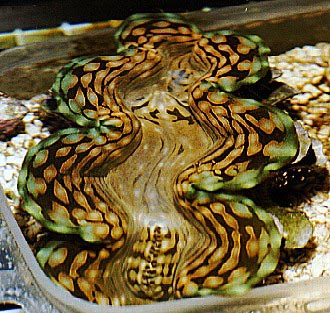 Photo © Harbor Aquatics
Giant clams have a soft, laterally compressed body that is enclosed in an elongated shell. The shell consists of two hinged parts. The hinge can be half the shell’s length.
The hinge has an opening called the “byssal opening,” where a muscular foot attaches to a hard surface. This opening can be large when the Squamosa Clam is young, but it can close up in adults as the shell grows, to the point where there may be no opening at all. Adults use their weight to keep them in place and can open and close their shell to right themselves if they are pushed over.
They have no head, but their soft body consists of a mantle forming an outer wall that encloses a visceral mass containing the body’s organs. The mantle protrudes in the form of flaps that are usually patterned. The siphon, also called the intake siphon, is a fleshy tube-like structure that is part of the mantle. The intake siphon is used to direct water flow into the mantle cavity and across the gills.
Squamosa Clams are most commonly found with a brown mantle with many golden brown or yellow wavy lines. However, the mantle can also be very variable in coloration and quite beautiful. Some varieties are accented on a dark background with green and blue spots, and sometimes rose or purple.
Characteristics of Squamosa Clams:
- Symmetrical shells
- Shells are usually white but can be yellow, orange, or pink
- Shell has large, widely spaced scutes
- The hinge is half the shell’s length
- The inhalant siphon has many large, branched tentacles
- The mantle extends well over the edges of the shell
- Small to medium size byssus gland opening in juveniles, but often no opening in large adults.
Comparing Squamosa Clams to other species of Giant Clams:
- Maxima Clam: Young Squamosa Clams are sometimes confused with the Maxima Clam Tridacna maxima, mostly because both clams have scutes on their shells. The rows of scutes of a Squamosa Clam are much larger and not as close together as on the Maxima Clam, and the hinge on the Maxima is smaller. Also the shell of the Squamosa Clam is symmetrical, while the shell of the Maxima Clam is asymmetrical.
- Crocea Clam: The byssus gland opening on the Squamosa is wide, but not like that of the Crocea Clam Tridacna crocea.
According to The Reef Aquarium Volume One, Squamosa Clams are known to form hybrids with the Crocea Clam T. crocea and the Maxima Clam T. maxima.
- Size of organism – inches: 17.7 inches (45.01 cm) – Commonly reach 12″ though can reach 17.7 over 60 to 70 years. Sexually mature in 3 to 5 years at around 6 to 7″ in length.
- Lifespan: 200 years – May live decades in captivity, but can live over 200 years in the wild.
Difficulty of Care
The Squamosa Clam is subtly beautiful and can be a good choice for a beginning saltwater aquarist. it is a durable clam that usually does well in reef aquariums. Like the Giant ClamTridacna gigas, it is very hardy, however, unlike the the Giant Clam it will not quickly outgrow your aquarium. Given a large tank with strong lighting and careful attention, Squamosa Clams require little else in the way of care.
If a healthy clam is obtained and proper lighting provided, this clam is quite hardy and relatively easy to keep. Obtain a specimen, preferably over 4,” and you’ll have a hardy clam that can easily acclimate to your tank. Young clams under 4″ are not as hardy and do not ship well. It is important to make sure they are not being irritated, not being fed upon by other organisms. When first obtained, inspect the clam’s shell for predators that can be removed.
Being placed on any surface is fine with them and plenty of fish in the aquarium will keep your clam fed. The Squamosa Clam isn’t as demanding in the light department as other Tridacna clams, like the Maxima and Crocea Clams. But they cannot tolerate a lack of light for even short periods of time, so having back up lighting would be a good decision. They are also not tolerant of sudden increases in light intensity. These clams do best with a low to moderate water flow. However, as long as water is turbulent (not one direction), and it is constantly flowing over and around the clam, the water can be slow, moderate or high.
These clams adjust to their new surroundings in time, and will become very hardy. But to keep them healthy, avoid wide fluctuations in light, water flow, reef water parameters (calcium, magnesium, etc.), and salinity. As Squamosa Clams grow larger, the insides of their shells become thicker and thicker. They continually consume large amount of calcium and alkalinity from the water, so these levels need to be kept up as the clam grows.
- Aquarium Hardiness: Moderately hardy
- Aquarist Experience Level: Beginner
Foods and Feeding
Most clams fulfill their nutritional requirements by filter feeding and absorbing dissolved organic compounds from the water. Giant clams have gone even further than this, using zooxanthellae to manufacture food for themselves. Larger clams, over 4,” receive the majority of their nutrition from their zooxanthellae. Squamosa Clams that are under 4″ do not have enough mantle tissue to provide enough space for zooxanthellae to keep the clam alive.
It is generally believed that mature giant clams do not require feeding in the aquarium. Whether additional feeding is required is still debated. Some hobbyists believe they should be fed, going on the assumption that they are filter feeders like other clams. Basic nutrients in the aquarium that giant clams need are calcium, strontium, iodine, and a minute amount of nitrate that is at least 2 ppm. They will not thrive at a level of 0 nitrates.
Four ways clams make food for themselves:
- These clams have large amounts of zooxanthellae that live in their tissues. With plenty of light this algae will make too much food for themselves and the extra carbon and glucose is given to the clam (similar to most reef corals).
- The actual zooxanthellae themselves can be eaten by amoeboid cells within the host clam if needed.
- Giant clams have the ability to absorb nutrients like ammonia, nitrate and phosphates from the water.
- Giant clams are filter-feeders, straining fine particulates like phytoplankton, zooplankton and detritus from surrounding waters with their specialized gills.
When small, Squamosa Clams are dependent on phytoplankton from various sources and they need to be spot fed several times per week. If they are under 2″ to 4″ they may need daily feedings. Feed them micro-foods designed for filter feeders such as a yeast-based suspension that has been mechanically whisked, live phytoplankton or commercially prepared micro-foods like ‘marine snow’ or ‘reef snow’.
In the wild, larger clams basically make their own food on days when the light is not strong enough. This shouldn’t be an issue in captivity with good lighting, but Squamosa Clams do eat more food than some of the other giant clams, such as the Crocea Clams. Once they are older they will still benefit from phytoplankton foods fed on a regular schedule in an aggressively skimmed tank. If there is a healthy population of fish in the tank, and the clam is over 4†long, it can be fed a little less. For more information about the feeding process of Squamosa Clams see What Do Clams Eat.
- Diet Type: Omnivore – Nutrition is obtained through filter-feeding of phytoplankton, zooplankton and detritus along with lighting and the marine algae, zooxanthellae.
- Flake Food: No – Will not eat this food.
- Tablet / Pellet: No – Will not eat this food.
- Live foods (fishes, shrimps, worms): Some of Diet – Clams under 4″ will need live phytoplankton to thrive.
- Liquid Foods: Some of Diet – Marine snow or other phytoplankton substitutes, especially if there are no fish. Lighting and the marine algae, zooxanthellae, make up the rest of the food.
- Meaty Food: Half of Diet – Zooplankton and Phytoplankton in the water. The rest comes from lighting and the marine algae, zooxanthellae.
- Feeding Frequency: Weekly – Daily for clams up to 2″ and several times per week for clams up to 4″ is recommended. Can be fed weekly when full grown, but can be fed less if there are plenty of fish in the tank.
Aquarium Care
Squamosa Clams are quite hardy and relatively easy to keep if a healthy clam is obtained. With careful attention paid to water parameters, proper lighting, and good filtration it will thrive. Stable tank conditions with water quality maintained are necessary to keep the Squamosa Clam healthy. Do typical water changes of 10% biweekly, 20% a month, or 5% weekly. It has been noted that 5% weekly water changes replenish many of the needed additives.
Basic nutrients in the aquarium that giant clams need are calcium, strontium, iodine, and a minute amount of nitrate. Along with regular water changes the following parameters are important in keeping your Squamosa Clam long term. Adding large doses weekly is not recommended. Daily doses or adding to top off water is best:
- Calcium: Calcium is the main building block for clams and should be present in the water at levels of at least 280 mg/L for growth to occur. Seachem’s calcium additive works at 385. More rapid, natural growth is seen when calcium is in the range of 400-480 mg/L.
- Strontium: Strontium is incorporated in the shell along with calcium and should also be provided for optimum growth.
- Iodine: The addition of iodine to the aquarium will also enhance growth and color. Use caution, as iodine spikes have been known to kill them. Add iodine with top off water or dose daily, but not at one time in a big weekly dose.
- Nitrate: They require some nitrogen for proper growth. They will not thrive at a level of 0 nitrates. Nitrate can be added if levels are extremely low, but be careful as nitrates should never exceed 2 mg/L. Provide a minute amount of nitrate that is at least 2 ppm.
If you have a healthy specimen, the Squamosa Clam will generally attach itself to the substrate in less than a day. Keep this in mind when placing your clam in the tank. Make sure you put it where you want it to stay. Squamosa Clams aren’t as demanding in the light department as other Tridacna clams, but do need constant light. They are also not as tolerant of strong fluctuations in water parameters as other Tridacnids, and you really don’t want your water parameters to fluctuate too much. Keep a watch for predators. It is important to make sure they are not being irritated or fed upon by other organisms. For more in depth information on caring for Squamosa Clams see, Caring For Tridacnid Clams.
- Water Changes: Bi-weekly – Keep water stable, test weekly
- Calcium Levels: 400.0 – 450.0 ppm – If using Seachem’s calcium, 385 should suffice.
- Alkalinity Levels: 8.0 – 12.0 dKH – Best at 9
- Magnesium Levels: 1,250.0 – 1,350.0 ppm – Adjust magnesium levels before checking calcium levels.
- Strontium Levels: 5.0 – 15.0 ppm
- Iodine Levels: – .030 to .060 ppm: Control is not recommended.
Aquarium Setup
Squamosa Clams can be kept in a reef environment with live rock. They should be placed on a firm substrate with a low to moderate water flow. Keep fluctuations in water parameters to a minimum. A high pH and high temperatures can cause problems.
The size of the tank should be at least 100 gallons per 12 to 18″ of clam (though larger is better) as this will help keep water parameters stable. Live rock is necessary and sand is preferred if they will be on the substrate. A mature tank is also important. The tank should be at least 6 months old from the time of adding that last piece of live rock. Once you see Coralline algae growing (that cool pink and purple hard algae) you know your tank is doing well and ready for your clam.
They should be placed on a firm substrate with a low to moderate water flow. They are fine on any surface, but Squamosa Clams can also be placed in a larger hole in the rockwork (large enough for them to open fully), but you should periodically use a turkey baster or power head to remove collected detritus. Where ever they are placed, make sure the eventual 12″ to 17″ of room they will occupy is free of shadowing.
Coming from slightly deeper waters than some of the other giant clams, Squamosa Clams will not need as intense lighting. They requires moderate to intense lighting. According to Aquarium Frontiers’ On The Half Shell by Daniel Knop, the T. squamosa is easily stressed if you put the clam under lighting that is too bright with strong currents and frequently develop central bleaching when under strong lighting.
They are tolerant of tanks that have T5s or other fluorescent lighting, and some will also do well with Metal Halides or intense LED lighting once acclimated. You can acclimate them to a bright aquarium by using layers of plastic screening between them and the lights. Remove one layer of screening every couple of days until the clam is fully adjusted to the light.
If your T. squamosa is wild caught, start by putting it in the lower third of your tank. If the clam doesn’t open within a few days, move it into a spot with indirect lighting. If the lighting above your tank is good, place the clam at the bottom of your tank. T. squamosa‘s can let loose a good, strong blast of water when they slam their shells shut. So, if you put your clam too close to the top of your tank, you’ll end up with water up in your lights.
Since salinity is critical, aim for 1.024 to prevent swinging out of the 1.023 and 1.025 range. Automatic fresh water top offs are highly suggested to keep salinity stable. Keep pH at 8.1 to 8.3, do not let the aquarium exceed a pH above 8.4. For hardness, maintain a dKH of 7.9-12, with the optimal being 9. A temperature between 74 to 86°F (23 to 30°C) is fine, however keeping it closer to 83°F is suggested, and be sure to keep it stable.
- Minimum Tank Size: 100 gal (379 L) – Tank should be at least 6 months old, preferably with coralline algae growth.
- Suitable for Nano Tank: No
- Live Rock Requirement: Typical Amount
- Substrate Type: Sand
- Lighting Needs: Moderate – normal lighting – Kelvins: 6K to 10K to mimic the light levels they receive in the shallow habitats of their natural environment.
- Temperature: 74.0 to 83.0° F (23.3 to 28.3° C) – Keep the temperature stable.
- Specific gravity: 1.023-1.025 SG – Salinity is important, too high or low a salinity can cause the death of a clam. Stay within this range, aiming for 1.024.
- Water Movement: Moderate – For the Squamosa Clam a low to moderate, turbulent current is best.
- Water Region: All – Dependent on lighting.
Social Behaviors
Clams are very stationary and peaceful, they are not aggressive towards other aquarium inhabitants. As the Squamosa Clam grows, it will lose its byssus gland. Though the byssus gland is what several Tridacna clams rely on to anchor themselves in place, that is not the case with these giant clams. The Squamosa Clam, though not getting quite as large as the Gigas ClamT. gigas and the Derasa ClamT. derasa, it is heavy and simply stays where is is put.
Even though they have the ability to close their shell, they will need protection from anemones and some corals. They should not be kept near any stinging cell creatures and must be kept away from any sweeper tentacles. Anemones need to be watched, as they can move close to a clam and sting or eat it.
Giant clams commonly have small shrimp and crabs that live in the mantle cavity. They are considered ectoparasites or commensals, and they will not harm a healthy clam. Be cautious with tank inhabitants that may pick at the clam or eat its mantle such as Trigger Fish and Puffers. Blennies, Butterfly Fish, and Clown Gobies. Angelfish and some shrimp may also disturb Tridacna clams.
- Venomous: No
- Temperament: Peaceful
- Compatible with:
- Same species – conspecifics: Yes
- Anemones: Monitor – Protect the clam from anemones that wander.
- Mushroom Anemones – Corallimorphs: Monitor – Safe if there is no contact with the clam’s mantle.
- Leather Corals: Monitor – Should be okay if spaced apart.
- Zoanthids – Button Polyps, Sea Mats: Monitor – Safe if there is no contact with the clam’s mantle.
- Sponges, Tunicates: Safe
- Shrimps, Crabs, Snails: Monitor – Small commensal shrimp are fine if the clam is healthy. Remove any small, rice-sized snails found on the clam’s surface with a toothbrush.
- Starfish: Safe – Starfish usually only eat dying organisms.
- Feather Dusters, Bristle Worms, Flatworms: Safe
- Clams, Scallops, Oysters: Safe
- Crabs: Monitor – Tiny commensal crabs are okay on a healthy clam, avoid other crabs.
- Snails: Monitor – Make sure nassarius snails cannot turn a young clam over. Remove parasitic pyramidellid snails, other snails are safe.
- Sea Apples, Cucumbers: Threat – The clam will die if these species expel their toxins. Giant clams are much more sensitive to these toxins than other invertebrates, even if the system is large.
- Urchins, Sand Dollars: Monitor – Should be safe, but it is unknown if any or all species are safe.
- Nudibranch, Sea Slugs: Monitor – Should be safe, but it is unknown if any or all species are safe.
- Copepods, Amphipods, Mini Brittle Stars: Safe
- Stony Corals: May be aggressive – Only safe as long as they do not come in contact. Stony corals can sting your clam.
- Soft Corals: May be aggressive – Give clam plenty of space.
Sex: Sexual differences
There are no discernible sexual differences.
Breeding / Reproduction
The giant clams are protandry, meaning they are born male and change to female. Clams will release eggs and sperm that can number into the tens of thousands of eggs. This event tends to happen around sunset. One aquarist noted a spawning clam pulsing out eggs every two minutes. Once the eggs are externally fertilized, the embryos develop into trocophore larva, which are free-swimming. The next stage is the bivalve veliger, which sort of looks like a tiny free swimming clam. These will find a shallow area of the reef to settle into, often perching on top or on the side of coral outcrops or settling into the substrate.
Squamosa Clams have been propagated in captivity and are often referred to as Squamosa Clam Cultured. The demand from aquarists has raised interest in producing colorful varieties of all the species. These clams have commonly been seen spawning in captivity, however raising the larvae is problematic. For detailed information of tridacnid propagation, see Giant Clam Breeding and Reproduction
- Ease of Breeding: Difficult
Ailments / Diseases
Keep a watch out for predators! The most dangerous predators are the highly prolific pyramidellid snails of the Tathrella, Pyrgiscus, and Turbonilla genera. These are parasitic snails about the size of a grain of rice or smaller, rarely reaching a maximum size of about 7mm in length. These snails attack giant clams with a trunk-like snout called a “proboscis.” They punch holes into the clam’s soft tissue and then feed on its bodily fluids.
While in nature, giant clams can deal with a few of these parasitic snails, in captivity these snails tend to multiply to dangerous numbers. They may hide in the scutes of the clam or in the substrate by day, but will often will be found around the edges of the clam’s mantle tissue or byssal gape (large foot hole) after the lights go out. They can produce numerous small, gelatinous, egg masses on the clam’s shell. These masses are transparent, so difficult to spot. Before putting it in the tank, scrub your clam’s shell vigorously with a toothbrush, or other brush with firm bristles, to remove the snails and their eggs. Be careful not to scrub the clam’s soft tissues, as that can cause injury and lead to infection. Inspect your clam regularly for several months and remove any snails you discover.
Some other common ailments of Giant Clams:
- Pinched Mantle: Another common affliction of giant clams is called the Pinched Mantle disease. The edges of the mantle become pinched and contorted, and the margins won’t extend fully. This condition almost always results in death unless treated, and it can spread to other clams. The actual cause of this ailment is unknown, but it may possibly be an attack by some sort of protozoan. An easy treatment, that is is stressful but effective, is to submerse the clam in a freshwater dip for a few minutes. Signs of recovery can take a day or two.
- Bubble Mantle: Caused by laminar flow directed at the clam or pouring water directly into the aquarium in a way that causes bubbles to form (use a siphon and water pump and/or pour very slowly and carefully or pour into sump only). These bubbles can get stuck in the clam’s mantle with can cause illness and death.
- Gaping: The larger of the two holes is gaping open, larger than normal. This is usually due to poor water quality. Stability of your water parameters need to be checked quickly and addressed.
Giant clams are also quite sensitive to chemicals or toxic substances dissolved in the water, so be sure to maintain good water quality. As mentioned under aquarium care and aquarium parameters above, high pH, high salinity, and high temperatures can also cause problems. Avoid large weekly doses of anything, especially iodine, which has been known to kill them. For in-depth information on potential Tridacna clam problems, see: Tridacnid Clams: Friends, Enemies & Ailments.
Availability
Squamosa Clams are seasonal spawners, but those obtained from aquaculture systems are often available online, and it may be possible to special order them in stores. They range in size, usually from 1.25″ to 3.25,” and are moderate to fairly expensive in price.
References
- Animal-World References: Marine and Reef
- Tridacna squamosa (Lamarck, 1819) fluted giant clam, SeaLifeBase
- Tridacna squamosa, IUNC Red List, International Union for Conservation of Nature and Natural Resources
- Scott W. Michael, The 101 Best Marine Invertebrates, TFH Publications, 2008
- Ronald L. Shimek, Guide to Marine Invertebrates: 500+ Essential-to-Know Aquarium Species, Microcosm, 2005
- Anthony Calfo, Book of Coral Propagation, Volume 1 Edition 2: Reef Gardening for Aquarists, Reading Trees; 2 edition, 2007
- ***Anthony Calfo and Robert M. Fenner, Reef Invertebrates: An Essential Guide to Selection, Care and Compatibility , Reading Trees, 2003
- Alf Jacob Nilsen and Svein A. Fossa, Reef Secrets: Starting Right, Selecting Fishes & Invertebrates, Advanced Biotope Techniques , T.F.H Publications inc., 2003
- ***John H. Tullock, Natural Reef Aquariums: Simplified Approaches to Creating Living Saltwater Microcosms, 2001
- ***Julian Spring and Daniel Ramirez, Invertebrates: A Quick Reference Guide, Ricordea Publishing, 2001
- Daniel Knop, Giant Clams: A Comprehensive Guide to the Identification and Care of Tridacnid Clams , Ricordea Publishing, 1996
- ***Julian Spring and J. Charles Delbeek, The Reef Aquarium: A Comprehensive Guide to the Identification and Care of Tropical Marine Invertebrates (Volume 1), Ricordea Publishing, 1994
- James FatherreeM.Sc., Aquarium Invertebrates: A Look at the Giant Clam Tridacna squamosa, Advanced Aquarist, 2013
Featured Image Credit: Rob Atherton, Shutterstock