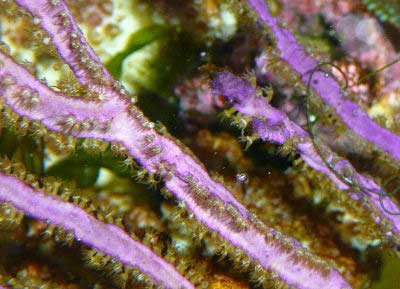
The Purple Sea Blade is a gorgeous gorgonian that gets really tall with long “ribbon-like” branches!
The Purple Sea Blade Pterogorgia anceps is a very handsome gorgonian, featuring flat branches that are dark purple. It has a long reach, growing to almost 3 feet (1 m) in height, making it the largest of the Pterogorgia genus. Thus it is also known as the Angular Sea Whip, Purple Whip, Purple Sea Whip Gorgonian, and Purple Ribbon Gorgonian.
The Pterogorgia gorgonians are easy to identify. They have a dichotomous growth structure, so rather than having branchlets extending out from a central stalk, their stalk divides into branches at cross sections. The branches are generally flattened and blade-like, giving them a ribbon-like appearance. Polyps emerge along the edges that can be white or tan. Although white polyps generally indicate a non-photosynthetic coral, the members of this genus are photosynthetic, living with a symbiotic marine algae known as zooxanthellae.
The Purple Sea Blade is just one of these beautiful Pterogorgia gorgonians. Two other common species are P. citrina and P. guadalupensis. The attractive Yellow Sea Whip or Yellow Ribbon P. citrina is a smaller, and slightly more delicate species. It can be yellow, green to olive green, or orange and possibly purple, with white or tan polyps. It typically only grows to about 12†tall (30 cm), though it has been seen up to 18†(46 cm), but it requires extremely bright light and a strong water flow to thrive. The Grooved-Blade Sea Whip P. guadalupensis can reach to 24†(60 cm) in height. Its polyps come from the edge of the blades, but also from grooves. It is gray to olive green and light purple, with cream or white polyps.
The Purple Sea Blade is moderately difficult to care for due to its to lighting, feeding, and water movement needs. In the past, they were thought of as impossible to keep. They would ship well, but deteriorate over time. Now it is realized that they need moderate to strong light, good water movement to prevent algae growth, and a regular feeding schedule. All Pterogorgia corals also have a secret weapon against algae. They will shed off a layer of their rind if it gets over taken by algae or cyanobacteria.
With the proper care this gorgonian will do fine, and so it is suggested for an intermediate aquarist. Be sure to only buy a Pterogorgia coral with the root attached to substrate. Provide the right environment and you will be rewarded with a beautifully colored gorgonian with open and happy polyps.
A large tank, 100 gallons are more that is close to 3′ tall is preferable, otherwise, regular trimmings will be needed. Avoid keeping it with a Flamingo Tongue Snail, which will quickly eat your gorgonian. Also, if doing an Atlantic biotope aquarium, keep encrusting gorgonians out of the reach of your Purple Sea Blade. For example, that Corky Sea FingerBriareum asbestinum will over-grow and kill it quite easily.
To learn more about these fascinating Octocorals see:
What Are Gorgonians? Types of Gorgonians, Sea Fans and Sea Whips
This video is quite relaxing! The Purple Sea Blade, found in the same waters as the Purple Bush Sea Fan compliment each other! Purple Sea Blades are a little less “fluffy” having flat blades, which help slow down water and the floating yummy foods it carries. Their polyps grow on the edges of the blades and even though the polyps are white (which non-photosynthetic have), they actually are a photosynthetic gorgonian. This Purple Sea Blade also has a “sister, P. citrinia which is bright yellow, orange or brown with white polyps, and the olive colored morph is the most commonly collected for the marine trade. They need to be fed daily, have strong water movement, strong lighting, ZERO phosphates and good water quality.
- Minimum Tank Size: 100 gal (379 L)
- Aquarist Experience Level: Intermediate
- Temperament: Peaceful
- Temperature: 70.0 to 84.0° F (21.1 to 28.9° C)
- Size of organism – inches: 36.0 inches (91.44 cm)
- Diet Type: Omnivore
- Suitable for Nano Tank: No
Habitat: Distribution / Background
The Purple Sea Blade Pterogorgia anceps was described by Pallas in 1766. Some other common names this species is known by are Angular Sea Whip, Purple Whip, Purple Sea Whip Gorgonian, and Purple Ribbon Gorgonian.
About the Pterogorgia Genus:
The Pterogorgia genus itself was described by Ehrenberg in 1834. There are at least 13 species in this genus, the most common being P. anceps, P. citrina, and P. guadalupensis. They are in the Class Anthozoa, Subclass Octocorallia, Order Alcyonacea, and Suborder Holaxonia (much sturdier species than Scleraxonia). The Pterogorgia genus was then placed in the Gorgoniidae family. This genus may also be found under the the Subfamily Plexaurinae with about 8 genera of gorgonians ranging in environments from subtropical to tropical waters.
The classification of gorgonians in general is done by some simple visual clues such as colony size, shape, axis structure, color, polyp placement, and pattern of branches. Getting a little more technical, they also look to see if the polyp is autozooid or siphonozooid. Then there is the more exacting use of chemotaxonomy, used to show the different terpenoids or other chemicals produced by each gorgonian species.
The Pterogorgia genus are found in the Western Atlantic Ocean near Florida, and in the Caribbean, Bahamas, and Colombia. They inhabit very shallow waters on in-shore reef flats with a very good current. They primarily occur on hard bottoms in back reef areas, near shore, or among seagrass, but they are seldom found on the reef itself. Their distinguishing characteristics are flattened branches with polyps usually extending only from the edges, though some species have polyps emerging from grooves as well. All the members are photosynthetic, containing the symbiotic marine algae called zooxanthellae.
Some additional common names of the genus, or of particular members of the genus, include Sea Whip, Sea Blade, Yellow Sea Whip, Green Lace Gorgonian, Grooved-Blade Sea Whip, Yellow Ribbon, and Gold Ribbon. The Pterogorgia genus has not been evaluated by the IUCN Red List for endangered species. They have been propagated in captivity, and interestingly, the Pterogorgia genus have pharmaceutical type compounds that are now being studied.
About the Purple Sea Blade:
The Purple Sea Blade is found in the Western Atlantic Ocean around south Florida, Caribbean and the Bahamas. Their habitat is typically back reefs where there are hard substrates in which they arise from. Water quality can vary and they are found from 3 to 65 feet (1 to 20 meters) in depth.
Predators of this gorgonian include the Flamingo Tongue Snails Cyphoma spp. and the Frilly Sea Slugs of the Tritonia and Tritoniopsis genera. Encrusting gorgonians will also easily grow over it. Like all the Pterogorgia corals, the Purple Sea Blade has a secret weapon against algae and cyanobacteria; It will shed off a layer of its rind to rid itself of these infestations.
- Scientific Name: Pterogoria Sp.
- IUCN Red List: NE – Not Evaluated or not listed
Description
The Purple Sea Blade and the other members of its genus are easily recognized gorgonians. Belonging in the Suborder Holaxonia, they have a rigid structure of branches that consist of a protein substance called gorgonin, thus the name gorgonian. The Gorgoniidae family has its coral structure covered by a rind, or tissue layer, with polyps on raised areas of the rind.
What sets the Pterogorgia genus apart is their formation. Rather than having a center stalk with branches extending out from it, they have a dichotomous growth structure, dividing at cross sections with a “Y†or “X†formation. The branches are flattened and blade-like, or can be triangular. Along the edges there are raised calyces with openings or grooves where polyps emerge. Pterogorgia species come in several colors from gray to purple, yellow, orange, brown and olive green. The polyps can be white or tan, and although white polyps generally indicate a non-photosynthetic coral, the members of this genus are photosynthetic. They do tend to shed their rind if the algae growth gets to be too much, so it is not necessarily a sign of decay.
The Purple Sea Blade is usually dark purple, though it may occasionally be seen in other colors. It has a dichotomous growth structure with 3 or 4 flanged, flat branches, thus the name Angular Sea Whip. On the edges, there are raised calyces with openings or grooves where the white or tan polyps emerge. It can also reach almost 3 feet (1 m) in height, making it the largest species in the genus. Lifespan is unknown.
There are a number of gorgonians this genus, but the two other common species are:
- P. citrina (Esper, 1792)
Yellow Sea Whip, Yellow Ribbon, Gold Ribbon
They are found in South Florida, the Bahamas, and the Caribbean Sea from depths of 3 to 33 feet (1 to 10 meters)on inshore shallow areas from back to patch reefs. They are small, typically only growing to 12†tall (30 cm), though they have been seen in the range of 7†to 18†(17 – 46 cm). They can be yellow, green to olive green, or orange and possibly purple with white or tan polyps along the edges of the blades.
These gorgonians can be difficult to keep in captivity, needing optimal conditions and rhythmic currents. They can take on a blue hue under strong metal halides. - P. guadalupensis
Grooved-Blade Sea Whip
These gorgonians are found in the Caribbean, Bahamas and Florida from depths of 3 to 60 feet (1 to 18 m). They can reach to 24†(60 cm) in height. Their polyps come from the edges of the blade also, but from grooves, as opposed to individual openings like P. citrina. The branches are numerous, long and slightly tapering towards the tip. Their color is gray to olive green and light purple, with cream or white polyps.
- Size of organism – inches: 36.0 inches (91.44 cm)
- Lifespan: – Unknown.
Difficulty of Care
The Purple Sea Blade, along the rest of the Pterogorgia genus, can be moderate to difficult to care for due to lighting, feeding, and water movement needs. It’s best to only buy Pterogorgia species with their root attached to substrate. Lighting needs to be moderate to high and moving in a sideways direction. Plenty of water flow helps prevent algae or cyanobacteria growth on the blades. If they do have cyano or algae growing on them, they will shed their tissue exposing the skeleton to rid themselves of this menace. Do not discard them as this is normal. They also need to be fed regularly.
Predators include the Flamingo Tongue Snails Cyphoma spp., which are often sold as a “pretty” snail. This snail will eat your Purple Sea Blade pretty quickly. If your gorgonian does not seem to be expanding their polyps, Also look for a Frilly Sea Slug (Tritonia and Tritoniopsis spp.) if your gorgonian does not seem to be expanding their polyps, as they feed on many Caribbean gorgonians. While one sea slug will not do too much harm, in the aquarium where there are no predators, they may eventually become over populated. This is easily avoided if the gorgonian is quarantined and the sea slugs are picked off when they are seen.
- Aquarium Hardiness: Moderately Difficult
- Aquarist Experience Level: Intermediate
Foods and Feeding
In the wild, Pterogorgia corals have developed several feeding strategies. They capture planktonic organisms and microscopic food particles from the water column, and can absorb dissolved organic matter. Unlike a lot of other Gorgonians, the Purple Sea Blade has symbiotic relationship with a marine algae known as zooxanthellae, where they receive some of their nutrients.
In captivity, the Purple Sea Blade P. anceps and others in this genus can be fed enriched Artemia nauplii, rotifers, copepods, daphnia, dust-sized pellet food, and other similar sized foods. Frozen foods that dissolve into fine particulate in the water are a great choice, and you can try marine snow as well. Feed twice a week or more, depending on appearance.
- Diet Type: Omnivore – Nutrition is obtained from phytoplankton, capturing food particulates from the water column, and the marine algae, Zooxanthellae.
- Flake Food: No – Will not eat this.
- Tablet / Pellet: Occasionally – Will only consume dust-sized morsels.
- Live foods (fishes, shrimps, worms): Some of Diet – Tiny live plankton.
- Liquid Foods: Some of Diet – Marine snow or other phytoplankton substitutes.
- Meaty Food: Some of Diet
- Feeding Frequency: Weekly – Feed twice a week or more, depending on appearance.
Aquarium Care
Clean, stable tank conditions are needed to keep the Purple Sea Blade and other Pterogorgia species. Doing water changes of 10% biweekly or 20% a month is needed, although it is suggested that doing 5% water changes once a week will replenish many of the needed additives.
With higher concentrations of coral with calcareous skeletons, there may be a need put in additional additives to maintain proper levels for good growth. Trace elements and iodine may be added, but Phosphates should be zero.
- Water Changes: Bi-weekly – To keep water stable, test weekly.
- Calcium Levels: 400.0 – 450.0 ppm – Seachem makes a calcium additive that states 385 as sufficient.
- Alkalinity Levels: 8.0 – 11.0 dKH – 10 dKH is recommended.
- Magnesium Levels: 1,200.0 – 1,350.0 ppm – Magnesium makes Calcium available. If your calcium is low, check your magnesium levels before adding any more calcium.
- Strontium Levels: 8.0 – 10.0 ppm
- Iodine Levels: – Add as directed on the label.
Aquarium Setup
The Purple Sea Blade is tall, growing to almost 3 feet (1 m) in height, and does best in a live rock/reef environment. A mature tank (well over a year old) with some fish for organic food production is advised to increase the successful keeping of Pterogorgia.
| Quick Reference Chart | |||
|---|---|---|---|
| Lighting: |  |  |  |
| Water Flow: |  |  |  |
| Temperament: |  |  |  |
A tank that is 100 gallons or more, and at least 24†high (60 cm). is suggested. Tall tanks that are 30-36″ high (76 -90 cm) will work best to accommodate their size, otherwise regular trimmings will be needed.They can also be kept in smaller aquariums, such as 50 gallons, if the water is well maintained.
A sandy bottom is best as it provides additional nutrients. But they need to be anchored, so having a rubble area where they can attach is advisable. Provide proper lighting and water movement. A moderate to strong, and sideways water flow, along with medium to high lighting are needed for the Purple Sea Blade to do well. These Octocorals are very peaceful but can be overgrown by other gorgonians, so adequate space should be provided between the different species.
- Minimum Tank Size: 100 gal (379 L) – 100 gallon is the suggested minimum, and 24″ tall or you may need to trim the Purple Sea Blade. The Pterogorgia gorgonians can be kept in a smaller tank, such as 50 gallons or so, if the water quality is kept high.
- Suitable for Nano Tank: No
- Live Rock Requirement: Typical Amount
- Substrate Type: Mix – Sand + Coral – Uses nutrients from sand, but should be anchored well in rubble.
- Lighting Needs: Moderate – normal lighting – Need moderate to high lighting.
- Temperature: 70.0 to 84.0° F (21.1 to 28.9° C)
- Specific gravity: 1.023-1.025 SG
- Water Movement: Moderate – Sideways and linear, not turbulent.
- Water Region: Bottom – Anchor at the bottom of the aquarium.
Social Behaviors
The Purple Sea Blade and other Pterogorgia corals are very peaceful and pose no threat to any other corals or gorgonians. They get along with their own species, but other gorgonians can over take the Pterogorgia corals, so will need to be kept at a distance. For example, encrusting gorgonians such as the Corky Sea FingerBriareum asbestinum, also from the Atlantic Ocean, will easily over-grow and kill it.
Butterflyfish and Parrotfish feed on gorgonian polyps or tissue. These fish will constantly chow, so they are not the best idea for a tank mate. Some angelfish will also pick at the polyps, but can be housed with them if the angelfish is well fed.
Avoid Flamingo Tongue Snails Cyphoma spp.. These pretty snails are readily available for purchase, but they will eat your gorgonian. Also avoid snails from the Murex genus as they will also attack this gorgonian. Watch out for any Frilly Sea Slugs of the Tritonia and Tritoniopsis genera that may be living within its branches when acquired. They will prey on this gorgonian also, so should be removed.
- Venomous: No
- Temperament: Peaceful
- Compatible with:
- Same species – conspecifics: Yes
- Anemones: Monitor – Keep the gorgonian out of their reach.
- Mushroom Anemones – Corallimorphs: Monitor – Keep the gorgonian out of their reach.
- Leather Corals: Monitor – Keep the gorgonian out of their reach.
- Zoanthids – Button Polyps, Sea Mats: Monitor – Keep the gorgonian out of their reach.
- Sponges, Tunicates: Safe
- Starfish: Safe – Only safe with “reef safe” starfish.
- Feather Dusters, Bristle Worms, Flatworms: Safe – Should be safe, but it is unknown if any or all species are safe.
- Clams, Scallops, Oysters: Safe
- Crabs: Threat
- Snails: Monitor – While most snails are safe, Murex genus snails and Flamingo Tongue snails will eat them.
- Sea Apples, Cucumbers: Threat – They can die if these expel their toxins.
- Urchins, Sand Dollars: Safe
- Nudibranch, Sea Slugs: Monitor – Frilly Sea Slugs will eat them if their population gets too high. Others should be safe, but it is unknown if any or all species are safe.
- Copepods, Amphipods, Mini Brittle Stars: Monitor – All are safe, however there are a few predatory copepods that should be removed before placing in system.
- Stony Corals: May be aggressive – Keep the gorgonian out of their reach.
- Soft Corals: May be aggressive – Keep the gorgonian out of their reach.
Sex: Sexual differences
There are male and females, although no sexual difference in appearance is known.
Breeding / Reproduction
The Pterogorgia genus has been propagated in captivity. These corals can reproduce reproduce by breakage or fragmentation, and they may also spawn like other gorgonians for sexual reproduction. When ready to spawn the Purple Sea Blade or Angular Sea Whip male releases sperm and the female takes it in, fertilizes the eggs, and allows the “young†to brood. The larva, called planula larva, can freely swim. As they mature they drop into the substrate to develop a primary polyp.
Propagation of gorgonians consists of using severing or clean cuts. Tearing the coral will result in infection. Be cautious with the use of glues, epoxy or cements, as many gorgonians react badly to the chemicals. Containment is recommended. This involves keeping the frag in one spot, say a small piece of upright pvc, around the same height as the frag, with sand or rubble at the bottom. This will keep the frag from blowing over before it can take root. It is suggested to drill holes in the pvc to keep the water flowing.
- Ease of Breeding: Moderate
Ailments / Diseases
The Pterogorgia genus is susceptible to algae and cyanobacteria accumulating on their branches. Keeping water flow strong will help prevent these ailments. If your Purple Sea Blade does get this, however, it will often shed its outer rind to rid itself of this problem. If this issue persists, it can lead to red band and black band infections. You can at times cut off the bad part and hope the rest will recover. Freshwater dips can also kill cyanobacteria and are an effective treatment.
- Black Band Disease (BBD)
This ailment is characterized by a leading band of black gooey material (mostly algae), which leaves a denuded skeleton behind. The bare skeleton then becomes covered with many species of algae. You can use a needle to lift the black band from the coral skeleton. With a small diameter airline tubing, siphon the black front away, catching any loosened debris as well. If it is not possible to remove all of the black band, you may be able to treat the area directly by applying a small amount of Erythromycin or Chloramphenicol. - Red Band Disease (RBD)
As the name “red band” indicates, this ailment is characterized by a brick red or dark brown band. The band is a soft microbial mat which will easily dislodge from the surface of the coral.
The Pterogorgia species are also a food source for Flamingo Tongue Snails Cyphoma spp., snails from the the Murex genus, and Frilly Sea Slugs of the Tritonia and Tritoniopsis genera. These pests feed on many Caribbean gorgonians, as well as many other photosynthetic gorgonians.
Availability
The Purple Sea Blade P. anceps, and other Pterogorgia gorgonians, are often available at pet shops and on line. They are moderately inexpensive, but the price can vary somewhat depending on size and color. This gorgonian will also be found under the common names Angular Sea Whip, Purple Whip, Purple Sea Whip Gorgonian, Purple Ribbon Gorgonian, or variations of these.
References
- Animal-World References: Marine and Reef
- Pterogorgia anceps (Pallas, 1766) angular sea whip, SeaLifeBase
- Anthony Calfo, Book of Coral Propagation, Volume 1 Edition 2: Reef Gardening for Aquarists, Reading Trees; 2nd edition, 2007
- Eric Borneman, Aquarium Corals : Selection, Husbandry, and Natural History , TFH Publications, 2001
- Alf Jacob Nilsen and Svein A. Fossa, Reef Secrets: Starting Right, Selecting Fishes & Invertebrates, Advanced Biotope Techniques , T.F.H Publications inc., 2003
- Julian Spring and J. Charles Delbeek, The Reef Aquarium: A Comprehensive Guide to the Identification and Care of Tropical Marine Invertebrates (Volume 1), Ricordea Publishing, 1994
- Julian Sprung, Caribbean Gorgonians: Beauty in Motion, Advanced Aquarist’s Online Magazine, Copyright 2003
- Purple Ribbon Gorgonian (Gorgonia spp.), LiveAquaria
- Pterogorgia citrina (Esper, 1792) Gorgoniidae, South Florida Octocorals, A guide to Identification
- Bob Goemans, Yellow Sea Whip/Sea Blade, Animal Library, Saltwatercorner.com
- Green Lace Gorgonian, LiveAquaria
- Pterogorgia anceps (Pallis, 1766),Gorgoniidae, South Florida Octocorals, A guide to Identification
- Grooved-Blade Sea Whip, Florent’s Guide to The Florida, Brahmas and Caribbean Reefs
- R. Collin, M. C. Diaz, J. Norenburg, R. M. Rocha, J.A. Sancheze, A Shulze, M. Schwartz, A Valdes, Photographic Identification Guide to Some Common Marine Invertebrates of Bocas Del Toro, Panama, Caribbean Journal of Science, Vol. 41, No. 3, 638-707, 2005